Preternatural Hexagonal High-Entropy Alloys: A Review
Li Rui-Xuan1, Qiao Jun-Wei2, Liaw Peter K.3, Zhang Yong,1
1Beijing Advanced Innovation Center of Materials Genome Engineering, State Key Laboratory for Advanced Metals and Materials, University of Science and Technology Beijing, 30 Xueyuan Road, Beijing, 100083, China
2Research Center for High-Entropy Alloys, College of Materials Science and Engineering, Taiyuan University of Technology, Taiyuan, 030024, China
3Department of Materials Science and Engineering, The University of Tennessee, Knoxville, TN, 37996, USA
Recently, various topics on high-entropy alloys have been reported and great amounts of excellent properties have been investigated, including high strength, great corrosion resistance, great thermal stability, good fatigue and fracture properties, etc. Among all these research activities, high-entropy alloys tend to form face-centered-cubic (FCC) or body-centered-cubic (BCC) solid solutions due to their high-entropy stabilization effect, while the hexagonal structures are rarely reported. Up to now, the reported hexagonal high-entropy alloys are mainly composed of rare-earth elements and transitional elements. Their phase transformation and magnetic properties have also aroused wide concern. This study summarizes the above results and provides the forecast to the future.
Li Rui-Xuan, Qiao Jun-Wei, Liaw Peter K., Zhang Yong. Preternatural Hexagonal High-Entropy Alloys: A Review. Acta Metallurgica Sinica (English Letters)[J], 2020, 33(8): 1033-1045 DOI:10.1007/s40195-020-01045-9
1 Introduction
High-entropy alloys (HEAs) have aroused wide public interests owing to their distinguished properties since they were first proposed in 2004 [1]. They usually consist of five or more components, and the atomic percentage of each component is 5-35% with no difference between the solute and solvent. As a result, different from the traditional alloys, the alloy-design range extends to the center of the phase diagram, and the large mixing entropy plays a dominant role to expand the dissolution range of the intermetallic compounds. Relatively, simple phase structures of face-centered cubic (FCC), body-centered cubic (BCC), or hexagonal close-packed (HCP) can be obtained. There are also some HEAs with amorphous structures [2, 3], but they are usually in the form of the film or small-sized sample, since the glass-forming ability is low. Up to now, the vast majority of the published reports mainly concentrate on multi-phase alloys for their great comprehensive properties [4,5,6], or on the single-phase FCC or BCC structures for their high ductility or high strength, respectively. The FCC alloys, including Al0.3CoCrFeNi [7], CoCrFeNi [8], and CoCrFeMnNi [9], are mainly based on 3D transition metals and exhibit comparable plasticity. The BCC alloys, including AlCoCrFeNi [10], NbMoTaW [11], NbMoTaVW [12], WTaFeCrV [13], and HfNbTaTiZr [14], are mainly based on refractory metals, and show ultra-high strength. As for the HCP HEAs, however, much effort has been made but few achievements are reached.
The crystal structure of HCP metals is significantly different from that of FCC and BCC materials, which belongs to the simple hexagonal lattice and have two lattice constants c and a. The metallic atoms are located not only at the junction of the hexagonal prism cell but also in the middle of the unit cell (at a height of c/2). The projection of the central three atoms on the bottom surface is located at the center of gravity of three non-adjacent triangles. In an ideal close-packed structure, adjacent atoms on the (0001) plane are tangent, and the nearest neighbor atoms on the adjacent two (0001) planes are also tangent to each other, so the coordination number is 12 in a HCP unit cell. But in fact, many of the actual HCP metals are only closely packed, and the degree of atomic closeness on each crystal plane changes with the change of the axial ratio c/a. When c/a > 1.63, only atoms in the same (0001) layer are tangent, while those on the adjacent (0001) planes are not tangent, and when c/a < 1.63, it turns to the contrary. The ideal hexagonal close-packed structure is shown in Fig. 1a.
Fig. 1
a Ideal, b practical HCP structures in HEAs
From the definition of high-entropy alloys, scientists have tried their best to prepare alloys with HCP structure. Chen et al. [15] tried to prepare BeCoMgTi and BeCoMgTiZn, which are entirely composed of HCP elements, using mechanical alloying. Nevertheless, no crystalline solid solutions and compounds formed during milling except that an amorphous phase developed gradually until full amorphization was attained. Then, in 2013, Gao and Alman [16] predicted that the CoOsReRu alloy may form a HCP structure based on available binary/ternary phase diagrams and other simulations, while there are no experimental results proving. Equi-atomic YGdTbDyLu and GdTbDyTmLu alloys with single-phase HCP structures were put forward for the first time by Takeuchi et al. [17], followed by another kind of HCPHEA, HoDyYGdTb, reported in 2015 [18]. Since then, the HEAs have ushered a new era in that all possible metallic structures have emerged, including HEAs with BCC, FCC, HCP, and amorphous structures. Since the size of different elements in HEAs can be very different in some cases (as shown in Fig. 1b), some differences on processing, properties, and deformation mechanisms have been made. In this study, HEAs with single-phase HCP structures and multi-phase containing HCP structures are summarized, as well as their special properties and deformation mechanisms.
2 Phase-Formation Rules
2.1 Empirical Criterions
The Hume-Rothery criterion is an important theoretical basis in the physical metallurgy, which describes the effects of atom size, crystal structure, valence electron concentration, and electronegativity on the phase formation. Zhang et al. [19, 20] extended the “Hume-Rothery Criterion” to the field of HEAs after surveying a wide range of alloy compositions, which put forward that it is the difference in the atomic radius (δ), mixing enthalpy (ΔHmix), and mixing entropy (ΔSmix) that affects the phase formation of HEAs. In their criterion, the three main factors are defined as:
where $\Omega_{ij} = 4\Delta H_{{{\text{mix}}}}^{{{\text{AB}}}}$, and $\Delta H_{{{\text{mix}}}}^{{{\text{AB}}}}$ is the mixing enthalpy of the binary alloy consisting of the ith and jth components in a regular solution, which can be calculated by the Miedema model [21]. ci and cj are the atomic ratio of the ith and jth components.
After statistically calculating and analyzing, Zhang et al. [19, 22] plotted the relationship between the atomic radius difference and mixing enthalpy, as shown in Fig. 2. The range of the solid solution phase formation is the atomic radius difference is less than 6.5%, and the mixing enthalpy is between - 15 kJ/mol and 5 kJ/mol, just as the S and S′ areas in the figure. The areas where the bulk amorphous structure forms are present in B1 and B2 regions. A large negative enthalpy of formation causes the formation of intermetallics, while a positive enthalpy often results in the phase separation into terminal phases with low mutual solubilities.
Fig. 2
Relationship between the atomic radius difference and the mixing enthalpy of the as-cast multi-component alloy [19]
Guo et al. [23] studied the relationship between the valence electron concentration (VEC) and the stability of the solid solution on the basis of Zhang et al. The VEC of the alloy is defined as:
where (VEC)i is the valence electron concentration of the ith component. It is evident that the VEC has close relationship with crystal structure of HEAs. Ye et al. [24]calculated ~ 90 cast HEAs and put forward that in the solid solution forming area, when VEC = 8.5, the FCC solid-solution phase is stable, while when VEC = 5, the BCC solid solution phase is relatively stable, as shown in Fig. 3. The formation of a HCP structure falls in the region of VEC = 2.8 ± 0.2. In this figure, Φ is another phase formation parameter put forward by Ye when the actual atomic size and actual degree of closeness are considered [25, 26], which is defined as
Fig. 3
Map of VEC and $\phi$ for different high-entropy alloys [24]
where SC denotes the configurational entropy of mixing for an ideal gas, SE is the excessive entropy of mixing that is a function of atomic packing and atom size, and SH is the complementary entropy derived from the enthalpy. There is a critical value Φc ~ 20 that can effectively separate the single-phase solid solution from the multi-phase structure, after a lot of computing from five-, six-, seven-, and eight-element alloys with single- or multi-phased structures. An HEA tends to display a single-phase solid solution when Φ > Φc.
2.2 Calculations and Simulations
The empirical rules of Zhang, Guo, Ye et al. [22, 25, 27, 28], and other scientists have successfully predicted a large number phase structures of high-entropy alloys. However, the enthalpy values from the Miedema model are not rigorous and accurate enough, relative to those from density functional theory (DFT) and calculations of phase diagrams (CALPHAD) modeling. Secondly, the lack of scientific basis leads to many compositions that satisfy these empirical rules but form multi-phase structures instead. This phenomenon indicates the necessity of developing more restrictive criteria (e.g., at atomic level) for single-phase solid solution formation.
A more reliable approach to predict phase formation is proposed by Gao and Alman [16]. They use predictive ab initio molecular dynamics (AIMD) simulations to investigate the nature of interatomic interaction and the CALPHAD method for calculating multi-component phase diagrams. By combining the computational simulations with binary and ternary phase diagrams, a new single-phase HCP multicomponent solid solution Co-Os-Re-Ru was predicted. The binary phase diagrams show that there is no compounds formation in Co-Os, Co-Re, Co-Ru, Os-Re, Os-Ru, and Re-Ru binaries at lower temperatures, and it indicates the formation of isomorphous HCP solid solution at room temperature. Also using this efficient searching strategy, Gao et al. [29] predicted a series of alloy compositions that hold significant potential in forming single-phase HCP HEAs, such as CoCrReRu, CoCrFeReRu, and CoPtReRu. There are also some other favorable rare earth elements, such as Sc, Y, Sm, Gd, Tb, Dy, Ho, Er, Tm, and Lu. It could be a total of 974 equi-molar alloys with four to ten principal components, although future experiments are still desired to verify these predictions. They conclude that the HCP HEAs can be prepared with a high probability when using (1) rare-earth elements; (2) double HCP elements; and (3) isomorphous transitional elements as main constituent elements.
3 Constituent Elements
3.1 HCP HEAs with Rare-Earth Elements
Zhang et al. [20] first proposed that it is likely to form HCP HEAs made up of rare-earth elements, because they have similar atomic sizes and crystal structures, and because they can form homogeneous solid solutions based on their binary phase diagrams. Based on this prediction, equi-atomic Y-Gd-Tb-Dy-Lu and Gd-Tb-Dy-Tm-Lu alloys with all the HCP rare-earth elements were designed and prepared in 2014 by Japanese scientists Takeuchi [17], which was assisted by the binary-phase diagrams and the elemental miscibility. These two kinds of HEAs are confirmed as an HCP structure by distinct sharp peaks in the X-ray diffraction (XRD) patterns. However, the enlarged XRD patterns contain some unknown phases, although the volume fractions of these unknown phases are negligibly smaller than the primary crystalline phases. The analysis of the XRD patterns also reveals that the XRD peaks are the reflections of the HCP structure with lattice constants of a = 0.364 nm, c = 0.573 nm, and c/a = 1.574 for the Y-Gd-Tb-Dy-Lu alloy. Furthermore, it is found that they have the delta parameter ($\delta$) values of 1.4 and 1.6, respectively, and mixing enthalpy ($\Delta H_{{{\text{mix}}}}$) equal to 0 kJ/mol for both, located in Zone S for disordered HEAs in a $\delta - {\Delta }H_{{{\text{mix}}}}$ diagram reported by Zhang et al., as shown in Fig. 3, which in turn proves the accuracy of the Zhang’s criterion.
Thereafter, Feuerbacheret al. [18] prepared the Ho-Dy-Y-Gd-Tb HEA through arc melting, and nanoscale samples were taken using a focused ion beam (FIB) from the centers of the ingots. The scanning electron microscopy, electron diffraction investigations, and high-resolution scanning transmission electron microscopy are employed, implying that this kind of alloy exhibits the HCP structure. The material is found to be homogeneous macroscopically and microscopically; no features due to composition variation, precipitation of secondary phases, dendrite formation, etc., could be observed by transmission electron microscopy (TEM). The electron diffraction pattern is inconsistency with an Mg-type structure and displays perfect hexagonal symmetry. Later, as a complementary result, Luzniket al. [30] proved the HCP structure of this Ho-Dy-Y-Gd-Tb HEA using XRD pattern, which also demonstrate that all peaks could be indexed to an HCP structure (space group P63/mmc) with the lattice parameters a = 0.3613(1) nm and c = 0.5704(2) nm.
Almost simultaneously, the group of Qiao successfully prepared several pure rare earth HCP alloys without any second phase, and firstly revealed their mechanical properties and the role of solid solution strengthening effect in it [31]. Details will be discussed in the next section.
3.2 HCP HEAs with Transitional Elements
Although HCP structure can be successfully prepared using rare-earth elements, the cost of them is relatively high, and the rare-earth alloys usually have poor mechanical properties. The HCP HEA with transitional elements Ir-Os-Re-Rh-Ru was firstly developed through a special chemical method, that is, the thermal decomposition of a single-source precursor [32]. It was found that the Ir0.19Os0.22Re0.21Rh0.20Ru0.19 alloy maintained the structural stability with no phase change at temperatures up to 1200 °C and isostatic pressures up to 45 GPa, which proves that it has great high-temperature stability and has the potential to be used as superalloys.
Takeuchi et al. [33] prepared a senary ScYLaTiZrHf HEA with a novel double HCP structure. The scanning electron micrograph of ScYLaTiZrHf and the distribution map of each element show that in this dual structure, one is mainly composed of Y and La, and another is mainly Ti, Zr, and Hf. This is because of the evolution of dendrites and the difference in interatomic forces. The mixing enthalpy of Y-La, Ti-Zr, Ti-Hf, and Zr-Hf are all equal to 0, while that of other elemental pairs is larger than 10 kJ/mol. The slightly large enthalpy of Sc-(Y, La, Ti, Zr, Hf) contributes to the homogeneous distribution of Sc. Further calculation indicates that this is not an entropy-driven alloy with mixing enthalpy ΔHmix = 11.4 kJ/mol. A new design strategy to alloys with double or three phases may be provided in this work, by using significantly different mixing enthalpy of elements.
Furthermore, HEAs made up of 3D transition elements can also exhibit HCP structures. In 2016, Tracy et al. and Zhang et al. [34, 35] almost simultaneously found that the CoCrFeMnNi HEA can be transformed from FCC to HCP structures under high pressure, and the alloy maintained the HCP structure after reducing the pressure. Their results are shown in Figs. 4 and 5, respectively. In Fig. 4, the CoCrFeMnNi alloy is prepared by arc melting. The alloy exhibits single FCC phase at 14 GPa, and almost all convert to the HCP phase at 54.1 GPa, while in Fig. 5, gas atomization is used, and the alloys are all FCC phase at 19.5 GPa. Then, almost all of them convert to the HCP phase when the pressure increases to 41 GPa. The difference in the critical value of the phase transition may be due to the difference in the preparation method. Both Tracy and Zhang believe that it is the lower stacking fault energy of the HCP structure under high pressures that cause this phenomenon. In addition to the ultra-high pressure, the phase transformation from FCC to HCP structures in CoCrFeMnNi can also be induced by the cryogenic high-pressure torsion [36], and the HCP phase is proved to be stable at low temperatures by thermodynamic calculations.
Fig. 5
a, b Experimental setup, c the in situ high-pressure XRD patterns of the CoCrFeMnNi HEA [29]
Another phase transformation from FCC to HCP happened in a novel low-density HEA Al20Li20Mg10Sc20Ti30 after annealing [37]. The material prepared by mechanical alloying was observed to have a single-phase FCC crystal structure in the as-milled condition initially. After annealing this sample at 500 °C for 1 h, the crystal structure changed to hexagonal.
The hexagonal structure can also be inco-existence with the FCC structure. Li et al. [38] developed a transformation-induced plasticity-assisted dual-phase HEA Fe50Mn30Cr10Co10 with varying phase fractions. The fraction of the HCP phase changes along with the variation of the annealing time and deformation. It was investigated that the sample annealed for only 3 min at 900 °C is fully recrystallized with the HCP phase fraction of ~ 32%. Interestingly, the further increase in the annealing time to 60 min results in the HCP phase fraction dropping to ~ 14% firstly, and then linearly increasing to ~ 36%. Another influence factor is the local strain level. The fraction of HCP phase maintains increasing with the increase in strain level. With increase in local strain from 0 to 10% and further increase to 30%, the average fraction of the HCP phase obtained from EBSD increases from 28 to 46% and further increase to 70%. Finally, with further increase in strain to 65%, localized necking occurs and still approximately 80% HCP phase is retained.
There are also some other kinds of phases coexisting with the HCP structure in the alloy, and these HCP phases usually present among dendrites slightly. Tsau and Chang [39] found that there are HCP phase existing in the dendrites of the BCC phase in the quaternary alloy TiCrZrNb of film state. He also found hard ordered HCP dendrites in the as-cast TiFeCoNi alloy [40], which did not alter its HCP dendrite structure after annealing at 1000 °C. Shun et al. [41, 42] also reported the interdendritic HCP phase in Al0.3CoCrFeNiTi0.1 and CoCrFeNiTi0.3.
4 Properties
4.1 Mechanical Properties
The group of Qiao et al. developed a variety of rare-earth HCP HEAs and deeply analyzed their mechanical properties. They reported the Gd-Ho-La-Tb-Y as a new HCP HEA system [31], and found that the hardness value of this alloy obey the rule of mixture, or the “additivity law,” which can be expressed as
where ci and pi are the atomic percentage and the mechanical property of each constituent element, respectively. They also widely applied the mixing rules to the alloy’s c/a, hardness, yield strength, fracture strength, plastic deformation, lattice constant, etc., and they were all found to be consistent with the mixing rule. On the contrary, as shown in Fig. 6, the measured Vickers hardness of FCC CoCrFeNi and BCC MoNbTaVW is significantly greater than the average hardness values calculated from the rule of mixture. This indicates that the high-entropy did not contribute to the same hardening effect in this kind of HCP HEA.
Fig. 6
Relationships of hardnesses for three kinds of HEAs, CoCrFeNi, MoNbTaVW, and GdHoLaTbY, and their constituent elements [31]
Then, this group also reported HCP HEAsDyErGdHoLuScTbY, DyGdHoLaTbY, and ErGdHoLaTbY [43].Their measured compressive yield stress values were 245, 205, and 360 MPa, respectively, and the corresponding solid solution strengthening contributions were only estimated as 28, 27, and 42 MPa, respectively. Based on the fact that the solid solution strengthening of alloys is caused by the elastic interactions between the local stress fields of solute atoms and those of dislocations, the solid solution strengthening caused by element i can be expressed as
$\Delta \sigma_{i} = ZGf_{i}^{4/3} c_{i}^{2/3}$ ,
where Z is a material-dependent dimensionless constant, G is the shear modulus of the alloy, ci is the concentration of element i, and fi is the mismatch parameter. The fi parameter can be calculated by
where $\delta G_{i}$ is the atomic modulus mismatch parameter, $\delta r_{i}$ is the atomic size mismatch parameter, and α is a constant. By summing Δσi of every component of the alloy, the solid solution strengthening (Δσ) of the alloy is calculated by
where $\sigma_{y}^{{{\text{mix}}}}$ is the average of yield stress calculated using Eq. 6.
The comparison in the yield stress between calculations and experiments, and the calculated solid solution strengthening value is exhibited in Fig. 7. It indicates that solid solution strengthening provides a lower proportion of total strength, which challenges the fundamental assertion that “solid solution strengthening is the most important strengthening mechanism for HEAs” and is instructive for the future study of the mechanical properties.
Fig. 7
Comparison in the yield stress between calculations and experiments [43]
4.2 Magnetic Properties
At present, studies on the magnetic properties of HEAs mainly focus on the soft magnetic properties of alloys with FCC, BCC, or amorphous structures [44,45,46,47,48]. Soft magnetic materials are those which can easily magnetize and demagnetize under a relatively weak magnetic field, and high-entropy alloys have drawn much attention for their especially low coercivity and saturation magnetization. The entropy increasing and chemical disordered structure make the magnetic reordering more difficult than traditional magnetic compounds, which is expected to raise coercivity. And the equi-atomic composition naturally reduces the concentration of nonmagnetic elements, which therefore reduce the saturation magnetization of alloys.
On the other hands, the magnetocaloric effect of HEAs has also generated some concern, and this in turn focuses on the HCP HEAs. The magnetocaloric effect refers to the exothermic or endothermic phenomenon when the magnetic field is enhanced or weakened, or the entropic change or adiabatic heating caused by the magnetization or demagnetization. The orientation of the magnetic moment in a magnet is disordered without magnetic field. At this time, the magnetic entropy is larger and the adiabatic temperature is lower. When the magnetic field is applied, the magnetic moment tends to be parallel to the magnetic field, resulting in magnetic entropy decrease, adiabatic temperature rise, and heat release; while when the magnetic field becomes smaller, things are opposite and heat absorption happened. The magnetic entropy change is defined by magnetic field H and temperature T as:
The refrigerant capacity (RC) value, which is determined by the temperature range and the magnetic entropy, has been commonly used for comparing magnetocaloric materials. RC can be calculated by three different criteria: (a) $\left| {{\Delta }S_{{\text{M}}}^{{{\text{pk}}}} } \right| \times \delta T$; (b) $\mathop \smallint \limits_{T1}^{T2} {\Delta }S_{{\text{M}}} {\text{d}}T$; and (c) the maximum value of ${\Delta }S_{{\text{M}}} \times \delta T$ below the ${\Delta }S_{{\text{M}}} \left( T \right)$ curve.
It has been accepted that the rare earth metal Gd has been the most typical magnetocaloric material in the room temperature. Gd exhibits ferromagnetic order from liquid helium temperature to room temperature, and its Curie temperature Tc = 293 K. The maximum magnetic enthalpy change of Gd under 0-2 T and 0-5 T magnetic field changes is about 5.0 and 9.7 J/(kgK). As a result, many Gd-based alloys also have great magnetocaloric effect.
Yuan et al. [49] studied the giant magnetocaloric effect of several rare-earth HEAs, including DyErGdHoTb, ErGdHoTb, DyErHoTb, and ErHoTb. They found that the quinary DyErGdHoTb alloy with the HCP structure exhibited a small magnetic hysteresis and possessed the largest RC reported to date (about 627 J kg-1 at the 5 T magnetic field), together with decent mechanical properties with the yield strength above 250 MPa and plasticity larger than 20%. A collection of magnetocalorific HEAs with different structures is summarized in Table 1. Chemical disorder in HEAs may cause sluggish magnetic phase transitions during cooling, resulting in an enhanced magnetocalorific effect, and among HEAs, Gd-containing multi-component alloys are the most outstanding ones in particular.
Table 1
Table 1A collection of magnetocalorific HEAs with different structures in recent years
Since metallic alloys for high-temperature load-bearing structures and thermal protection remain in high demand for the aerospace industry, there is a clear rationale for exploring alloys composed of constituents with high melting temperatures and high softening point. At present, it has been widely accepted that HEAs usually have excellent high-temperature properties and high melting temperatures, and can maintain their microstructure during high-temperature annealing. This is because the system entropy is high enough to decrease the Gibbs free energy, slow down the atomic diffusion, and stabilize the phase structure.
Some distinctive HEAs are promising for high-temperature applications and have the potential to replace Ni-base superalloys as the next-generation high-temperature materials, which nearly exclusively based on refractory metals, such as W, Mo, Nb, Ta, typically crystallizing in BCC structure. Due to the well-known high melting point of refractory elements, alloys manufactured from these elements seem to be very promising for applications at very high service temperatures. Outstanding values were reported for yield strength of Nb-Mo-Ta-W and V-Nb-Mo-Ta-W alloys at temperatures of up to 1600 °C. To reduce the strikingly high alloy density, some heavy refractory elements were substituted by lighter elements, such as Zr and Ti.
Recently, one novel HCP alloy system Ir-Mo-Rh-Ru-W with potentially excellent high thermo-stability is reported by Takeuchi et al. [56, 57]. They investigated that Ir26Mo20Rh22.5Ru20W11.5 and Ir25.5Mo20Rh20Ru25W9.5 alloys show single-phase HCP structure after annealing at 2373 K for 1 h, and they exhibit a stable HCP phase for a wide range from 2500 to 1300 K. Moreover, another refractory alloy Ir29.0678Mo15Rh29.0678Ru11.8644W15 annealed at 1273 K for 200 h still maintains the single HCP structure. Table 2 exhibits the comparison of physical properties and high-temperature performances between these novel alloys and the reported refractory HEAs. The melting point and density are calculated using the equation $T_{{\text{m}}} = \sum c_{i} T_{{{\text{m}}i}}$ and $\rho = \frac{{\sum c_{i} A_{i} }}{{\sum({c_{i} A_{i}}/\rho_{i})}}$, respectively, where ci, Ai, ρi, and Tmi are the atomic ratio, relative atomic mass, density, and melting point of the ith component, respectively. It clearly shows that the newly developed HCP HEAs have similar melting point and high-temperature phase stability with other BCC refractory HEAs. Unfortunately, the density of these alloys is much higher than the existing refractory HEAs, and mechanical properties are not reported, so further researches are still needed.
Table 2
Table 2Comparison of different refractory high-entropy alloys
At present, researches on HCP HEAs mainly focus on the design of alloys with required structures by empirical formulas or simulations, but there are few studies on their mechanical properties, which may result from the intrinsic HCP crystal structures. There are few independent slip systems in the dense hexagonal structure, which therefore cause immense hardship to provide five independent strain components and satisfy the deformation coordination conditions. In addition, the degree of atomic closeness on each crystal plane varies with the axial ratio c/a. As a result, the deformation of the hexagonal crystal is much more complicated than that of FCC and BCC crystals. The axis ratio c/a, impurity atom concentration, test temperature, etc., all have a significant effect on the plastic deformation.
The atomic closeness changes with c/a ratio, and then results in the change of slip plane and the amount of slip system. In general, when the axial ratio c/a > 1.63, the slip is dominated by the basal plane 0001 (< a > slip); when the axial ratio c/a < 1.63, the basal plane is no longer the only close-packed one, other prismatic plane 1010 or the pyramidal plane 1011 also has a similar degree of closeness, even exceeding that of the basal surface, at which time prismatic and pyramidal sliding become possible. Table 3 shows the different slipping modes in the HCP alloy. Among all these slip, what’s really rise the importance of the pyramidal slip system is that it can provide five independent strain components in the 〈c + a〉 slip. As a result, any HCP crystal exhibiting 〈c + a〉 slip fulfills the von Mises criterion and the homogeneous plastic deformation occur. In another word, the open of 〈c + a〉 slip will lead to a reduced single-crystal plastic anisotropy, which is often blamed for HCP alloys’ typically poor overall mechanical behavior. Now, there are two main ways by which non-basal 〈c + a〉 slip dislocations can be generated (a) at/near surfaces and interfaces such as grain boundaries and incoherent twin boundaries, and (b) at heterogeneous sites in the grain interior such as the junction associated with 〈a〉 and 〈c〉 dislocations [60].
The development of HEAs provides a new way for 〈c + a〉 slip activation by adjusting alloying element content. Taking traditional Mg and Ti alloys as examples. Generally, the deformation of pure Mg with large c/a ratio is dominated by only basal 〈a〉 slip, and its plasticity is severely limited [61]. Reduced axial ratio helps to obtain large plasticity, so in pure Ti alloys which have decreased c/a ratio as 1.588, the deformability can be enhanced relative to the Mg alloys, where only prismatic 〈a〉 slip occurs during deformation [62]. Figure 8 summarizes the changes in the c/a ratio of several Mg-Li, Mg-Y, and Ti-Al alloys [63,64,65]. It can be found that the increase in alloying elements shifts the axial ratio to the middle region, that is, 1.588 < c/a < 1.624, and the study of alloy properties reveals that the shift of the axial ratio corresponds to the activation of 〈c + a〉 slip and the improvement of plasticity.
In the concept of entropy controlling, alloying element increasing in Mg-Li, Mg-Y, and Ti-Al alloys corresponds to the increase in entropy value from low entropy to a range close to medium entropy. Therefore, it can be concluded that the entropy value has some influence on the open of 〈c + a〉 slip. Table 4 exhibits the currently developed single-phase HCP alloys and alloys with HCP structure as the main phase, and the c/a ratio of these alloys are also added to the axial ratio slip mode diagram in Fig. 8. The c/a value of transitional HCP HEAs falls exactly in the area where the 〈c + a〉 slip can be activated, such as Fe50Mn30Cr10Co10 and Co-Re-Ru-V, so they are more likely to have significant ductility in nature. When it turns to alloys composed of rare-earth elements, such as Gd20Ho20La20Tb20Y20, the axial ratio c/a reduces to the level of pure Ti, placing themselves in the prismatic slip region. The ductility of these alloys therefore falls off to that similar with Ti alloys [31, 62], but they are still in decent value. In the dual-phase HEA Fe50Mn30Cr10Co10, Bu et al. observed 50% non-basal slip and double cross-slip in the HCP phase through in situ and postmortem observations, and proved that ductile HCP structure can be designed by increasing the alloying content and shifting the c/a ratio into the middle regions, where the non-basal 〈c + a〉 dislocation slip is promoted [66].
Table 4
Table 4Currently developed single-phase HCP alloys and alloys with HCP structure as the main phase
Fig. 8
Overview of the c/a ratios of Mg alloys, Ti alloys and HEAs exhibiting HCP structure. TE transitional elements, and RE rare earth elements
Consequently, with the help of multi-alloying elements in HEAs, the shift in the c/a ratio indeed leads to the activation of non-basal 〈a〉 and 〈c + a〉 slip, placing the HCP HEAs into a range where multiple deformation systems become active and contributing to the great ductility, especially in the alloys composed of transitional elements.
6 Conclusion and Prospect
HCP HEAs are based on the multi-principal-element concept combined with hexagonal crystal structure, and the study of them fills in the blanks of the total HEAs research, such as some fundamental understandings, processing methods, and properties. This article reviews the phase formation, physical properties, and mechanical properties of newly developed hexagonal HEAs. With the aid of four core effects of HEAs, hexagonal alloys have similar high-temperature properties, more special magnetic properties, and more complex mechanical properties, compared with traditional FCC and BCC HEAs. On the other hand, this field is still in its incipient stage, and there are still some problems and opportunities involved in the further research:
(1) The first generation of HCP HEAs mainly consists of rare-earth elements, and these alloys are mainly prepared using arc melting method. Figure 9 shows the constituent elements using in present HCP HEAs, and the green areas exhibit the elements used in the first generation. Then, along with the expansion of HEA definitions changing from equi-molar to non-equi-molar multi-phase solid solution alloys, the second generation rises, and they are composed of transitional or lightweight elements [32, 37], just as the blue areas shown in Fig. 9. Diversified preparation methods have also been employed, such as mechanical alloying, thermal decomposition, and gas atomization. A variety of dual-phase and multi-phase HEAs containing HCP phases have also been developed to help improve the overall performance of the alloys. However, there are still some similar elements located in the same family or the same period in the phase diagram not been used, such as Pr, Md, and Pm in the Lanthanide and Ta and Te in the transitional family. As a result, based on these unused vacancy elements, more novel hexagonal alloys may also be developed.
Fig. 9
Constituent elements used in the present HCP HEAs. The green areas exhibit the elements used in the first generation of HCP HEA, and the blue areas correspond to the second generation
(2) Compared with experimental exploring, the alloy designing, based on the properties calculated by the DFT method and the multi-component phase diagrams assessed by CALPHAD, is an effective way to save time and reduce the cost [69,70,71]. However, the multiple elements and complex microstructures make the computation much more complex. Furthermore, there exists a difference between simulation results and experiment. Therefore, based on experimental verification, a more efficient HEA database needs to be built and improved.
(3) There is a great opportunity for HEAs to overcome the bottlenecks of conventional alloys. As for HCP HEAs, further studies still needed, while they are supposed to provide broad potential use in the high-temperature, magnetic, and superconductivity field. The high-temperature mechanical and oxidation resistance of the alloys need to be optimized. In order to further decrease the density, the light elements, such as Al (ρ = 2.7 g/cm3), V (ρ = 6.11 g/cm3), Zr (ρ = 6.51 g/cm3), Cr (ρ = 7.14 g/cm3), and Ti (ρ = 4.51 g/cm3), can be employed. Secondly, since the size of different elements in HEAs can be very different in some cases, the slip modes can be adjusted and enough slip system can be activated, contributing to the enhanced ductility and paving the way to develop high-performance alloys. Thirdly, the superconductivity of HCP binaries Re-Os, Re-Ru, Ru-Os, and Re-W has been studied [72], and HCP HEAs through substitutional of these similar elements have also been investigated. It is to be expected that novel superconductivity will be reported, after combining the four special effects of HEAs. Last, based on their small magnetic hysteresis and large RC, these special hexagonal HEAs are conducive to the development of environmentally friendly magnetic-refrigerant materials with excellent comprehensive properties.
Acknowledgements
Yong Zhang would like to thank the financial support from the National Natural Science Foundation of China (No 51671020) and the Fundamental Research Funds for the Central Universities (No. FRF-MP-19-013).
Research was performed on an Al0.5CoCrCuFeNi high entropy alloy (HEA) in an attempt to study the fatigue behavior. The present fatigue investigation shows encouraging fatigue resistance characteristics due to the prolonged fatigue lives of various samples at relatively high stresses. The current results indicate that the fatigue behavior of HEAs compares favorably with many conventional alloys, such as steels, titanium alloys, and advanced bulk metallic glasses with a fatigue endurance limit of between 540 and 945 MPa and a fatigue endurance limit to ultimate tensile strength ratio of between 0.402 and 0.703. Some unpredictability in the fatigue life of the samples was observed as scattering in the stress vs. lifetime plot. Weibull models were applied to predict the fatigue data and to characterize the variability seen in the HEAs. A Weibull mixture predictive model was used to separate the data into two, strong and weak, groups. This model predicts that at stresses above 858 MPa the median time to failure of specimens in the strong group will be greater than 10(7) cycles. It was shown that microstructural defects, such as aluminum oxide inclusions and microcracks, may have a significant effect on the fatigue behavior of HEAs. It is believed that a reduction in the number of these defects may result in a fatigue behavior which exceeds that of conventional alloys. (c) 2012 Acta Materialia Inc. Published by Elsevier Ltd.
Next-generation high-performance structural materials are required for lightweight design strategies and advanced energy applications. Maraging steels, combining a martensite matrix with nanoprecipitates, are a class of high-strength materials with the potential for matching these demands. Their outstanding strength originates from semi-coherent precipitates, which unavoidably exhibit a heterogeneous distribution that creates large coherency strains, which in turn may promote crack initiation under load. Here we report a counterintuitive strategy for the design of ultrastrong steel alloys by high-density nanoprecipitation with minimal lattice misfit. We found that these highly dispersed, fully coherent precipitates (that is, the crystal lattice of the precipitates is almost the same as that of the surrounding matrix), showing very low lattice misfit with the matrix and high anti-phase boundary energy, strengthen alloys without sacrificing ductility. Such low lattice misfit (0.03 +/- 0.04 per cent) decreases the nucleation barrier for precipitation, thus enabling and stabilizing nanoprecipitates with an extremely high number density (more than 10(24) per cubic metre) and small size (about 2.7 +/- 0.2 nanometres). The minimized elastic misfit strain around the particles does not contribute much to the dislocation interaction, which is typically needed for strength increase. Instead, our strengthening mechanism exploits the chemical ordering effect that creates backstresses (the forces opposing deformation) when precipitates are cut by dislocations. We create a class of steels, strengthened by Ni(Al,Fe) precipitates, with a strength of up to 2.2 gigapascals and good ductility (about 8.2 per cent). The chemical composition of the precipitates enables a substantial reduction in cost compared to conventional maraging steels owing to the replacement of the essential but high-cost alloying elements cobalt and titanium with inexpensive and lightweight aluminium. Strengthening of this class of steel alloy is based on minimal lattice misfit to achieve maximal precipitate dispersion and high cutting stress (the stress required for dislocations to cut through coherent precipitates and thus produce plastic deformation), and we envisage that this lattice misfit design concept may be applied to many other metallic alloys.
I.Basu, V.Ocelik, J.T.M. De Hosson, Acta Mater.150, 104 (2018)
AbstractTwo refractory high-entropy alloys with near-equiatomic concentrations, W–Nb–Mo–Ta and W–Nb–Mo–Ta–V, were produced by vacuum arc melting. Despite containing many constituents both alloys have a single-phase body-centered cubic (BCC) structure. The lattice parameters a = 3.2134(3) Å for the quaternary alloy and a = 3.1832(2) Å for the quinternary alloy were determined with high-energy X-ray diffraction using a scattering vector length range from 0.7 to 20 Å−1. The alloy density and Vickers microhardness were ρ = 13.75 g/cm3 and Hv = 4455 MPa for the W–Nb–Mo–Ta alloy and ρ = 12.36 g/cm3 and Hv = 5250 MPa for the W–Nb–Mo–Ta–V alloy. The exceptional microhardness in these alloys is greater than any individual constituent, suggesting the operation of a solid-solution-like strengthening mechanism.]]>
Two refractory high entropy alloys with compositions near Nb25Mo25Ta25W25 and V20Nb20Mo20Ta20W20, were produced by vacuum arc-melting. Despite containing many constituents, both alloys had a single-phase body-centered cubic (BCC) structure that remained not only stable after exposure to 1400 degrees C, but also disordered, as confirmed by the absence of superlattice reflections in neutron diffraction data. Compressive flow properties and microstructure development of these alloys were determined from room temperature up to 1600 degrees C. Limited compressive plasticity and quasi-cleavage fracture at room temperature suggest that the ductile-to-brittle transition for these alloys occurs above room temperature. At 600 degrees C and above, both alloys showed extensive compressive plastic strain. The yield stress of both alloys dropped by 30-40% between room temperature and 600 degrees C, but was relatively insensitive to temperature above 600 degrees C, comparing favorably with conventional superalloys. (C) 2011 Elsevier Ltd.
Polymorphism, which describes the occurrence of different lattice structures in a crystalline material, is a critical phenomenon in materials science and condensed matter physics. Recently, configuration disorder was compositionally engineered into single lattices, leading to the discovery of high-entropy alloys and high-entropy oxides. For these novel entropy-stabilized forms of crystalline matter with extremely high structural stability, is polymorphism still possible? Here by employing in situ high-pressure synchrotron radiation X-ray diffraction, we reveal a polymorphic transition from face-centred-cubic (fcc) structure to hexagonal-close-packing (hcp) structure in the prototype CoCrFeMnNi high-entropy alloy. The transition is irreversible, and our in situ high-temperature synchrotron radiation X-ray diffraction experiments at different pressures of the retained hcp high-entropy alloy reveal that the fcc phase is a stable polymorph at high temperatures, while the hcp structure is more thermodynamically favourable at lower temperatures. As pressure is increased, the critical temperature for the hcp-to-fcc transformation also rises.
Pure magnesium exhibits poor ductility owing to pyramidal [Formula: see text] dislocation transformations to immobile structures, making this lowest-density structural metal unusable for many applications where it could enhance energy efficiency. We show why magnesium can be made ductile by specific dilute solute additions, which increase the [Formula: see text] cross-slip and multiplication rates to levels much faster than the deleterious [Formula: see text] transformation, enabling both favorable texture during processing and continued plastic straining during deformation. A quantitative theory establishes the conditions for ductility as a function of alloy composition in very good agreement with experiments on many existing magnesium alloys, and the solute-enhanced cross-slip mechanism is confirmed by transmission electron microscopy observations in magnesium-yttrium. The mechanistic theory can quickly screen for alloy compositions favoring conditions for high ductility and may help in the development of high-formability magnesium alloys.
Linear defects, referred to as dislocations, determine the strength, formability, and toughness of crystalline metallic alloys. The associated deformation mechanisms are well understood for traditional metallic materials consisting of one or two prevalent matrix elements such as steels or aluminum alloys. In the recently developed high-entropy alloys (HEAs) containing multiple principal elements, the relationship between dislocations and the mechanical behavior is less understood. Particularly HEAs with a hexagonal close-packed (hcp) structure can suffer from intrinsic brittleness due to their insufficient number of slip systems. Here we report on the surprisingly high formability of a novel high-entropy phase with hcp structure. Through in situ tensile testing and postmortem characterization by transmission electron microscopy we reveal that the hcp phase in a dual-phase HEA (Fe_{50}Mn_{30}Co_{10}Cr_{10}, at. %) activates three types of dislocations, i.e., a, c, and c+a. Specifically, nonbasal c+a dislocations occupy a high line fraction of approximately 31% allowing for frequent double cross slip which explains the high deformability of this high-entropy phase. The hcp structure has a c/a ratio of 1.616, i.e., below the ideal value of 1.633. This modest change in the structure parameters promotes nonbasal c+a slip, suggesting that ductile HEAs with hcp structure can be designed by shifting the c/a ratio into regimes where nonbasal slip systems are activated. This simple alloy design principle is particularly suited for HEAs due to their characteristic massive solid solution content which readily allows tuning the c/a ratio of hcp phases into regimes promoting nonbasal slip activation.
Multi-principle element alloys have enormous potential, but their exploration suffers from the tremendously large range of configurations. In the last decade such alloys have been designed with a focus on random solid solutions. Here we apply an experimentally verified, combined thermodynamic and first-principles design strategy to reverse the traditional approach and to generate a new type of hcp Al-Hf-Sc-Ti-Zr high entropy alloy with a hitherto unique structure. A phase diagram analysis narrows down the large compositional space to a well-defined set of candidates. First-principles calculations demonstrate the energetic preference of an ordered superstructure over the competing disordered solid solutions. The chief ingredient is the Al concentration, which can be tuned to achieve a D019 ordering on the hexagonal lattice. The computationally designed D019 superstructure is experimentally confirmed by transmission electron microscopy and X-ray studies. Our scheme enables the exploration of a new class of high entropy alloys.
Multielement solid solution alloys are intrinsically disordered on the atomic scale, and many of their advanced properties originate from the local structural characteristics. The local structure of a NiCoCr solid solution alloy is measured with x-ray or neutron total scattering and extended x-ray absorption fine structure (EXAFS) techniques. The atomic pair distribution function analysis does not exhibit an observable structural distortion. However, an EXAFS analysis suggests that the Cr atoms are favorably bonded with Ni and Co in the solid solution alloys. This short-range order (SRO) may make an important contribution to the low values of the electrical and thermal conductivities of the Cr-alloyed solid solutions. In addition, an EXAFS analysis of Ni ion irradiated samples reveals that the degree of SRO in NiCoCr alloys is enhanced after irradiation.
... High-entropy alloys (HEAs) have aroused wide public interests owing to their distinguished properties since they were first proposed in 2004 [1]. They usually consist of five or more components, and the atomic percentage of each component is 5-35% with no difference between the solute and solvent. As a result, different from the traditional alloys, the alloy-design range extends to the center of the phase diagram, and the large mixing entropy plays a dominant role to expand the dissolution range of the intermetallic compounds. Relatively, simple phase structures of face-centered cubic (FCC), body-centered cubic (BCC), or hexagonal close-packed (HCP) can be obtained. There are also some HEAs with amorphous structures [2, 3], but they are usually in the form of the film or small-sized sample, since the glass-forming ability is low. Up to now, the vast majority of the published reports mainly concentrate on multi-phase alloys for their great comprehensive properties [4,5,6], or on the single-phase FCC or BCC structures for their high ductility or high strength, respectively. The FCC alloys, including Al0.3CoCrFeNi [7], CoCrFeNi [8], and CoCrFeMnNi [9], are mainly based on 3D transition metals and exhibit comparable plasticity. The BCC alloys, including AlCoCrFeNi [10], NbMoTaW [11], NbMoTaVW [12], WTaFeCrV [13], and HfNbTaTiZr [14], are mainly based on refractory metals, and show ultra-high strength. As for the HCP HEAs, however, much effort has been made but few achievements are reached. ...
1
2015
... High-entropy alloys (HEAs) have aroused wide public interests owing to their distinguished properties since they were first proposed in 2004 [1]. They usually consist of five or more components, and the atomic percentage of each component is 5-35% with no difference between the solute and solvent. As a result, different from the traditional alloys, the alloy-design range extends to the center of the phase diagram, and the large mixing entropy plays a dominant role to expand the dissolution range of the intermetallic compounds. Relatively, simple phase structures of face-centered cubic (FCC), body-centered cubic (BCC), or hexagonal close-packed (HCP) can be obtained. There are also some HEAs with amorphous structures [2, 3], but they are usually in the form of the film or small-sized sample, since the glass-forming ability is low. Up to now, the vast majority of the published reports mainly concentrate on multi-phase alloys for their great comprehensive properties [4,5,6], or on the single-phase FCC or BCC structures for their high ductility or high strength, respectively. The FCC alloys, including Al0.3CoCrFeNi [7], CoCrFeNi [8], and CoCrFeMnNi [9], are mainly based on 3D transition metals and exhibit comparable plasticity. The BCC alloys, including AlCoCrFeNi [10], NbMoTaW [11], NbMoTaVW [12], WTaFeCrV [13], and HfNbTaTiZr [14], are mainly based on refractory metals, and show ultra-high strength. As for the HCP HEAs, however, much effort has been made but few achievements are reached. ...
1
2014
... High-entropy alloys (HEAs) have aroused wide public interests owing to their distinguished properties since they were first proposed in 2004 [1]. They usually consist of five or more components, and the atomic percentage of each component is 5-35% with no difference between the solute and solvent. As a result, different from the traditional alloys, the alloy-design range extends to the center of the phase diagram, and the large mixing entropy plays a dominant role to expand the dissolution range of the intermetallic compounds. Relatively, simple phase structures of face-centered cubic (FCC), body-centered cubic (BCC), or hexagonal close-packed (HCP) can be obtained. There are also some HEAs with amorphous structures [2, 3], but they are usually in the form of the film or small-sized sample, since the glass-forming ability is low. Up to now, the vast majority of the published reports mainly concentrate on multi-phase alloys for their great comprehensive properties [4,5,6], or on the single-phase FCC or BCC structures for their high ductility or high strength, respectively. The FCC alloys, including Al0.3CoCrFeNi [7], CoCrFeNi [8], and CoCrFeMnNi [9], are mainly based on 3D transition metals and exhibit comparable plasticity. The BCC alloys, including AlCoCrFeNi [10], NbMoTaW [11], NbMoTaVW [12], WTaFeCrV [13], and HfNbTaTiZr [14], are mainly based on refractory metals, and show ultra-high strength. As for the HCP HEAs, however, much effort has been made but few achievements are reached. ...
1
2012
... High-entropy alloys (HEAs) have aroused wide public interests owing to their distinguished properties since they were first proposed in 2004 [1]. They usually consist of five or more components, and the atomic percentage of each component is 5-35% with no difference between the solute and solvent. As a result, different from the traditional alloys, the alloy-design range extends to the center of the phase diagram, and the large mixing entropy plays a dominant role to expand the dissolution range of the intermetallic compounds. Relatively, simple phase structures of face-centered cubic (FCC), body-centered cubic (BCC), or hexagonal close-packed (HCP) can be obtained. There are also some HEAs with amorphous structures [2, 3], but they are usually in the form of the film or small-sized sample, since the glass-forming ability is low. Up to now, the vast majority of the published reports mainly concentrate on multi-phase alloys for their great comprehensive properties [4,5,6], or on the single-phase FCC or BCC structures for their high ductility or high strength, respectively. The FCC alloys, including Al0.3CoCrFeNi [7], CoCrFeNi [8], and CoCrFeMnNi [9], are mainly based on 3D transition metals and exhibit comparable plasticity. The BCC alloys, including AlCoCrFeNi [10], NbMoTaW [11], NbMoTaVW [12], WTaFeCrV [13], and HfNbTaTiZr [14], are mainly based on refractory metals, and show ultra-high strength. As for the HCP HEAs, however, much effort has been made but few achievements are reached. ...
1
2017
... High-entropy alloys (HEAs) have aroused wide public interests owing to their distinguished properties since they were first proposed in 2004 [1]. They usually consist of five or more components, and the atomic percentage of each component is 5-35% with no difference between the solute and solvent. As a result, different from the traditional alloys, the alloy-design range extends to the center of the phase diagram, and the large mixing entropy plays a dominant role to expand the dissolution range of the intermetallic compounds. Relatively, simple phase structures of face-centered cubic (FCC), body-centered cubic (BCC), or hexagonal close-packed (HCP) can be obtained. There are also some HEAs with amorphous structures [2, 3], but they are usually in the form of the film or small-sized sample, since the glass-forming ability is low. Up to now, the vast majority of the published reports mainly concentrate on multi-phase alloys for their great comprehensive properties [4,5,6], or on the single-phase FCC or BCC structures for their high ductility or high strength, respectively. The FCC alloys, including Al0.3CoCrFeNi [7], CoCrFeNi [8], and CoCrFeMnNi [9], are mainly based on 3D transition metals and exhibit comparable plasticity. The BCC alloys, including AlCoCrFeNi [10], NbMoTaW [11], NbMoTaVW [12], WTaFeCrV [13], and HfNbTaTiZr [14], are mainly based on refractory metals, and show ultra-high strength. As for the HCP HEAs, however, much effort has been made but few achievements are reached. ...
1
2018
... High-entropy alloys (HEAs) have aroused wide public interests owing to their distinguished properties since they were first proposed in 2004 [1]. They usually consist of five or more components, and the atomic percentage of each component is 5-35% with no difference between the solute and solvent. As a result, different from the traditional alloys, the alloy-design range extends to the center of the phase diagram, and the large mixing entropy plays a dominant role to expand the dissolution range of the intermetallic compounds. Relatively, simple phase structures of face-centered cubic (FCC), body-centered cubic (BCC), or hexagonal close-packed (HCP) can be obtained. There are also some HEAs with amorphous structures [2, 3], but they are usually in the form of the film or small-sized sample, since the glass-forming ability is low. Up to now, the vast majority of the published reports mainly concentrate on multi-phase alloys for their great comprehensive properties [4,5,6], or on the single-phase FCC or BCC structures for their high ductility or high strength, respectively. The FCC alloys, including Al0.3CoCrFeNi [7], CoCrFeNi [8], and CoCrFeMnNi [9], are mainly based on 3D transition metals and exhibit comparable plasticity. The BCC alloys, including AlCoCrFeNi [10], NbMoTaW [11], NbMoTaVW [12], WTaFeCrV [13], and HfNbTaTiZr [14], are mainly based on refractory metals, and show ultra-high strength. As for the HCP HEAs, however, much effort has been made but few achievements are reached. ...
1
2017
... High-entropy alloys (HEAs) have aroused wide public interests owing to their distinguished properties since they were first proposed in 2004 [1]. They usually consist of five or more components, and the atomic percentage of each component is 5-35% with no difference between the solute and solvent. As a result, different from the traditional alloys, the alloy-design range extends to the center of the phase diagram, and the large mixing entropy plays a dominant role to expand the dissolution range of the intermetallic compounds. Relatively, simple phase structures of face-centered cubic (FCC), body-centered cubic (BCC), or hexagonal close-packed (HCP) can be obtained. There are also some HEAs with amorphous structures [2, 3], but they are usually in the form of the film or small-sized sample, since the glass-forming ability is low. Up to now, the vast majority of the published reports mainly concentrate on multi-phase alloys for their great comprehensive properties [4,5,6], or on the single-phase FCC or BCC structures for their high ductility or high strength, respectively. The FCC alloys, including Al0.3CoCrFeNi [7], CoCrFeNi [8], and CoCrFeMnNi [9], are mainly based on 3D transition metals and exhibit comparable plasticity. The BCC alloys, including AlCoCrFeNi [10], NbMoTaW [11], NbMoTaVW [12], WTaFeCrV [13], and HfNbTaTiZr [14], are mainly based on refractory metals, and show ultra-high strength. As for the HCP HEAs, however, much effort has been made but few achievements are reached. ...
1
2019
... High-entropy alloys (HEAs) have aroused wide public interests owing to their distinguished properties since they were first proposed in 2004 [1]. They usually consist of five or more components, and the atomic percentage of each component is 5-35% with no difference between the solute and solvent. As a result, different from the traditional alloys, the alloy-design range extends to the center of the phase diagram, and the large mixing entropy plays a dominant role to expand the dissolution range of the intermetallic compounds. Relatively, simple phase structures of face-centered cubic (FCC), body-centered cubic (BCC), or hexagonal close-packed (HCP) can be obtained. There are also some HEAs with amorphous structures [2, 3], but they are usually in the form of the film or small-sized sample, since the glass-forming ability is low. Up to now, the vast majority of the published reports mainly concentrate on multi-phase alloys for their great comprehensive properties [4,5,6], or on the single-phase FCC or BCC structures for their high ductility or high strength, respectively. The FCC alloys, including Al0.3CoCrFeNi [7], CoCrFeNi [8], and CoCrFeMnNi [9], are mainly based on 3D transition metals and exhibit comparable plasticity. The BCC alloys, including AlCoCrFeNi [10], NbMoTaW [11], NbMoTaVW [12], WTaFeCrV [13], and HfNbTaTiZr [14], are mainly based on refractory metals, and show ultra-high strength. As for the HCP HEAs, however, much effort has been made but few achievements are reached. ...
1
2015
... High-entropy alloys (HEAs) have aroused wide public interests owing to their distinguished properties since they were first proposed in 2004 [1]. They usually consist of five or more components, and the atomic percentage of each component is 5-35% with no difference between the solute and solvent. As a result, different from the traditional alloys, the alloy-design range extends to the center of the phase diagram, and the large mixing entropy plays a dominant role to expand the dissolution range of the intermetallic compounds. Relatively, simple phase structures of face-centered cubic (FCC), body-centered cubic (BCC), or hexagonal close-packed (HCP) can be obtained. There are also some HEAs with amorphous structures [2, 3], but they are usually in the form of the film or small-sized sample, since the glass-forming ability is low. Up to now, the vast majority of the published reports mainly concentrate on multi-phase alloys for their great comprehensive properties [4,5,6], or on the single-phase FCC or BCC structures for their high ductility or high strength, respectively. The FCC alloys, including Al0.3CoCrFeNi [7], CoCrFeNi [8], and CoCrFeMnNi [9], are mainly based on 3D transition metals and exhibit comparable plasticity. The BCC alloys, including AlCoCrFeNi [10], NbMoTaW [11], NbMoTaVW [12], WTaFeCrV [13], and HfNbTaTiZr [14], are mainly based on refractory metals, and show ultra-high strength. As for the HCP HEAs, however, much effort has been made but few achievements are reached. ...
1
2011
... High-entropy alloys (HEAs) have aroused wide public interests owing to their distinguished properties since they were first proposed in 2004 [1]. They usually consist of five or more components, and the atomic percentage of each component is 5-35% with no difference between the solute and solvent. As a result, different from the traditional alloys, the alloy-design range extends to the center of the phase diagram, and the large mixing entropy plays a dominant role to expand the dissolution range of the intermetallic compounds. Relatively, simple phase structures of face-centered cubic (FCC), body-centered cubic (BCC), or hexagonal close-packed (HCP) can be obtained. There are also some HEAs with amorphous structures [2, 3], but they are usually in the form of the film or small-sized sample, since the glass-forming ability is low. Up to now, the vast majority of the published reports mainly concentrate on multi-phase alloys for their great comprehensive properties [4,5,6], or on the single-phase FCC or BCC structures for their high ductility or high strength, respectively. The FCC alloys, including Al0.3CoCrFeNi [7], CoCrFeNi [8], and CoCrFeMnNi [9], are mainly based on 3D transition metals and exhibit comparable plasticity. The BCC alloys, including AlCoCrFeNi [10], NbMoTaW [11], NbMoTaVW [12], WTaFeCrV [13], and HfNbTaTiZr [14], are mainly based on refractory metals, and show ultra-high strength. As for the HCP HEAs, however, much effort has been made but few achievements are reached. ...
3
2010
... High-entropy alloys (HEAs) have aroused wide public interests owing to their distinguished properties since they were first proposed in 2004 [1]. They usually consist of five or more components, and the atomic percentage of each component is 5-35% with no difference between the solute and solvent. As a result, different from the traditional alloys, the alloy-design range extends to the center of the phase diagram, and the large mixing entropy plays a dominant role to expand the dissolution range of the intermetallic compounds. Relatively, simple phase structures of face-centered cubic (FCC), body-centered cubic (BCC), or hexagonal close-packed (HCP) can be obtained. There are also some HEAs with amorphous structures [2, 3], but they are usually in the form of the film or small-sized sample, since the glass-forming ability is low. Up to now, the vast majority of the published reports mainly concentrate on multi-phase alloys for their great comprehensive properties [4,5,6], or on the single-phase FCC or BCC structures for their high ductility or high strength, respectively. The FCC alloys, including Al0.3CoCrFeNi [7], CoCrFeNi [8], and CoCrFeMnNi [9], are mainly based on 3D transition metals and exhibit comparable plasticity. The BCC alloys, including AlCoCrFeNi [10], NbMoTaW [11], NbMoTaVW [12], WTaFeCrV [13], and HfNbTaTiZr [14], are mainly based on refractory metals, and show ultra-high strength. As for the HCP HEAs, however, much effort has been made but few achievements are reached. ...
... Comparison of different refractory high-entropy alloys
Alloy
Melting point (°C)
Density (g/cm3)
Structure
Phase stable condition
References
Ir26Mo20Rh22.5Ru20W11.5
2459
15.37
HCP
Annealing at 2373 K for 1 h
[56]
Ir25.5Mo20Rh20Ru25W9.5
2444
15.18
HCP
Annealing at 2373 K for 1 h
[56]
Ir29.0678Mo15Rh29.0678Ru11.8644W15
2463
16.07
HCP
Annealing at 1273 K for 2000 h
[57]
Hf25Nb25Ti25Zr25
2039
8.4
BCC
Annealing at 1573 K for 6 h
[58]
Nb25Mo25Ta25W25
2904
13.64
BCC
Annealing at 1673 K for 19 h
[11]
Nb20Mo20Ta20W20V20
2673
12.36
BCC
Annealing at 1673 K for 19 h
[11]
Ti20Zr20Hf20Nb20Ta20
2231
9.94
BCC
HIPing at 1473 K, 207 MPa for 3 h
[14]
Mo20Nb20Ta20Ti20V20
2341
9.27
BCC
Stable at 516-2162 °C by CALPHAD
[59]
5 Discussion
At present, researches on HCP HEAs mainly focus on the design of alloys with required structures by empirical formulas or simulations, but there are few studies on their mechanical properties, which may result from the intrinsic HCP crystal structures. There are few independent slip systems in the dense hexagonal structure, which therefore cause immense hardship to provide five independent strain components and satisfy the deformation coordination conditions. In addition, the degree of atomic closeness on each crystal plane varies with the axial ratio c/a. As a result, the deformation of the hexagonal crystal is much more complicated than that of FCC and BCC crystals. The axis ratio c/a, impurity atom concentration, test temperature, etc., all have a significant effect on the plastic deformation. ...
... [11]
Ti20Zr20Hf20Nb20Ta20
2231
9.94
BCC
HIPing at 1473 K, 207 MPa for 3 h
[14]
Mo20Nb20Ta20Ti20V20
2341
9.27
BCC
Stable at 516-2162 °C by CALPHAD
[59]
5 Discussion
At present, researches on HCP HEAs mainly focus on the design of alloys with required structures by empirical formulas or simulations, but there are few studies on their mechanical properties, which may result from the intrinsic HCP crystal structures. There are few independent slip systems in the dense hexagonal structure, which therefore cause immense hardship to provide five independent strain components and satisfy the deformation coordination conditions. In addition, the degree of atomic closeness on each crystal plane varies with the axial ratio c/a. As a result, the deformation of the hexagonal crystal is much more complicated than that of FCC and BCC crystals. The axis ratio c/a, impurity atom concentration, test temperature, etc., all have a significant effect on the plastic deformation. ...
1
2011
... High-entropy alloys (HEAs) have aroused wide public interests owing to their distinguished properties since they were first proposed in 2004 [1]. They usually consist of five or more components, and the atomic percentage of each component is 5-35% with no difference between the solute and solvent. As a result, different from the traditional alloys, the alloy-design range extends to the center of the phase diagram, and the large mixing entropy plays a dominant role to expand the dissolution range of the intermetallic compounds. Relatively, simple phase structures of face-centered cubic (FCC), body-centered cubic (BCC), or hexagonal close-packed (HCP) can be obtained. There are also some HEAs with amorphous structures [2, 3], but they are usually in the form of the film or small-sized sample, since the glass-forming ability is low. Up to now, the vast majority of the published reports mainly concentrate on multi-phase alloys for their great comprehensive properties [4,5,6], or on the single-phase FCC or BCC structures for their high ductility or high strength, respectively. The FCC alloys, including Al0.3CoCrFeNi [7], CoCrFeNi [8], and CoCrFeMnNi [9], are mainly based on 3D transition metals and exhibit comparable plasticity. The BCC alloys, including AlCoCrFeNi [10], NbMoTaW [11], NbMoTaVW [12], WTaFeCrV [13], and HfNbTaTiZr [14], are mainly based on refractory metals, and show ultra-high strength. As for the HCP HEAs, however, much effort has been made but few achievements are reached. ...
1
2018
... High-entropy alloys (HEAs) have aroused wide public interests owing to their distinguished properties since they were first proposed in 2004 [1]. They usually consist of five or more components, and the atomic percentage of each component is 5-35% with no difference between the solute and solvent. As a result, different from the traditional alloys, the alloy-design range extends to the center of the phase diagram, and the large mixing entropy plays a dominant role to expand the dissolution range of the intermetallic compounds. Relatively, simple phase structures of face-centered cubic (FCC), body-centered cubic (BCC), or hexagonal close-packed (HCP) can be obtained. There are also some HEAs with amorphous structures [2, 3], but they are usually in the form of the film or small-sized sample, since the glass-forming ability is low. Up to now, the vast majority of the published reports mainly concentrate on multi-phase alloys for their great comprehensive properties [4,5,6], or on the single-phase FCC or BCC structures for their high ductility or high strength, respectively. The FCC alloys, including Al0.3CoCrFeNi [7], CoCrFeNi [8], and CoCrFeMnNi [9], are mainly based on 3D transition metals and exhibit comparable plasticity. The BCC alloys, including AlCoCrFeNi [10], NbMoTaW [11], NbMoTaVW [12], WTaFeCrV [13], and HfNbTaTiZr [14], are mainly based on refractory metals, and show ultra-high strength. As for the HCP HEAs, however, much effort has been made but few achievements are reached. ...
2
2011
... High-entropy alloys (HEAs) have aroused wide public interests owing to their distinguished properties since they were first proposed in 2004 [1]. They usually consist of five or more components, and the atomic percentage of each component is 5-35% with no difference between the solute and solvent. As a result, different from the traditional alloys, the alloy-design range extends to the center of the phase diagram, and the large mixing entropy plays a dominant role to expand the dissolution range of the intermetallic compounds. Relatively, simple phase structures of face-centered cubic (FCC), body-centered cubic (BCC), or hexagonal close-packed (HCP) can be obtained. There are also some HEAs with amorphous structures [2, 3], but they are usually in the form of the film or small-sized sample, since the glass-forming ability is low. Up to now, the vast majority of the published reports mainly concentrate on multi-phase alloys for their great comprehensive properties [4,5,6], or on the single-phase FCC or BCC structures for their high ductility or high strength, respectively. The FCC alloys, including Al0.3CoCrFeNi [7], CoCrFeNi [8], and CoCrFeMnNi [9], are mainly based on 3D transition metals and exhibit comparable plasticity. The BCC alloys, including AlCoCrFeNi [10], NbMoTaW [11], NbMoTaVW [12], WTaFeCrV [13], and HfNbTaTiZr [14], are mainly based on refractory metals, and show ultra-high strength. As for the HCP HEAs, however, much effort has been made but few achievements are reached. ...
... Comparison of different refractory high-entropy alloys
Alloy
Melting point (°C)
Density (g/cm3)
Structure
Phase stable condition
References
Ir26Mo20Rh22.5Ru20W11.5
2459
15.37
HCP
Annealing at 2373 K for 1 h
[56]
Ir25.5Mo20Rh20Ru25W9.5
2444
15.18
HCP
Annealing at 2373 K for 1 h
[56]
Ir29.0678Mo15Rh29.0678Ru11.8644W15
2463
16.07
HCP
Annealing at 1273 K for 2000 h
[57]
Hf25Nb25Ti25Zr25
2039
8.4
BCC
Annealing at 1573 K for 6 h
[58]
Nb25Mo25Ta25W25
2904
13.64
BCC
Annealing at 1673 K for 19 h
[11]
Nb20Mo20Ta20W20V20
2673
12.36
BCC
Annealing at 1673 K for 19 h
[11]
Ti20Zr20Hf20Nb20Ta20
2231
9.94
BCC
HIPing at 1473 K, 207 MPa for 3 h
[14]
Mo20Nb20Ta20Ti20V20
2341
9.27
BCC
Stable at 516-2162 °C by CALPHAD
[59]
5 Discussion
At present, researches on HCP HEAs mainly focus on the design of alloys with required structures by empirical formulas or simulations, but there are few studies on their mechanical properties, which may result from the intrinsic HCP crystal structures. There are few independent slip systems in the dense hexagonal structure, which therefore cause immense hardship to provide five independent strain components and satisfy the deformation coordination conditions. In addition, the degree of atomic closeness on each crystal plane varies with the axial ratio c/a. As a result, the deformation of the hexagonal crystal is much more complicated than that of FCC and BCC crystals. The axis ratio c/a, impurity atom concentration, test temperature, etc., all have a significant effect on the plastic deformation. ...
1
2010
... From the definition of high-entropy alloys, scientists have tried their best to prepare alloys with HCP structure. Chen et al. [15] tried to prepare BeCoMgTi and BeCoMgTiZn, which are entirely composed of HCP elements, using mechanical alloying. Nevertheless, no crystalline solid solutions and compounds formed during milling except that an amorphous phase developed gradually until full amorphization was attained. Then, in 2013, Gao and Alman [16] predicted that the CoOsReRu alloy may form a HCP structure based on available binary/ternary phase diagrams and other simulations, while there are no experimental results proving. Equi-atomic YGdTbDyLu and GdTbDyTmLu alloys with single-phase HCP structures were put forward for the first time by Takeuchi et al. [17], followed by another kind of HCPHEA, HoDyYGdTb, reported in 2015 [18]. Since then, the HEAs have ushered a new era in that all possible metallic structures have emerged, including HEAs with BCC, FCC, HCP, and amorphous structures. Since the size of different elements in HEAs can be very different in some cases (as shown in Fig. 1b), some differences on processing, properties, and deformation mechanisms have been made. In this study, HEAs with single-phase HCP structures and multi-phase containing HCP structures are summarized, as well as their special properties and deformation mechanisms. ...
3
2013
... From the definition of high-entropy alloys, scientists have tried their best to prepare alloys with HCP structure. Chen et al. [15] tried to prepare BeCoMgTi and BeCoMgTiZn, which are entirely composed of HCP elements, using mechanical alloying. Nevertheless, no crystalline solid solutions and compounds formed during milling except that an amorphous phase developed gradually until full amorphization was attained. Then, in 2013, Gao and Alman [16] predicted that the CoOsReRu alloy may form a HCP structure based on available binary/ternary phase diagrams and other simulations, while there are no experimental results proving. Equi-atomic YGdTbDyLu and GdTbDyTmLu alloys with single-phase HCP structures were put forward for the first time by Takeuchi et al. [17], followed by another kind of HCPHEA, HoDyYGdTb, reported in 2015 [18]. Since then, the HEAs have ushered a new era in that all possible metallic structures have emerged, including HEAs with BCC, FCC, HCP, and amorphous structures. Since the size of different elements in HEAs can be very different in some cases (as shown in Fig. 1b), some differences on processing, properties, and deformation mechanisms have been made. In this study, HEAs with single-phase HCP structures and multi-phase containing HCP structures are summarized, as well as their special properties and deformation mechanisms. ...
... A more reliable approach to predict phase formation is proposed by Gao and Alman [16]. They use predictive ab initio molecular dynamics (AIMD) simulations to investigate the nature of interatomic interaction and the CALPHAD method for calculating multi-component phase diagrams. By combining the computational simulations with binary and ternary phase diagrams, a new single-phase HCP multicomponent solid solution Co-Os-Re-Ru was predicted. The binary phase diagrams show that there is no compounds formation in Co-Os, Co-Re, Co-Ru, Os-Re, Os-Ru, and Re-Ru binaries at lower temperatures, and it indicates the formation of isomorphous HCP solid solution at room temperature. Also using this efficient searching strategy, Gao et al. [29] predicted a series of alloy compositions that hold significant potential in forming single-phase HCP HEAs, such as CoCrReRu, CoCrFeReRu, and CoPtReRu. There are also some other favorable rare earth elements, such as Sc, Y, Sm, Gd, Tb, Dy, Ho, Er, Tm, and Lu. It could be a total of 974 equi-molar alloys with four to ten principal components, although future experiments are still desired to verify these predictions. They conclude that the HCP HEAs can be prepared with a high probability when using (1) rare-earth elements; (2) double HCP elements; and (3) isomorphous transitional elements as main constituent elements. ...
... Currently developed single-phase HCP alloys and alloys with HCP structure as the main phase
Published year
Composition
Structure
c/a
References
2013
Co25Os25Re25Ru25
HCP (predicted)
None
[16]
2014
Y20Gd20Tb20Dy20Lu20
HCP + OMP
1.574
[17]
2014
Gd20Tb20Dy20Tm20Lu20
HCP + OMP
1.574
[17]
2014
Ho20Dy20Y20Gd20Tb20
HCP
1.579
[18, 30]
2014
Al20Li20Mg20Sc20Ti20
HCP (annealing)
1.588
[37]
2015
Co25Fe25Re25Ru25
HCP
1.581
[29]
2015
Co25Re25Ru25V25
HCP + OMP
1.606
[29]
2016
Sc16.67Y16.67La16.67Ti16.67Zr16.67Hf16.67
Dual HCP
1.583/1.575
[33]
2016
Gd20Ho20La20Tb20Y20
HCP
1.589
[31]
2017
Al15Hf25Sc10Ti25Zr25
HCP + OMP
1.585
[67]
2017
Ir19Os22Re21Rh20Ru19
HCP
1.590
[32]
2017
Gd20Dy20Er20Ho20Tb20
HCP
1.578
[49]
2017
Co20Cr20Fe20Mn20Ni20
HCP (high pressure)
1.620
[34, 35]
2017
Co20Cr26Fe20Mn20Ni14
HCP (high pressure torsion)
1.620
[36]
2017
Fe50Mn30Co10Cr10
HCP + FCC
1.616
[38]
2018
Ce20Gd20Tb20Dy20Ho20
HCP + OMP
1.588
[68]
2018
Er16.67Gd16.67Ho16.67La16.67Tb16.67Y16.67
HCP
1.578
[43]
2019
Ir26Mo20Rh22.5Ru20W11.5
HCP
1.601
[56]
2019
Ir25.5Mo20Rh20Ru25W9.5
HCP
1.598
[56]
OMP other minor phase ...
4
1984
... From the definition of high-entropy alloys, scientists have tried their best to prepare alloys with HCP structure. Chen et al. [15] tried to prepare BeCoMgTi and BeCoMgTiZn, which are entirely composed of HCP elements, using mechanical alloying. Nevertheless, no crystalline solid solutions and compounds formed during milling except that an amorphous phase developed gradually until full amorphization was attained. Then, in 2013, Gao and Alman [16] predicted that the CoOsReRu alloy may form a HCP structure based on available binary/ternary phase diagrams and other simulations, while there are no experimental results proving. Equi-atomic YGdTbDyLu and GdTbDyTmLu alloys with single-phase HCP structures were put forward for the first time by Takeuchi et al. [17], followed by another kind of HCPHEA, HoDyYGdTb, reported in 2015 [18]. Since then, the HEAs have ushered a new era in that all possible metallic structures have emerged, including HEAs with BCC, FCC, HCP, and amorphous structures. Since the size of different elements in HEAs can be very different in some cases (as shown in Fig. 1b), some differences on processing, properties, and deformation mechanisms have been made. In this study, HEAs with single-phase HCP structures and multi-phase containing HCP structures are summarized, as well as their special properties and deformation mechanisms. ...
... Zhang et al. [20] first proposed that it is likely to form HCP HEAs made up of rare-earth elements, because they have similar atomic sizes and crystal structures, and because they can form homogeneous solid solutions based on their binary phase diagrams. Based on this prediction, equi-atomic Y-Gd-Tb-Dy-Lu and Gd-Tb-Dy-Tm-Lu alloys with all the HCP rare-earth elements were designed and prepared in 2014 by Japanese scientists Takeuchi [17], which was assisted by the binary-phase diagrams and the elemental miscibility. These two kinds of HEAs are confirmed as an HCP structure by distinct sharp peaks in the X-ray diffraction (XRD) patterns. However, the enlarged XRD patterns contain some unknown phases, although the volume fractions of these unknown phases are negligibly smaller than the primary crystalline phases. The analysis of the XRD patterns also reveals that the XRD peaks are the reflections of the HCP structure with lattice constants of a = 0.364 nm, c = 0.573 nm, and c/a = 1.574 for the Y-Gd-Tb-Dy-Lu alloy. Furthermore, it is found that they have the delta parameter ($\delta$) values of 1.4 and 1.6, respectively, and mixing enthalpy ($\Delta H_{{{\text{mix}}}}$) equal to 0 kJ/mol for both, located in Zone S for disordered HEAs in a $\delta - {\Delta }H_{{{\text{mix}}}}$ diagram reported by Zhang et al., as shown in Fig. 3, which in turn proves the accuracy of the Zhang’s criterion. ...
... Currently developed single-phase HCP alloys and alloys with HCP structure as the main phase
Published year
Composition
Structure
c/a
References
2013
Co25Os25Re25Ru25
HCP (predicted)
None
[16]
2014
Y20Gd20Tb20Dy20Lu20
HCP + OMP
1.574
[17]
2014
Gd20Tb20Dy20Tm20Lu20
HCP + OMP
1.574
[17]
2014
Ho20Dy20Y20Gd20Tb20
HCP
1.579
[18, 30]
2014
Al20Li20Mg20Sc20Ti20
HCP (annealing)
1.588
[37]
2015
Co25Fe25Re25Ru25
HCP
1.581
[29]
2015
Co25Re25Ru25V25
HCP + OMP
1.606
[29]
2016
Sc16.67Y16.67La16.67Ti16.67Zr16.67Hf16.67
Dual HCP
1.583/1.575
[33]
2016
Gd20Ho20La20Tb20Y20
HCP
1.589
[31]
2017
Al15Hf25Sc10Ti25Zr25
HCP + OMP
1.585
[67]
2017
Ir19Os22Re21Rh20Ru19
HCP
1.590
[32]
2017
Gd20Dy20Er20Ho20Tb20
HCP
1.578
[49]
2017
Co20Cr20Fe20Mn20Ni20
HCP (high pressure)
1.620
[34, 35]
2017
Co20Cr26Fe20Mn20Ni14
HCP (high pressure torsion)
1.620
[36]
2017
Fe50Mn30Co10Cr10
HCP + FCC
1.616
[38]
2018
Ce20Gd20Tb20Dy20Ho20
HCP + OMP
1.588
[68]
2018
Er16.67Gd16.67Ho16.67La16.67Tb16.67Y16.67
HCP
1.578
[43]
2019
Ir26Mo20Rh22.5Ru20W11.5
HCP
1.601
[56]
2019
Ir25.5Mo20Rh20Ru25W9.5
HCP
1.598
[56]
OMP other minor phase ...
... [17]
2014
Ho20Dy20Y20Gd20Tb20
HCP
1.579
[18, 30]
2014
Al20Li20Mg20Sc20Ti20
HCP (annealing)
1.588
[37]
2015
Co25Fe25Re25Ru25
HCP
1.581
[29]
2015
Co25Re25Ru25V25
HCP + OMP
1.606
[29]
2016
Sc16.67Y16.67La16.67Ti16.67Zr16.67Hf16.67
Dual HCP
1.583/1.575
[33]
2016
Gd20Ho20La20Tb20Y20
HCP
1.589
[31]
2017
Al15Hf25Sc10Ti25Zr25
HCP + OMP
1.585
[67]
2017
Ir19Os22Re21Rh20Ru19
HCP
1.590
[32]
2017
Gd20Dy20Er20Ho20Tb20
HCP
1.578
[49]
2017
Co20Cr20Fe20Mn20Ni20
HCP (high pressure)
1.620
[34, 35]
2017
Co20Cr26Fe20Mn20Ni14
HCP (high pressure torsion)
1.620
[36]
2017
Fe50Mn30Co10Cr10
HCP + FCC
1.616
[38]
2018
Ce20Gd20Tb20Dy20Ho20
HCP + OMP
1.588
[68]
2018
Er16.67Gd16.67Ho16.67La16.67Tb16.67Y16.67
HCP
1.578
[43]
2019
Ir26Mo20Rh22.5Ru20W11.5
HCP
1.601
[56]
2019
Ir25.5Mo20Rh20Ru25W9.5
HCP
1.598
[56]
OMP other minor phase ...
3
2014
... From the definition of high-entropy alloys, scientists have tried their best to prepare alloys with HCP structure. Chen et al. [15] tried to prepare BeCoMgTi and BeCoMgTiZn, which are entirely composed of HCP elements, using mechanical alloying. Nevertheless, no crystalline solid solutions and compounds formed during milling except that an amorphous phase developed gradually until full amorphization was attained. Then, in 2013, Gao and Alman [16] predicted that the CoOsReRu alloy may form a HCP structure based on available binary/ternary phase diagrams and other simulations, while there are no experimental results proving. Equi-atomic YGdTbDyLu and GdTbDyTmLu alloys with single-phase HCP structures were put forward for the first time by Takeuchi et al. [17], followed by another kind of HCPHEA, HoDyYGdTb, reported in 2015 [18]. Since then, the HEAs have ushered a new era in that all possible metallic structures have emerged, including HEAs with BCC, FCC, HCP, and amorphous structures. Since the size of different elements in HEAs can be very different in some cases (as shown in Fig. 1b), some differences on processing, properties, and deformation mechanisms have been made. In this study, HEAs with single-phase HCP structures and multi-phase containing HCP structures are summarized, as well as their special properties and deformation mechanisms. ...
... Thereafter, Feuerbacheret al. [18] prepared the Ho-Dy-Y-Gd-Tb HEA through arc melting, and nanoscale samples were taken using a focused ion beam (FIB) from the centers of the ingots. The scanning electron microscopy, electron diffraction investigations, and high-resolution scanning transmission electron microscopy are employed, implying that this kind of alloy exhibits the HCP structure. The material is found to be homogeneous macroscopically and microscopically; no features due to composition variation, precipitation of secondary phases, dendrite formation, etc., could be observed by transmission electron microscopy (TEM). The electron diffraction pattern is inconsistency with an Mg-type structure and displays perfect hexagonal symmetry. Later, as a complementary result, Luzniket al. [30] proved the HCP structure of this Ho-Dy-Y-Gd-Tb HEA using XRD pattern, which also demonstrate that all peaks could be indexed to an HCP structure (space group P63/mmc) with the lattice parameters a = 0.3613(1) nm and c = 0.5704(2) nm. ...
... Currently developed single-phase HCP alloys and alloys with HCP structure as the main phase
Published year
Composition
Structure
c/a
References
2013
Co25Os25Re25Ru25
HCP (predicted)
None
[16]
2014
Y20Gd20Tb20Dy20Lu20
HCP + OMP
1.574
[17]
2014
Gd20Tb20Dy20Tm20Lu20
HCP + OMP
1.574
[17]
2014
Ho20Dy20Y20Gd20Tb20
HCP
1.579
[18, 30]
2014
Al20Li20Mg20Sc20Ti20
HCP (annealing)
1.588
[37]
2015
Co25Fe25Re25Ru25
HCP
1.581
[29]
2015
Co25Re25Ru25V25
HCP + OMP
1.606
[29]
2016
Sc16.67Y16.67La16.67Ti16.67Zr16.67Hf16.67
Dual HCP
1.583/1.575
[33]
2016
Gd20Ho20La20Tb20Y20
HCP
1.589
[31]
2017
Al15Hf25Sc10Ti25Zr25
HCP + OMP
1.585
[67]
2017
Ir19Os22Re21Rh20Ru19
HCP
1.590
[32]
2017
Gd20Dy20Er20Ho20Tb20
HCP
1.578
[49]
2017
Co20Cr20Fe20Mn20Ni20
HCP (high pressure)
1.620
[34, 35]
2017
Co20Cr26Fe20Mn20Ni14
HCP (high pressure torsion)
1.620
[36]
2017
Fe50Mn30Co10Cr10
HCP + FCC
1.616
[38]
2018
Ce20Gd20Tb20Dy20Ho20
HCP + OMP
1.588
[68]
2018
Er16.67Gd16.67Ho16.67La16.67Tb16.67Y16.67
HCP
1.578
[43]
2019
Ir26Mo20Rh22.5Ru20W11.5
HCP
1.601
[56]
2019
Ir25.5Mo20Rh20Ru25W9.5
HCP
1.598
[56]
OMP other minor phase ...
3
2008
... The Hume-Rothery criterion is an important theoretical basis in the physical metallurgy, which describes the effects of atom size, crystal structure, valence electron concentration, and electronegativity on the phase formation. Zhang et al. [19, 20] extended the “Hume-Rothery Criterion” to the field of HEAs after surveying a wide range of alloy compositions, which put forward that it is the difference in the atomic radius (δ), mixing enthalpy (ΔHmix), and mixing entropy (ΔSmix) that affects the phase formation of HEAs. In their criterion, the three main factors are defined as: ...
... After statistically calculating and analyzing, Zhang et al. [19, 22] plotted the relationship between the atomic radius difference and mixing enthalpy, as shown in Fig. 2. The range of the solid solution phase formation is the atomic radius difference is less than 6.5%, and the mixing enthalpy is between - 15 kJ/mol and 5 kJ/mol, just as the S and S′ areas in the figure. The areas where the bulk amorphous structure forms are present in B1 and B2 regions. A large negative enthalpy of formation causes the formation of intermetallics, while a positive enthalpy often results in the phase separation into terminal phases with low mutual solubilities. ...
... Relationship between the atomic radius difference and the mixing enthalpy of the as-cast multi-component alloy [19]
Guo et al. [23] studied the relationship between the valence electron concentration (VEC) and the stability of the solid solution on the basis of Zhang et al. The VEC of the alloy is defined as: ...
2
2014
... The Hume-Rothery criterion is an important theoretical basis in the physical metallurgy, which describes the effects of atom size, crystal structure, valence electron concentration, and electronegativity on the phase formation. Zhang et al. [19, 20] extended the “Hume-Rothery Criterion” to the field of HEAs after surveying a wide range of alloy compositions, which put forward that it is the difference in the atomic radius (δ), mixing enthalpy (ΔHmix), and mixing entropy (ΔSmix) that affects the phase formation of HEAs. In their criterion, the three main factors are defined as: ...
... Zhang et al. [20] first proposed that it is likely to form HCP HEAs made up of rare-earth elements, because they have similar atomic sizes and crystal structures, and because they can form homogeneous solid solutions based on their binary phase diagrams. Based on this prediction, equi-atomic Y-Gd-Tb-Dy-Lu and Gd-Tb-Dy-Tm-Lu alloys with all the HCP rare-earth elements were designed and prepared in 2014 by Japanese scientists Takeuchi [17], which was assisted by the binary-phase diagrams and the elemental miscibility. These two kinds of HEAs are confirmed as an HCP structure by distinct sharp peaks in the X-ray diffraction (XRD) patterns. However, the enlarged XRD patterns contain some unknown phases, although the volume fractions of these unknown phases are negligibly smaller than the primary crystalline phases. The analysis of the XRD patterns also reveals that the XRD peaks are the reflections of the HCP structure with lattice constants of a = 0.364 nm, c = 0.573 nm, and c/a = 1.574 for the Y-Gd-Tb-Dy-Lu alloy. Furthermore, it is found that they have the delta parameter ($\delta$) values of 1.4 and 1.6, respectively, and mixing enthalpy ($\Delta H_{{{\text{mix}}}}$) equal to 0 kJ/mol for both, located in Zone S for disordered HEAs in a $\delta - {\Delta }H_{{{\text{mix}}}}$ diagram reported by Zhang et al., as shown in Fig. 3, which in turn proves the accuracy of the Zhang’s criterion. ...
1
2005
... where $\Omega_{ij} = 4\Delta H_{{{\text{mix}}}}^{{{\text{AB}}}}$, and $\Delta H_{{{\text{mix}}}}^{{{\text{AB}}}}$ is the mixing enthalpy of the binary alloy consisting of the ith and jth components in a regular solution, which can be calculated by the Miedema model [21]. ci and cj are the atomic ratio of the ith and jth components. ...
2
2012
... After statistically calculating and analyzing, Zhang et al. [19, 22] plotted the relationship between the atomic radius difference and mixing enthalpy, as shown in Fig. 2. The range of the solid solution phase formation is the atomic radius difference is less than 6.5%, and the mixing enthalpy is between - 15 kJ/mol and 5 kJ/mol, just as the S and S′ areas in the figure. The areas where the bulk amorphous structure forms are present in B1 and B2 regions. A large negative enthalpy of formation causes the formation of intermetallics, while a positive enthalpy often results in the phase separation into terminal phases with low mutual solubilities. ...
... The empirical rules of Zhang, Guo, Ye et al. [22, 25, 27, 28], and other scientists have successfully predicted a large number phase structures of high-entropy alloys. However, the enthalpy values from the Miedema model are not rigorous and accurate enough, relative to those from density functional theory (DFT) and calculations of phase diagrams (CALPHAD) modeling. Secondly, the lack of scientific basis leads to many compositions that satisfy these empirical rules but form multi-phase structures instead. This phenomenon indicates the necessity of developing more restrictive criteria (e.g., at atomic level) for single-phase solid solution formation. ...
1
2011
... Guo et al. [23] studied the relationship between the valence electron concentration (VEC) and the stability of the solid solution on the basis of Zhang et al. The VEC of the alloy is defined as: ...
2
2016
... where (VEC)i is the valence electron concentration of the ith component. It is evident that the VEC has close relationship with crystal structure of HEAs. Ye et al. [24]calculated ~ 90 cast HEAs and put forward that in the solid solution forming area, when VEC = 8.5, the FCC solid-solution phase is stable, while when VEC = 5, the BCC solid solution phase is relatively stable, as shown in Fig. 3. The formation of a HCP structure falls in the region of VEC = 2.8 ± 0.2. In this figure, Φ is another phase formation parameter put forward by Ye when the actual atomic size and actual degree of closeness are considered [25, 26], which is defined as ...
... Map of VEC and $\phi$ for different high-entropy alloys [24]
where SC denotes the configurational entropy of mixing for an ideal gas, SE is the excessive entropy of mixing that is a function of atomic packing and atom size, and SH is the complementary entropy derived from the enthalpy. There is a critical value Φc ~ 20 that can effectively separate the single-phase solid solution from the multi-phase structure, after a lot of computing from five-, six-, seven-, and eight-element alloys with single- or multi-phased structures. An HEA tends to display a single-phase solid solution when Φ > Φc. ...
2
2015
... where (VEC)i is the valence electron concentration of the ith component. It is evident that the VEC has close relationship with crystal structure of HEAs. Ye et al. [24]calculated ~ 90 cast HEAs and put forward that in the solid solution forming area, when VEC = 8.5, the FCC solid-solution phase is stable, while when VEC = 5, the BCC solid solution phase is relatively stable, as shown in Fig. 3. The formation of a HCP structure falls in the region of VEC = 2.8 ± 0.2. In this figure, Φ is another phase formation parameter put forward by Ye when the actual atomic size and actual degree of closeness are considered [25, 26], which is defined as ...
... The empirical rules of Zhang, Guo, Ye et al. [22, 25, 27, 28], and other scientists have successfully predicted a large number phase structures of high-entropy alloys. However, the enthalpy values from the Miedema model are not rigorous and accurate enough, relative to those from density functional theory (DFT) and calculations of phase diagrams (CALPHAD) modeling. Secondly, the lack of scientific basis leads to many compositions that satisfy these empirical rules but form multi-phase structures instead. This phenomenon indicates the necessity of developing more restrictive criteria (e.g., at atomic level) for single-phase solid solution formation. ...
1
2016
... where (VEC)i is the valence electron concentration of the ith component. It is evident that the VEC has close relationship with crystal structure of HEAs. Ye et al. [24]calculated ~ 90 cast HEAs and put forward that in the solid solution forming area, when VEC = 8.5, the FCC solid-solution phase is stable, while when VEC = 5, the BCC solid solution phase is relatively stable, as shown in Fig. 3. The formation of a HCP structure falls in the region of VEC = 2.8 ± 0.2. In this figure, Φ is another phase formation parameter put forward by Ye when the actual atomic size and actual degree of closeness are considered [25, 26], which is defined as ...
1
2015
... The empirical rules of Zhang, Guo, Ye et al. [22, 25, 27, 28], and other scientists have successfully predicted a large number phase structures of high-entropy alloys. However, the enthalpy values from the Miedema model are not rigorous and accurate enough, relative to those from density functional theory (DFT) and calculations of phase diagrams (CALPHAD) modeling. Secondly, the lack of scientific basis leads to many compositions that satisfy these empirical rules but form multi-phase structures instead. This phenomenon indicates the necessity of developing more restrictive criteria (e.g., at atomic level) for single-phase solid solution formation. ...
2
2016
... The empirical rules of Zhang, Guo, Ye et al. [22, 25, 27, 28], and other scientists have successfully predicted a large number phase structures of high-entropy alloys. However, the enthalpy values from the Miedema model are not rigorous and accurate enough, relative to those from density functional theory (DFT) and calculations of phase diagrams (CALPHAD) modeling. Secondly, the lack of scientific basis leads to many compositions that satisfy these empirical rules but form multi-phase structures instead. This phenomenon indicates the necessity of developing more restrictive criteria (e.g., at atomic level) for single-phase solid solution formation. ...
... Furthermore, HEAs made up of 3D transition elements can also exhibit HCP structures. In 2016, Tracy et al. and Zhang et al. [34, 35] almost simultaneously found that the CoCrFeMnNi HEA can be transformed from FCC to HCP structures under high pressure, and the alloy maintained the HCP structure after reducing the pressure. Their results are shown in Figs. 4 and 5, respectively. In Fig. 4, the CoCrFeMnNi alloy is prepared by arc melting. The alloy exhibits single FCC phase at 14 GPa, and almost all convert to the HCP phase at 54.1 GPa, while in Fig. 5, gas atomization is used, and the alloys are all FCC phase at 19.5 GPa. Then, almost all of them convert to the HCP phase when the pressure increases to 41 GPa. The difference in the critical value of the phase transition may be due to the difference in the preparation method. Both Tracy and Zhang believe that it is the lower stacking fault energy of the HCP structure under high pressures that cause this phenomenon. In addition to the ultra-high pressure, the phase transformation from FCC to HCP structures in CoCrFeMnNi can also be induced by the cryogenic high-pressure torsion [36], and the HCP phase is proved to be stable at low temperatures by thermodynamic calculations.
HCP phase fraction as a function of pressure [<xref ref-type="bibr" rid="b28">28</xref>]
a, b Experimental setup, c the in situ high-pressure XRD patterns of the CoCrFeMnNi HEA [<xref ref-type="bibr" rid="b29">29</xref>]
Another phase transformation from FCC to HCP happened in a novel low-density HEA Al20Li20Mg10Sc20Ti30 after annealing [37]. The material prepared by mechanical alloying was observed to have a single-phase FCC crystal structure in the as-milled condition initially. After annealing this sample at 500 °C for 1 h, the crystal structure changed to hexagonal. ...
4
2015
... A more reliable approach to predict phase formation is proposed by Gao and Alman [16]. They use predictive ab initio molecular dynamics (AIMD) simulations to investigate the nature of interatomic interaction and the CALPHAD method for calculating multi-component phase diagrams. By combining the computational simulations with binary and ternary phase diagrams, a new single-phase HCP multicomponent solid solution Co-Os-Re-Ru was predicted. The binary phase diagrams show that there is no compounds formation in Co-Os, Co-Re, Co-Ru, Os-Re, Os-Ru, and Re-Ru binaries at lower temperatures, and it indicates the formation of isomorphous HCP solid solution at room temperature. Also using this efficient searching strategy, Gao et al. [29] predicted a series of alloy compositions that hold significant potential in forming single-phase HCP HEAs, such as CoCrReRu, CoCrFeReRu, and CoPtReRu. There are also some other favorable rare earth elements, such as Sc, Y, Sm, Gd, Tb, Dy, Ho, Er, Tm, and Lu. It could be a total of 974 equi-molar alloys with four to ten principal components, although future experiments are still desired to verify these predictions. They conclude that the HCP HEAs can be prepared with a high probability when using (1) rare-earth elements; (2) double HCP elements; and (3) isomorphous transitional elements as main constituent elements. ...
... Furthermore, HEAs made up of 3D transition elements can also exhibit HCP structures. In 2016, Tracy et al. and Zhang et al. [34, 35] almost simultaneously found that the CoCrFeMnNi HEA can be transformed from FCC to HCP structures under high pressure, and the alloy maintained the HCP structure after reducing the pressure. Their results are shown in Figs. 4 and 5, respectively. In Fig. 4, the CoCrFeMnNi alloy is prepared by arc melting. The alloy exhibits single FCC phase at 14 GPa, and almost all convert to the HCP phase at 54.1 GPa, while in Fig. 5, gas atomization is used, and the alloys are all FCC phase at 19.5 GPa. Then, almost all of them convert to the HCP phase when the pressure increases to 41 GPa. The difference in the critical value of the phase transition may be due to the difference in the preparation method. Both Tracy and Zhang believe that it is the lower stacking fault energy of the HCP structure under high pressures that cause this phenomenon. In addition to the ultra-high pressure, the phase transformation from FCC to HCP structures in CoCrFeMnNi can also be induced by the cryogenic high-pressure torsion [36], and the HCP phase is proved to be stable at low temperatures by thermodynamic calculations.
HCP phase fraction as a function of pressure [<xref ref-type="bibr" rid="b28">28</xref>]
a, b Experimental setup, c the in situ high-pressure XRD patterns of the CoCrFeMnNi HEA [<xref ref-type="bibr" rid="b29">29</xref>]
Another phase transformation from FCC to HCP happened in a novel low-density HEA Al20Li20Mg10Sc20Ti30 after annealing [37]. The material prepared by mechanical alloying was observed to have a single-phase FCC crystal structure in the as-milled condition initially. After annealing this sample at 500 °C for 1 h, the crystal structure changed to hexagonal. ...
... Currently developed single-phase HCP alloys and alloys with HCP structure as the main phase
Published year
Composition
Structure
c/a
References
2013
Co25Os25Re25Ru25
HCP (predicted)
None
[16]
2014
Y20Gd20Tb20Dy20Lu20
HCP + OMP
1.574
[17]
2014
Gd20Tb20Dy20Tm20Lu20
HCP + OMP
1.574
[17]
2014
Ho20Dy20Y20Gd20Tb20
HCP
1.579
[18, 30]
2014
Al20Li20Mg20Sc20Ti20
HCP (annealing)
1.588
[37]
2015
Co25Fe25Re25Ru25
HCP
1.581
[29]
2015
Co25Re25Ru25V25
HCP + OMP
1.606
[29]
2016
Sc16.67Y16.67La16.67Ti16.67Zr16.67Hf16.67
Dual HCP
1.583/1.575
[33]
2016
Gd20Ho20La20Tb20Y20
HCP
1.589
[31]
2017
Al15Hf25Sc10Ti25Zr25
HCP + OMP
1.585
[67]
2017
Ir19Os22Re21Rh20Ru19
HCP
1.590
[32]
2017
Gd20Dy20Er20Ho20Tb20
HCP
1.578
[49]
2017
Co20Cr20Fe20Mn20Ni20
HCP (high pressure)
1.620
[34, 35]
2017
Co20Cr26Fe20Mn20Ni14
HCP (high pressure torsion)
1.620
[36]
2017
Fe50Mn30Co10Cr10
HCP + FCC
1.616
[38]
2018
Ce20Gd20Tb20Dy20Ho20
HCP + OMP
1.588
[68]
2018
Er16.67Gd16.67Ho16.67La16.67Tb16.67Y16.67
HCP
1.578
[43]
2019
Ir26Mo20Rh22.5Ru20W11.5
HCP
1.601
[56]
2019
Ir25.5Mo20Rh20Ru25W9.5
HCP
1.598
[56]
OMP other minor phase ...
... [29]
2016
Sc16.67Y16.67La16.67Ti16.67Zr16.67Hf16.67
Dual HCP
1.583/1.575
[33]
2016
Gd20Ho20La20Tb20Y20
HCP
1.589
[31]
2017
Al15Hf25Sc10Ti25Zr25
HCP + OMP
1.585
[67]
2017
Ir19Os22Re21Rh20Ru19
HCP
1.590
[32]
2017
Gd20Dy20Er20Ho20Tb20
HCP
1.578
[49]
2017
Co20Cr20Fe20Mn20Ni20
HCP (high pressure)
1.620
[34, 35]
2017
Co20Cr26Fe20Mn20Ni14
HCP (high pressure torsion)
1.620
[36]
2017
Fe50Mn30Co10Cr10
HCP + FCC
1.616
[38]
2018
Ce20Gd20Tb20Dy20Ho20
HCP + OMP
1.588
[68]
2018
Er16.67Gd16.67Ho16.67La16.67Tb16.67Y16.67
HCP
1.578
[43]
2019
Ir26Mo20Rh22.5Ru20W11.5
HCP
1.601
[56]
2019
Ir25.5Mo20Rh20Ru25W9.5
HCP
1.598
[56]
OMP other minor phase ...
2
2015
... Thereafter, Feuerbacheret al. [18] prepared the Ho-Dy-Y-Gd-Tb HEA through arc melting, and nanoscale samples were taken using a focused ion beam (FIB) from the centers of the ingots. The scanning electron microscopy, electron diffraction investigations, and high-resolution scanning transmission electron microscopy are employed, implying that this kind of alloy exhibits the HCP structure. The material is found to be homogeneous macroscopically and microscopically; no features due to composition variation, precipitation of secondary phases, dendrite formation, etc., could be observed by transmission electron microscopy (TEM). The electron diffraction pattern is inconsistency with an Mg-type structure and displays perfect hexagonal symmetry. Later, as a complementary result, Luzniket al. [30] proved the HCP structure of this Ho-Dy-Y-Gd-Tb HEA using XRD pattern, which also demonstrate that all peaks could be indexed to an HCP structure (space group P63/mmc) with the lattice parameters a = 0.3613(1) nm and c = 0.5704(2) nm. ...
... Currently developed single-phase HCP alloys and alloys with HCP structure as the main phase
Published year
Composition
Structure
c/a
References
2013
Co25Os25Re25Ru25
HCP (predicted)
None
[16]
2014
Y20Gd20Tb20Dy20Lu20
HCP + OMP
1.574
[17]
2014
Gd20Tb20Dy20Tm20Lu20
HCP + OMP
1.574
[17]
2014
Ho20Dy20Y20Gd20Tb20
HCP
1.579
[18, 30]
2014
Al20Li20Mg20Sc20Ti20
HCP (annealing)
1.588
[37]
2015
Co25Fe25Re25Ru25
HCP
1.581
[29]
2015
Co25Re25Ru25V25
HCP + OMP
1.606
[29]
2016
Sc16.67Y16.67La16.67Ti16.67Zr16.67Hf16.67
Dual HCP
1.583/1.575
[33]
2016
Gd20Ho20La20Tb20Y20
HCP
1.589
[31]
2017
Al15Hf25Sc10Ti25Zr25
HCP + OMP
1.585
[67]
2017
Ir19Os22Re21Rh20Ru19
HCP
1.590
[32]
2017
Gd20Dy20Er20Ho20Tb20
HCP
1.578
[49]
2017
Co20Cr20Fe20Mn20Ni20
HCP (high pressure)
1.620
[34, 35]
2017
Co20Cr26Fe20Mn20Ni14
HCP (high pressure torsion)
1.620
[36]
2017
Fe50Mn30Co10Cr10
HCP + FCC
1.616
[38]
2018
Ce20Gd20Tb20Dy20Ho20
HCP + OMP
1.588
[68]
2018
Er16.67Gd16.67Ho16.67La16.67Tb16.67Y16.67
HCP
1.578
[43]
2019
Ir26Mo20Rh22.5Ru20W11.5
HCP
1.601
[56]
2019
Ir25.5Mo20Rh20Ru25W9.5
HCP
1.598
[56]
OMP other minor phase ...
5
2016
... Almost simultaneously, the group of Qiao successfully prepared several pure rare earth HCP alloys without any second phase, and firstly revealed their mechanical properties and the role of solid solution strengthening effect in it [31]. Details will be discussed in the next section. ...
... The group of Qiao et al. developed a variety of rare-earth HCP HEAs and deeply analyzed their mechanical properties. They reported the Gd-Ho-La-Tb-Y as a new HCP HEA system [31], and found that the hardness value of this alloy obey the rule of mixture, or the “additivity law,” which can be expressed as ...
... where ci and pi are the atomic percentage and the mechanical property of each constituent element, respectively. They also widely applied the mixing rules to the alloy’s c/a, hardness, yield strength, fracture strength, plastic deformation, lattice constant, etc., and they were all found to be consistent with the mixing rule. On the contrary, as shown in Fig. 6, the measured Vickers hardness of FCC CoCrFeNi and BCC MoNbTaVW is significantly greater than the average hardness values calculated from the rule of mixture. This indicates that the high-entropy did not contribute to the same hardening effect in this kind of HCP HEA.
Relationships of hardnesses for three kinds of HEAs, CoCrFeNi, MoNbTaVW, and GdHoLaTbY, and their constituent elements [<xref ref-type="bibr" rid="b31">31</xref>]
Then, this group also reported HCP HEAsDyErGdHoLuScTbY, DyGdHoLaTbY, and ErGdHoLaTbY [43].Their measured compressive yield stress values were 245, 205, and 360 MPa, respectively, and the corresponding solid solution strengthening contributions were only estimated as 28, 27, and 42 MPa, respectively. Based on the fact that the solid solution strengthening of alloys is caused by the elastic interactions between the local stress fields of solute atoms and those of dislocations, the solid solution strengthening caused by element i can be expressed as ...
... In the concept of entropy controlling, alloying element increasing in Mg-Li, Mg-Y, and Ti-Al alloys corresponds to the increase in entropy value from low entropy to a range close to medium entropy. Therefore, it can be concluded that the entropy value has some influence on the open of 〈c + a〉 slip. Table 4 exhibits the currently developed single-phase HCP alloys and alloys with HCP structure as the main phase, and the c/a ratio of these alloys are also added to the axial ratio slip mode diagram in Fig. 8. The c/a value of transitional HCP HEAs falls exactly in the area where the 〈c + a〉 slip can be activated, such as Fe50Mn30Cr10Co10 and Co-Re-Ru-V, so they are more likely to have significant ductility in nature. When it turns to alloys composed of rare-earth elements, such as Gd20Ho20La20Tb20Y20, the axial ratio c/a reduces to the level of pure Ti, placing themselves in the prismatic slip region. The ductility of these alloys therefore falls off to that similar with Ti alloys [31, 62], but they are still in decent value. In the dual-phase HEA Fe50Mn30Cr10Co10, Bu et al. observed 50% non-basal slip and double cross-slip in the HCP phase through in situ and postmortem observations, and proved that ductile HCP structure can be designed by increasing the alloying content and shifting the c/a ratio into the middle regions, where the non-basal 〈c + a〉 dislocation slip is promoted [66]. ...
... Currently developed single-phase HCP alloys and alloys with HCP structure as the main phase
Published year
Composition
Structure
c/a
References
2013
Co25Os25Re25Ru25
HCP (predicted)
None
[16]
2014
Y20Gd20Tb20Dy20Lu20
HCP + OMP
1.574
[17]
2014
Gd20Tb20Dy20Tm20Lu20
HCP + OMP
1.574
[17]
2014
Ho20Dy20Y20Gd20Tb20
HCP
1.579
[18, 30]
2014
Al20Li20Mg20Sc20Ti20
HCP (annealing)
1.588
[37]
2015
Co25Fe25Re25Ru25
HCP
1.581
[29]
2015
Co25Re25Ru25V25
HCP + OMP
1.606
[29]
2016
Sc16.67Y16.67La16.67Ti16.67Zr16.67Hf16.67
Dual HCP
1.583/1.575
[33]
2016
Gd20Ho20La20Tb20Y20
HCP
1.589
[31]
2017
Al15Hf25Sc10Ti25Zr25
HCP + OMP
1.585
[67]
2017
Ir19Os22Re21Rh20Ru19
HCP
1.590
[32]
2017
Gd20Dy20Er20Ho20Tb20
HCP
1.578
[49]
2017
Co20Cr20Fe20Mn20Ni20
HCP (high pressure)
1.620
[34, 35]
2017
Co20Cr26Fe20Mn20Ni14
HCP (high pressure torsion)
1.620
[36]
2017
Fe50Mn30Co10Cr10
HCP + FCC
1.616
[38]
2018
Ce20Gd20Tb20Dy20Ho20
HCP + OMP
1.588
[68]
2018
Er16.67Gd16.67Ho16.67La16.67Tb16.67Y16.67
HCP
1.578
[43]
2019
Ir26Mo20Rh22.5Ru20W11.5
HCP
1.601
[56]
2019
Ir25.5Mo20Rh20Ru25W9.5
HCP
1.598
[56]
OMP other minor phase ...
3
2017
... Although HCP structure can be successfully prepared using rare-earth elements, the cost of them is relatively high, and the rare-earth alloys usually have poor mechanical properties. The HCP HEA with transitional elements Ir-Os-Re-Rh-Ru was firstly developed through a special chemical method, that is, the thermal decomposition of a single-source precursor [32]. It was found that the Ir0.19Os0.22Re0.21Rh0.20Ru0.19 alloy maintained the structural stability with no phase change at temperatures up to 1200 °C and isostatic pressures up to 45 GPa, which proves that it has great high-temperature stability and has the potential to be used as superalloys. ...
... Currently developed single-phase HCP alloys and alloys with HCP structure as the main phase
Published year
Composition
Structure
c/a
References
2013
Co25Os25Re25Ru25
HCP (predicted)
None
[16]
2014
Y20Gd20Tb20Dy20Lu20
HCP + OMP
1.574
[17]
2014
Gd20Tb20Dy20Tm20Lu20
HCP + OMP
1.574
[17]
2014
Ho20Dy20Y20Gd20Tb20
HCP
1.579
[18, 30]
2014
Al20Li20Mg20Sc20Ti20
HCP (annealing)
1.588
[37]
2015
Co25Fe25Re25Ru25
HCP
1.581
[29]
2015
Co25Re25Ru25V25
HCP + OMP
1.606
[29]
2016
Sc16.67Y16.67La16.67Ti16.67Zr16.67Hf16.67
Dual HCP
1.583/1.575
[33]
2016
Gd20Ho20La20Tb20Y20
HCP
1.589
[31]
2017
Al15Hf25Sc10Ti25Zr25
HCP + OMP
1.585
[67]
2017
Ir19Os22Re21Rh20Ru19
HCP
1.590
[32]
2017
Gd20Dy20Er20Ho20Tb20
HCP
1.578
[49]
2017
Co20Cr20Fe20Mn20Ni20
HCP (high pressure)
1.620
[34, 35]
2017
Co20Cr26Fe20Mn20Ni14
HCP (high pressure torsion)
1.620
[36]
2017
Fe50Mn30Co10Cr10
HCP + FCC
1.616
[38]
2018
Ce20Gd20Tb20Dy20Ho20
HCP + OMP
1.588
[68]
2018
Er16.67Gd16.67Ho16.67La16.67Tb16.67Y16.67
HCP
1.578
[43]
2019
Ir26Mo20Rh22.5Ru20W11.5
HCP
1.601
[56]
2019
Ir25.5Mo20Rh20Ru25W9.5
HCP
1.598
[56]
OMP other minor phase ...
... (1) The first generation of HCP HEAs mainly consists of rare-earth elements, and these alloys are mainly prepared using arc melting method. Figure 9 shows the constituent elements using in present HCP HEAs, and the green areas exhibit the elements used in the first generation. Then, along with the expansion of HEA definitions changing from equi-molar to non-equi-molar multi-phase solid solution alloys, the second generation rises, and they are composed of transitional or lightweight elements [32, 37], just as the blue areas shown in Fig. 9. Diversified preparation methods have also been employed, such as mechanical alloying, thermal decomposition, and gas atomization. A variety of dual-phase and multi-phase HEAs containing HCP phases have also been developed to help improve the overall performance of the alloys. However, there are still some similar elements located in the same family or the same period in the phase diagram not been used, such as Pr, Md, and Pm in the Lanthanide and Ta and Te in the transitional family. As a result, based on these unused vacancy elements, more novel hexagonal alloys may also be developed. ...
2
2016
... Takeuchi et al. [33] prepared a senary ScYLaTiZrHf HEA with a novel double HCP structure. The scanning electron micrograph of ScYLaTiZrHf and the distribution map of each element show that in this dual structure, one is mainly composed of Y and La, and another is mainly Ti, Zr, and Hf. This is because of the evolution of dendrites and the difference in interatomic forces. The mixing enthalpy of Y-La, Ti-Zr, Ti-Hf, and Zr-Hf are all equal to 0, while that of other elemental pairs is larger than 10 kJ/mol. The slightly large enthalpy of Sc-(Y, La, Ti, Zr, Hf) contributes to the homogeneous distribution of Sc. Further calculation indicates that this is not an entropy-driven alloy with mixing enthalpy ΔHmix = 11.4 kJ/mol. A new design strategy to alloys with double or three phases may be provided in this work, by using significantly different mixing enthalpy of elements. ...
... Currently developed single-phase HCP alloys and alloys with HCP structure as the main phase
Published year
Composition
Structure
c/a
References
2013
Co25Os25Re25Ru25
HCP (predicted)
None
[16]
2014
Y20Gd20Tb20Dy20Lu20
HCP + OMP
1.574
[17]
2014
Gd20Tb20Dy20Tm20Lu20
HCP + OMP
1.574
[17]
2014
Ho20Dy20Y20Gd20Tb20
HCP
1.579
[18, 30]
2014
Al20Li20Mg20Sc20Ti20
HCP (annealing)
1.588
[37]
2015
Co25Fe25Re25Ru25
HCP
1.581
[29]
2015
Co25Re25Ru25V25
HCP + OMP
1.606
[29]
2016
Sc16.67Y16.67La16.67Ti16.67Zr16.67Hf16.67
Dual HCP
1.583/1.575
[33]
2016
Gd20Ho20La20Tb20Y20
HCP
1.589
[31]
2017
Al15Hf25Sc10Ti25Zr25
HCP + OMP
1.585
[67]
2017
Ir19Os22Re21Rh20Ru19
HCP
1.590
[32]
2017
Gd20Dy20Er20Ho20Tb20
HCP
1.578
[49]
2017
Co20Cr20Fe20Mn20Ni20
HCP (high pressure)
1.620
[34, 35]
2017
Co20Cr26Fe20Mn20Ni14
HCP (high pressure torsion)
1.620
[36]
2017
Fe50Mn30Co10Cr10
HCP + FCC
1.616
[38]
2018
Ce20Gd20Tb20Dy20Ho20
HCP + OMP
1.588
[68]
2018
Er16.67Gd16.67Ho16.67La16.67Tb16.67Y16.67
HCP
1.578
[43]
2019
Ir26Mo20Rh22.5Ru20W11.5
HCP
1.601
[56]
2019
Ir25.5Mo20Rh20Ru25W9.5
HCP
1.598
[56]
OMP other minor phase ...
2
2017
... Furthermore, HEAs made up of 3D transition elements can also exhibit HCP structures. In 2016, Tracy et al. and Zhang et al. [34, 35] almost simultaneously found that the CoCrFeMnNi HEA can be transformed from FCC to HCP structures under high pressure, and the alloy maintained the HCP structure after reducing the pressure. Their results are shown in Figs. 4 and 5, respectively. In Fig. 4, the CoCrFeMnNi alloy is prepared by arc melting. The alloy exhibits single FCC phase at 14 GPa, and almost all convert to the HCP phase at 54.1 GPa, while in Fig. 5, gas atomization is used, and the alloys are all FCC phase at 19.5 GPa. Then, almost all of them convert to the HCP phase when the pressure increases to 41 GPa. The difference in the critical value of the phase transition may be due to the difference in the preparation method. Both Tracy and Zhang believe that it is the lower stacking fault energy of the HCP structure under high pressures that cause this phenomenon. In addition to the ultra-high pressure, the phase transformation from FCC to HCP structures in CoCrFeMnNi can also be induced by the cryogenic high-pressure torsion [36], and the HCP phase is proved to be stable at low temperatures by thermodynamic calculations. ...
... Currently developed single-phase HCP alloys and alloys with HCP structure as the main phase
Published year
Composition
Structure
c/a
References
2013
Co25Os25Re25Ru25
HCP (predicted)
None
[16]
2014
Y20Gd20Tb20Dy20Lu20
HCP + OMP
1.574
[17]
2014
Gd20Tb20Dy20Tm20Lu20
HCP + OMP
1.574
[17]
2014
Ho20Dy20Y20Gd20Tb20
HCP
1.579
[18, 30]
2014
Al20Li20Mg20Sc20Ti20
HCP (annealing)
1.588
[37]
2015
Co25Fe25Re25Ru25
HCP
1.581
[29]
2015
Co25Re25Ru25V25
HCP + OMP
1.606
[29]
2016
Sc16.67Y16.67La16.67Ti16.67Zr16.67Hf16.67
Dual HCP
1.583/1.575
[33]
2016
Gd20Ho20La20Tb20Y20
HCP
1.589
[31]
2017
Al15Hf25Sc10Ti25Zr25
HCP + OMP
1.585
[67]
2017
Ir19Os22Re21Rh20Ru19
HCP
1.590
[32]
2017
Gd20Dy20Er20Ho20Tb20
HCP
1.578
[49]
2017
Co20Cr20Fe20Mn20Ni20
HCP (high pressure)
1.620
[34, 35]
2017
Co20Cr26Fe20Mn20Ni14
HCP (high pressure torsion)
1.620
[36]
2017
Fe50Mn30Co10Cr10
HCP + FCC
1.616
[38]
2018
Ce20Gd20Tb20Dy20Ho20
HCP + OMP
1.588
[68]
2018
Er16.67Gd16.67Ho16.67La16.67Tb16.67Y16.67
HCP
1.578
[43]
2019
Ir26Mo20Rh22.5Ru20W11.5
HCP
1.601
[56]
2019
Ir25.5Mo20Rh20Ru25W9.5
HCP
1.598
[56]
OMP other minor phase ...
2
2017
... Furthermore, HEAs made up of 3D transition elements can also exhibit HCP structures. In 2016, Tracy et al. and Zhang et al. [34, 35] almost simultaneously found that the CoCrFeMnNi HEA can be transformed from FCC to HCP structures under high pressure, and the alloy maintained the HCP structure after reducing the pressure. Their results are shown in Figs. 4 and 5, respectively. In Fig. 4, the CoCrFeMnNi alloy is prepared by arc melting. The alloy exhibits single FCC phase at 14 GPa, and almost all convert to the HCP phase at 54.1 GPa, while in Fig. 5, gas atomization is used, and the alloys are all FCC phase at 19.5 GPa. Then, almost all of them convert to the HCP phase when the pressure increases to 41 GPa. The difference in the critical value of the phase transition may be due to the difference in the preparation method. Both Tracy and Zhang believe that it is the lower stacking fault energy of the HCP structure under high pressures that cause this phenomenon. In addition to the ultra-high pressure, the phase transformation from FCC to HCP structures in CoCrFeMnNi can also be induced by the cryogenic high-pressure torsion [36], and the HCP phase is proved to be stable at low temperatures by thermodynamic calculations. ...
... Currently developed single-phase HCP alloys and alloys with HCP structure as the main phase
Published year
Composition
Structure
c/a
References
2013
Co25Os25Re25Ru25
HCP (predicted)
None
[16]
2014
Y20Gd20Tb20Dy20Lu20
HCP + OMP
1.574
[17]
2014
Gd20Tb20Dy20Tm20Lu20
HCP + OMP
1.574
[17]
2014
Ho20Dy20Y20Gd20Tb20
HCP
1.579
[18, 30]
2014
Al20Li20Mg20Sc20Ti20
HCP (annealing)
1.588
[37]
2015
Co25Fe25Re25Ru25
HCP
1.581
[29]
2015
Co25Re25Ru25V25
HCP + OMP
1.606
[29]
2016
Sc16.67Y16.67La16.67Ti16.67Zr16.67Hf16.67
Dual HCP
1.583/1.575
[33]
2016
Gd20Ho20La20Tb20Y20
HCP
1.589
[31]
2017
Al15Hf25Sc10Ti25Zr25
HCP + OMP
1.585
[67]
2017
Ir19Os22Re21Rh20Ru19
HCP
1.590
[32]
2017
Gd20Dy20Er20Ho20Tb20
HCP
1.578
[49]
2017
Co20Cr20Fe20Mn20Ni20
HCP (high pressure)
1.620
[34, 35]
2017
Co20Cr26Fe20Mn20Ni14
HCP (high pressure torsion)
1.620
[36]
2017
Fe50Mn30Co10Cr10
HCP + FCC
1.616
[38]
2018
Ce20Gd20Tb20Dy20Ho20
HCP + OMP
1.588
[68]
2018
Er16.67Gd16.67Ho16.67La16.67Tb16.67Y16.67
HCP
1.578
[43]
2019
Ir26Mo20Rh22.5Ru20W11.5
HCP
1.601
[56]
2019
Ir25.5Mo20Rh20Ru25W9.5
HCP
1.598
[56]
OMP other minor phase ...
2
2017
... Furthermore, HEAs made up of 3D transition elements can also exhibit HCP structures. In 2016, Tracy et al. and Zhang et al. [34, 35] almost simultaneously found that the CoCrFeMnNi HEA can be transformed from FCC to HCP structures under high pressure, and the alloy maintained the HCP structure after reducing the pressure. Their results are shown in Figs. 4 and 5, respectively. In Fig. 4, the CoCrFeMnNi alloy is prepared by arc melting. The alloy exhibits single FCC phase at 14 GPa, and almost all convert to the HCP phase at 54.1 GPa, while in Fig. 5, gas atomization is used, and the alloys are all FCC phase at 19.5 GPa. Then, almost all of them convert to the HCP phase when the pressure increases to 41 GPa. The difference in the critical value of the phase transition may be due to the difference in the preparation method. Both Tracy and Zhang believe that it is the lower stacking fault energy of the HCP structure under high pressures that cause this phenomenon. In addition to the ultra-high pressure, the phase transformation from FCC to HCP structures in CoCrFeMnNi can also be induced by the cryogenic high-pressure torsion [36], and the HCP phase is proved to be stable at low temperatures by thermodynamic calculations. ...
... Currently developed single-phase HCP alloys and alloys with HCP structure as the main phase
Published year
Composition
Structure
c/a
References
2013
Co25Os25Re25Ru25
HCP (predicted)
None
[16]
2014
Y20Gd20Tb20Dy20Lu20
HCP + OMP
1.574
[17]
2014
Gd20Tb20Dy20Tm20Lu20
HCP + OMP
1.574
[17]
2014
Ho20Dy20Y20Gd20Tb20
HCP
1.579
[18, 30]
2014
Al20Li20Mg20Sc20Ti20
HCP (annealing)
1.588
[37]
2015
Co25Fe25Re25Ru25
HCP
1.581
[29]
2015
Co25Re25Ru25V25
HCP + OMP
1.606
[29]
2016
Sc16.67Y16.67La16.67Ti16.67Zr16.67Hf16.67
Dual HCP
1.583/1.575
[33]
2016
Gd20Ho20La20Tb20Y20
HCP
1.589
[31]
2017
Al15Hf25Sc10Ti25Zr25
HCP + OMP
1.585
[67]
2017
Ir19Os22Re21Rh20Ru19
HCP
1.590
[32]
2017
Gd20Dy20Er20Ho20Tb20
HCP
1.578
[49]
2017
Co20Cr20Fe20Mn20Ni20
HCP (high pressure)
1.620
[34, 35]
2017
Co20Cr26Fe20Mn20Ni14
HCP (high pressure torsion)
1.620
[36]
2017
Fe50Mn30Co10Cr10
HCP + FCC
1.616
[38]
2018
Ce20Gd20Tb20Dy20Ho20
HCP + OMP
1.588
[68]
2018
Er16.67Gd16.67Ho16.67La16.67Tb16.67Y16.67
HCP
1.578
[43]
2019
Ir26Mo20Rh22.5Ru20W11.5
HCP
1.601
[56]
2019
Ir25.5Mo20Rh20Ru25W9.5
HCP
1.598
[56]
OMP other minor phase ...
3
2014
... Another phase transformation from FCC to HCP happened in a novel low-density HEA Al20Li20Mg10Sc20Ti30 after annealing [37]. The material prepared by mechanical alloying was observed to have a single-phase FCC crystal structure in the as-milled condition initially. After annealing this sample at 500 °C for 1 h, the crystal structure changed to hexagonal. ...
... Currently developed single-phase HCP alloys and alloys with HCP structure as the main phase
Published year
Composition
Structure
c/a
References
2013
Co25Os25Re25Ru25
HCP (predicted)
None
[16]
2014
Y20Gd20Tb20Dy20Lu20
HCP + OMP
1.574
[17]
2014
Gd20Tb20Dy20Tm20Lu20
HCP + OMP
1.574
[17]
2014
Ho20Dy20Y20Gd20Tb20
HCP
1.579
[18, 30]
2014
Al20Li20Mg20Sc20Ti20
HCP (annealing)
1.588
[37]
2015
Co25Fe25Re25Ru25
HCP
1.581
[29]
2015
Co25Re25Ru25V25
HCP + OMP
1.606
[29]
2016
Sc16.67Y16.67La16.67Ti16.67Zr16.67Hf16.67
Dual HCP
1.583/1.575
[33]
2016
Gd20Ho20La20Tb20Y20
HCP
1.589
[31]
2017
Al15Hf25Sc10Ti25Zr25
HCP + OMP
1.585
[67]
2017
Ir19Os22Re21Rh20Ru19
HCP
1.590
[32]
2017
Gd20Dy20Er20Ho20Tb20
HCP
1.578
[49]
2017
Co20Cr20Fe20Mn20Ni20
HCP (high pressure)
1.620
[34, 35]
2017
Co20Cr26Fe20Mn20Ni14
HCP (high pressure torsion)
1.620
[36]
2017
Fe50Mn30Co10Cr10
HCP + FCC
1.616
[38]
2018
Ce20Gd20Tb20Dy20Ho20
HCP + OMP
1.588
[68]
2018
Er16.67Gd16.67Ho16.67La16.67Tb16.67Y16.67
HCP
1.578
[43]
2019
Ir26Mo20Rh22.5Ru20W11.5
HCP
1.601
[56]
2019
Ir25.5Mo20Rh20Ru25W9.5
HCP
1.598
[56]
OMP other minor phase ...
... (1) The first generation of HCP HEAs mainly consists of rare-earth elements, and these alloys are mainly prepared using arc melting method. Figure 9 shows the constituent elements using in present HCP HEAs, and the green areas exhibit the elements used in the first generation. Then, along with the expansion of HEA definitions changing from equi-molar to non-equi-molar multi-phase solid solution alloys, the second generation rises, and they are composed of transitional or lightweight elements [32, 37], just as the blue areas shown in Fig. 9. Diversified preparation methods have also been employed, such as mechanical alloying, thermal decomposition, and gas atomization. A variety of dual-phase and multi-phase HEAs containing HCP phases have also been developed to help improve the overall performance of the alloys. However, there are still some similar elements located in the same family or the same period in the phase diagram not been used, such as Pr, Md, and Pm in the Lanthanide and Ta and Te in the transitional family. As a result, based on these unused vacancy elements, more novel hexagonal alloys may also be developed. ...
2
2017
... The hexagonal structure can also be inco-existence with the FCC structure. Li et al. [38] developed a transformation-induced plasticity-assisted dual-phase HEA Fe50Mn30Cr10Co10 with varying phase fractions. The fraction of the HCP phase changes along with the variation of the annealing time and deformation. It was investigated that the sample annealed for only 3 min at 900 °C is fully recrystallized with the HCP phase fraction of ~ 32%. Interestingly, the further increase in the annealing time to 60 min results in the HCP phase fraction dropping to ~ 14% firstly, and then linearly increasing to ~ 36%. Another influence factor is the local strain level. The fraction of HCP phase maintains increasing with the increase in strain level. With increase in local strain from 0 to 10% and further increase to 30%, the average fraction of the HCP phase obtained from EBSD increases from 28 to 46% and further increase to 70%. Finally, with further increase in strain to 65%, localized necking occurs and still approximately 80% HCP phase is retained. ...
... Currently developed single-phase HCP alloys and alloys with HCP structure as the main phase
Published year
Composition
Structure
c/a
References
2013
Co25Os25Re25Ru25
HCP (predicted)
None
[16]
2014
Y20Gd20Tb20Dy20Lu20
HCP + OMP
1.574
[17]
2014
Gd20Tb20Dy20Tm20Lu20
HCP + OMP
1.574
[17]
2014
Ho20Dy20Y20Gd20Tb20
HCP
1.579
[18, 30]
2014
Al20Li20Mg20Sc20Ti20
HCP (annealing)
1.588
[37]
2015
Co25Fe25Re25Ru25
HCP
1.581
[29]
2015
Co25Re25Ru25V25
HCP + OMP
1.606
[29]
2016
Sc16.67Y16.67La16.67Ti16.67Zr16.67Hf16.67
Dual HCP
1.583/1.575
[33]
2016
Gd20Ho20La20Tb20Y20
HCP
1.589
[31]
2017
Al15Hf25Sc10Ti25Zr25
HCP + OMP
1.585
[67]
2017
Ir19Os22Re21Rh20Ru19
HCP
1.590
[32]
2017
Gd20Dy20Er20Ho20Tb20
HCP
1.578
[49]
2017
Co20Cr20Fe20Mn20Ni20
HCP (high pressure)
1.620
[34, 35]
2017
Co20Cr26Fe20Mn20Ni14
HCP (high pressure torsion)
1.620
[36]
2017
Fe50Mn30Co10Cr10
HCP + FCC
1.616
[38]
2018
Ce20Gd20Tb20Dy20Ho20
HCP + OMP
1.588
[68]
2018
Er16.67Gd16.67Ho16.67La16.67Tb16.67Y16.67
HCP
1.578
[43]
2019
Ir26Mo20Rh22.5Ru20W11.5
HCP
1.601
[56]
2019
Ir25.5Mo20Rh20Ru25W9.5
HCP
1.598
[56]
OMP other minor phase ...
1
2013
... There are also some other kinds of phases coexisting with the HCP structure in the alloy, and these HCP phases usually present among dendrites slightly. Tsau and Chang [39] found that there are HCP phase existing in the dendrites of the BCC phase in the quaternary alloy TiCrZrNb of film state. He also found hard ordered HCP dendrites in the as-cast TiFeCoNi alloy [40], which did not alter its HCP dendrite structure after annealing at 1000 °C. Shun et al. [41, 42] also reported the interdendritic HCP phase in Al0.3CoCrFeNiTi0.1 and CoCrFeNiTi0.3. ...
1
2009
... There are also some other kinds of phases coexisting with the HCP structure in the alloy, and these HCP phases usually present among dendrites slightly. Tsau and Chang [39] found that there are HCP phase existing in the dendrites of the BCC phase in the quaternary alloy TiCrZrNb of film state. He also found hard ordered HCP dendrites in the as-cast TiFeCoNi alloy [40], which did not alter its HCP dendrite structure after annealing at 1000 °C. Shun et al. [41, 42] also reported the interdendritic HCP phase in Al0.3CoCrFeNiTi0.1 and CoCrFeNiTi0.3. ...
1
2010
... There are also some other kinds of phases coexisting with the HCP structure in the alloy, and these HCP phases usually present among dendrites slightly. Tsau and Chang [39] found that there are HCP phase existing in the dendrites of the BCC phase in the quaternary alloy TiCrZrNb of film state. He also found hard ordered HCP dendrites in the as-cast TiFeCoNi alloy [40], which did not alter its HCP dendrite structure after annealing at 1000 °C. Shun et al. [41, 42] also reported the interdendritic HCP phase in Al0.3CoCrFeNiTi0.1 and CoCrFeNiTi0.3. ...
1
2010
... There are also some other kinds of phases coexisting with the HCP structure in the alloy, and these HCP phases usually present among dendrites slightly. Tsau and Chang [39] found that there are HCP phase existing in the dendrites of the BCC phase in the quaternary alloy TiCrZrNb of film state. He also found hard ordered HCP dendrites in the as-cast TiFeCoNi alloy [40], which did not alter its HCP dendrite structure after annealing at 1000 °C. Shun et al. [41, 42] also reported the interdendritic HCP phase in Al0.3CoCrFeNiTi0.1 and CoCrFeNiTi0.3. ...
3
2018
... Then, this group also reported HCP HEAsDyErGdHoLuScTbY, DyGdHoLaTbY, and ErGdHoLaTbY [43].Their measured compressive yield stress values were 245, 205, and 360 MPa, respectively, and the corresponding solid solution strengthening contributions were only estimated as 28, 27, and 42 MPa, respectively. Based on the fact that the solid solution strengthening of alloys is caused by the elastic interactions between the local stress fields of solute atoms and those of dislocations, the solid solution strengthening caused by element i can be expressed as ...
... The comparison in the yield stress between calculations and experiments, and the calculated solid solution strengthening value is exhibited in Fig. 7. It indicates that solid solution strengthening provides a lower proportion of total strength, which challenges the fundamental assertion that “solid solution strengthening is the most important strengthening mechanism for HEAs” and is instructive for the future study of the mechanical properties.
Comparison in the yield stress between calculations and experiments [<xref ref-type="bibr" rid="b43">43</xref>]
4.2 Magnetic Properties
At present, studies on the magnetic properties of HEAs mainly focus on the soft magnetic properties of alloys with FCC, BCC, or amorphous structures [44,45,46,47,48]. Soft magnetic materials are those which can easily magnetize and demagnetize under a relatively weak magnetic field, and high-entropy alloys have drawn much attention for their especially low coercivity and saturation magnetization. The entropy increasing and chemical disordered structure make the magnetic reordering more difficult than traditional magnetic compounds, which is expected to raise coercivity. And the equi-atomic composition naturally reduces the concentration of nonmagnetic elements, which therefore reduce the saturation magnetization of alloys. ...
... Currently developed single-phase HCP alloys and alloys with HCP structure as the main phase
Published year
Composition
Structure
c/a
References
2013
Co25Os25Re25Ru25
HCP (predicted)
None
[16]
2014
Y20Gd20Tb20Dy20Lu20
HCP + OMP
1.574
[17]
2014
Gd20Tb20Dy20Tm20Lu20
HCP + OMP
1.574
[17]
2014
Ho20Dy20Y20Gd20Tb20
HCP
1.579
[18, 30]
2014
Al20Li20Mg20Sc20Ti20
HCP (annealing)
1.588
[37]
2015
Co25Fe25Re25Ru25
HCP
1.581
[29]
2015
Co25Re25Ru25V25
HCP + OMP
1.606
[29]
2016
Sc16.67Y16.67La16.67Ti16.67Zr16.67Hf16.67
Dual HCP
1.583/1.575
[33]
2016
Gd20Ho20La20Tb20Y20
HCP
1.589
[31]
2017
Al15Hf25Sc10Ti25Zr25
HCP + OMP
1.585
[67]
2017
Ir19Os22Re21Rh20Ru19
HCP
1.590
[32]
2017
Gd20Dy20Er20Ho20Tb20
HCP
1.578
[49]
2017
Co20Cr20Fe20Mn20Ni20
HCP (high pressure)
1.620
[34, 35]
2017
Co20Cr26Fe20Mn20Ni14
HCP (high pressure torsion)
1.620
[36]
2017
Fe50Mn30Co10Cr10
HCP + FCC
1.616
[38]
2018
Ce20Gd20Tb20Dy20Ho20
HCP + OMP
1.588
[68]
2018
Er16.67Gd16.67Ho16.67La16.67Tb16.67Y16.67
HCP
1.578
[43]
2019
Ir26Mo20Rh22.5Ru20W11.5
HCP
1.601
[56]
2019
Ir25.5Mo20Rh20Ru25W9.5
HCP
1.598
[56]
OMP other minor phase ...
1
2017
... At present, studies on the magnetic properties of HEAs mainly focus on the soft magnetic properties of alloys with FCC, BCC, or amorphous structures [44,45,46,47,48]. Soft magnetic materials are those which can easily magnetize and demagnetize under a relatively weak magnetic field, and high-entropy alloys have drawn much attention for their especially low coercivity and saturation magnetization. The entropy increasing and chemical disordered structure make the magnetic reordering more difficult than traditional magnetic compounds, which is expected to raise coercivity. And the equi-atomic composition naturally reduces the concentration of nonmagnetic elements, which therefore reduce the saturation magnetization of alloys. ...
1
2018
... At present, studies on the magnetic properties of HEAs mainly focus on the soft magnetic properties of alloys with FCC, BCC, or amorphous structures [44,45,46,47,48]. Soft magnetic materials are those which can easily magnetize and demagnetize under a relatively weak magnetic field, and high-entropy alloys have drawn much attention for their especially low coercivity and saturation magnetization. The entropy increasing and chemical disordered structure make the magnetic reordering more difficult than traditional magnetic compounds, which is expected to raise coercivity. And the equi-atomic composition naturally reduces the concentration of nonmagnetic elements, which therefore reduce the saturation magnetization of alloys. ...
1
2017
... At present, studies on the magnetic properties of HEAs mainly focus on the soft magnetic properties of alloys with FCC, BCC, or amorphous structures [44,45,46,47,48]. Soft magnetic materials are those which can easily magnetize and demagnetize under a relatively weak magnetic field, and high-entropy alloys have drawn much attention for their especially low coercivity and saturation magnetization. The entropy increasing and chemical disordered structure make the magnetic reordering more difficult than traditional magnetic compounds, which is expected to raise coercivity. And the equi-atomic composition naturally reduces the concentration of nonmagnetic elements, which therefore reduce the saturation magnetization of alloys. ...
1
2017
... At present, studies on the magnetic properties of HEAs mainly focus on the soft magnetic properties of alloys with FCC, BCC, or amorphous structures [44,45,46,47,48]. Soft magnetic materials are those which can easily magnetize and demagnetize under a relatively weak magnetic field, and high-entropy alloys have drawn much attention for their especially low coercivity and saturation magnetization. The entropy increasing and chemical disordered structure make the magnetic reordering more difficult than traditional magnetic compounds, which is expected to raise coercivity. And the equi-atomic composition naturally reduces the concentration of nonmagnetic elements, which therefore reduce the saturation magnetization of alloys. ...
1
2019
... At present, studies on the magnetic properties of HEAs mainly focus on the soft magnetic properties of alloys with FCC, BCC, or amorphous structures [44,45,46,47,48]. Soft magnetic materials are those which can easily magnetize and demagnetize under a relatively weak magnetic field, and high-entropy alloys have drawn much attention for their especially low coercivity and saturation magnetization. The entropy increasing and chemical disordered structure make the magnetic reordering more difficult than traditional magnetic compounds, which is expected to raise coercivity. And the equi-atomic composition naturally reduces the concentration of nonmagnetic elements, which therefore reduce the saturation magnetization of alloys. ...
3
2017
... Yuan et al. [49] studied the giant magnetocaloric effect of several rare-earth HEAs, including DyErGdHoTb, ErGdHoTb, DyErHoTb, and ErHoTb. They found that the quinary DyErGdHoTb alloy with the HCP structure exhibited a small magnetic hysteresis and possessed the largest RC reported to date (about 627 J kg-1 at the 5 T magnetic field), together with decent mechanical properties with the yield strength above 250 MPa and plasticity larger than 20%. A collection of magnetocalorific HEAs with different structures is summarized in Table 1. Chemical disorder in HEAs may cause sluggish magnetic phase transitions during cooling, resulting in an enhanced magnetocalorific effect, and among HEAs, Gd-containing multi-component alloys are the most outstanding ones in particular. ...
... A collection of magnetocalorific HEAs with different structures in recent years
Since metallic alloys for high-temperature load-bearing structures and thermal protection remain in high demand for the aerospace industry, there is a clear rationale for exploring alloys composed of constituents with high melting temperatures and high softening point. At present, it has been widely accepted that HEAs usually have excellent high-temperature properties and high melting temperatures, and can maintain their microstructure during high-temperature annealing. This is because the system entropy is high enough to decrease the Gibbs free energy, slow down the atomic diffusion, and stabilize the phase structure. ...
... Currently developed single-phase HCP alloys and alloys with HCP structure as the main phase
Published year
Composition
Structure
c/a
References
2013
Co25Os25Re25Ru25
HCP (predicted)
None
[16]
2014
Y20Gd20Tb20Dy20Lu20
HCP + OMP
1.574
[17]
2014
Gd20Tb20Dy20Tm20Lu20
HCP + OMP
1.574
[17]
2014
Ho20Dy20Y20Gd20Tb20
HCP
1.579
[18, 30]
2014
Al20Li20Mg20Sc20Ti20
HCP (annealing)
1.588
[37]
2015
Co25Fe25Re25Ru25
HCP
1.581
[29]
2015
Co25Re25Ru25V25
HCP + OMP
1.606
[29]
2016
Sc16.67Y16.67La16.67Ti16.67Zr16.67Hf16.67
Dual HCP
1.583/1.575
[33]
2016
Gd20Ho20La20Tb20Y20
HCP
1.589
[31]
2017
Al15Hf25Sc10Ti25Zr25
HCP + OMP
1.585
[67]
2017
Ir19Os22Re21Rh20Ru19
HCP
1.590
[32]
2017
Gd20Dy20Er20Ho20Tb20
HCP
1.578
[49]
2017
Co20Cr20Fe20Mn20Ni20
HCP (high pressure)
1.620
[34, 35]
2017
Co20Cr26Fe20Mn20Ni14
HCP (high pressure torsion)
1.620
[36]
2017
Fe50Mn30Co10Cr10
HCP + FCC
1.616
[38]
2018
Ce20Gd20Tb20Dy20Ho20
HCP + OMP
1.588
[68]
2018
Er16.67Gd16.67Ho16.67La16.67Tb16.67Y16.67
HCP
1.578
[43]
2019
Ir26Mo20Rh22.5Ru20W11.5
HCP
1.601
[56]
2019
Ir25.5Mo20Rh20Ru25W9.5
HCP
1.598
[56]
OMP other minor phase ...
1
2019
... A collection of magnetocalorific HEAs with different structures in recent years
Since metallic alloys for high-temperature load-bearing structures and thermal protection remain in high demand for the aerospace industry, there is a clear rationale for exploring alloys composed of constituents with high melting temperatures and high softening point. At present, it has been widely accepted that HEAs usually have excellent high-temperature properties and high melting temperatures, and can maintain their microstructure during high-temperature annealing. This is because the system entropy is high enough to decrease the Gibbs free energy, slow down the atomic diffusion, and stabilize the phase structure. ...
1
2020
... A collection of magnetocalorific HEAs with different structures in recent years
Since metallic alloys for high-temperature load-bearing structures and thermal protection remain in high demand for the aerospace industry, there is a clear rationale for exploring alloys composed of constituents with high melting temperatures and high softening point. At present, it has been widely accepted that HEAs usually have excellent high-temperature properties and high melting temperatures, and can maintain their microstructure during high-temperature annealing. This is because the system entropy is high enough to decrease the Gibbs free energy, slow down the atomic diffusion, and stabilize the phase structure. ...
1
2019
... A collection of magnetocalorific HEAs with different structures in recent years
Since metallic alloys for high-temperature load-bearing structures and thermal protection remain in high demand for the aerospace industry, there is a clear rationale for exploring alloys composed of constituents with high melting temperatures and high softening point. At present, it has been widely accepted that HEAs usually have excellent high-temperature properties and high melting temperatures, and can maintain their microstructure during high-temperature annealing. This is because the system entropy is high enough to decrease the Gibbs free energy, slow down the atomic diffusion, and stabilize the phase structure. ...
1
2018
... A collection of magnetocalorific HEAs with different structures in recent years
Since metallic alloys for high-temperature load-bearing structures and thermal protection remain in high demand for the aerospace industry, there is a clear rationale for exploring alloys composed of constituents with high melting temperatures and high softening point. At present, it has been widely accepted that HEAs usually have excellent high-temperature properties and high melting temperatures, and can maintain their microstructure during high-temperature annealing. This is because the system entropy is high enough to decrease the Gibbs free energy, slow down the atomic diffusion, and stabilize the phase structure. ...
1
2015
... A collection of magnetocalorific HEAs with different structures in recent years
Since metallic alloys for high-temperature load-bearing structures and thermal protection remain in high demand for the aerospace industry, there is a clear rationale for exploring alloys composed of constituents with high melting temperatures and high softening point. At present, it has been widely accepted that HEAs usually have excellent high-temperature properties and high melting temperatures, and can maintain their microstructure during high-temperature annealing. This is because the system entropy is high enough to decrease the Gibbs free energy, slow down the atomic diffusion, and stabilize the phase structure. ...
1
2019
... A collection of magnetocalorific HEAs with different structures in recent years
Since metallic alloys for high-temperature load-bearing structures and thermal protection remain in high demand for the aerospace industry, there is a clear rationale for exploring alloys composed of constituents with high melting temperatures and high softening point. At present, it has been widely accepted that HEAs usually have excellent high-temperature properties and high melting temperatures, and can maintain their microstructure during high-temperature annealing. This is because the system entropy is high enough to decrease the Gibbs free energy, slow down the atomic diffusion, and stabilize the phase structure. ...
5
2019
... Recently, one novel HCP alloy system Ir-Mo-Rh-Ru-W with potentially excellent high thermo-stability is reported by Takeuchi et al. [56, 57]. They investigated that Ir26Mo20Rh22.5Ru20W11.5 and Ir25.5Mo20Rh20Ru25W9.5 alloys show single-phase HCP structure after annealing at 2373 K for 1 h, and they exhibit a stable HCP phase for a wide range from 2500 to 1300 K. Moreover, another refractory alloy Ir29.0678Mo15Rh29.0678Ru11.8644W15 annealed at 1273 K for 200 h still maintains the single HCP structure. Table 2 exhibits the comparison of physical properties and high-temperature performances between these novel alloys and the reported refractory HEAs. The melting point and density are calculated using the equation $T_{{\text{m}}} = \sum c_{i} T_{{{\text{m}}i}}$ and $\rho = \frac{{\sum c_{i} A_{i} }}{{\sum({c_{i} A_{i}}/\rho_{i})}}$, respectively, where ci, Ai, ρi, and Tmi are the atomic ratio, relative atomic mass, density, and melting point of the ith component, respectively. It clearly shows that the newly developed HCP HEAs have similar melting point and high-temperature phase stability with other BCC refractory HEAs. Unfortunately, the density of these alloys is much higher than the existing refractory HEAs, and mechanical properties are not reported, so further researches are still needed. ...
... Comparison of different refractory high-entropy alloys
Alloy
Melting point (°C)
Density (g/cm3)
Structure
Phase stable condition
References
Ir26Mo20Rh22.5Ru20W11.5
2459
15.37
HCP
Annealing at 2373 K for 1 h
[56]
Ir25.5Mo20Rh20Ru25W9.5
2444
15.18
HCP
Annealing at 2373 K for 1 h
[56]
Ir29.0678Mo15Rh29.0678Ru11.8644W15
2463
16.07
HCP
Annealing at 1273 K for 2000 h
[57]
Hf25Nb25Ti25Zr25
2039
8.4
BCC
Annealing at 1573 K for 6 h
[58]
Nb25Mo25Ta25W25
2904
13.64
BCC
Annealing at 1673 K for 19 h
[11]
Nb20Mo20Ta20W20V20
2673
12.36
BCC
Annealing at 1673 K for 19 h
[11]
Ti20Zr20Hf20Nb20Ta20
2231
9.94
BCC
HIPing at 1473 K, 207 MPa for 3 h
[14]
Mo20Nb20Ta20Ti20V20
2341
9.27
BCC
Stable at 516-2162 °C by CALPHAD
[59]
5 Discussion
At present, researches on HCP HEAs mainly focus on the design of alloys with required structures by empirical formulas or simulations, but there are few studies on their mechanical properties, which may result from the intrinsic HCP crystal structures. There are few independent slip systems in the dense hexagonal structure, which therefore cause immense hardship to provide five independent strain components and satisfy the deformation coordination conditions. In addition, the degree of atomic closeness on each crystal plane varies with the axial ratio c/a. As a result, the deformation of the hexagonal crystal is much more complicated than that of FCC and BCC crystals. The axis ratio c/a, impurity atom concentration, test temperature, etc., all have a significant effect on the plastic deformation. ...
... [56]
Ir29.0678Mo15Rh29.0678Ru11.8644W15
2463
16.07
HCP
Annealing at 1273 K for 2000 h
[57]
Hf25Nb25Ti25Zr25
2039
8.4
BCC
Annealing at 1573 K for 6 h
[58]
Nb25Mo25Ta25W25
2904
13.64
BCC
Annealing at 1673 K for 19 h
[11]
Nb20Mo20Ta20W20V20
2673
12.36
BCC
Annealing at 1673 K for 19 h
[11]
Ti20Zr20Hf20Nb20Ta20
2231
9.94
BCC
HIPing at 1473 K, 207 MPa for 3 h
[14]
Mo20Nb20Ta20Ti20V20
2341
9.27
BCC
Stable at 516-2162 °C by CALPHAD
[59]
5 Discussion
At present, researches on HCP HEAs mainly focus on the design of alloys with required structures by empirical formulas or simulations, but there are few studies on their mechanical properties, which may result from the intrinsic HCP crystal structures. There are few independent slip systems in the dense hexagonal structure, which therefore cause immense hardship to provide five independent strain components and satisfy the deformation coordination conditions. In addition, the degree of atomic closeness on each crystal plane varies with the axial ratio c/a. As a result, the deformation of the hexagonal crystal is much more complicated than that of FCC and BCC crystals. The axis ratio c/a, impurity atom concentration, test temperature, etc., all have a significant effect on the plastic deformation. ...
... Currently developed single-phase HCP alloys and alloys with HCP structure as the main phase
Published year
Composition
Structure
c/a
References
2013
Co25Os25Re25Ru25
HCP (predicted)
None
[16]
2014
Y20Gd20Tb20Dy20Lu20
HCP + OMP
1.574
[17]
2014
Gd20Tb20Dy20Tm20Lu20
HCP + OMP
1.574
[17]
2014
Ho20Dy20Y20Gd20Tb20
HCP
1.579
[18, 30]
2014
Al20Li20Mg20Sc20Ti20
HCP (annealing)
1.588
[37]
2015
Co25Fe25Re25Ru25
HCP
1.581
[29]
2015
Co25Re25Ru25V25
HCP + OMP
1.606
[29]
2016
Sc16.67Y16.67La16.67Ti16.67Zr16.67Hf16.67
Dual HCP
1.583/1.575
[33]
2016
Gd20Ho20La20Tb20Y20
HCP
1.589
[31]
2017
Al15Hf25Sc10Ti25Zr25
HCP + OMP
1.585
[67]
2017
Ir19Os22Re21Rh20Ru19
HCP
1.590
[32]
2017
Gd20Dy20Er20Ho20Tb20
HCP
1.578
[49]
2017
Co20Cr20Fe20Mn20Ni20
HCP (high pressure)
1.620
[34, 35]
2017
Co20Cr26Fe20Mn20Ni14
HCP (high pressure torsion)
1.620
[36]
2017
Fe50Mn30Co10Cr10
HCP + FCC
1.616
[38]
2018
Ce20Gd20Tb20Dy20Ho20
HCP + OMP
1.588
[68]
2018
Er16.67Gd16.67Ho16.67La16.67Tb16.67Y16.67
HCP
1.578
[43]
2019
Ir26Mo20Rh22.5Ru20W11.5
HCP
1.601
[56]
2019
Ir25.5Mo20Rh20Ru25W9.5
HCP
1.598
[56]
OMP other minor phase ...
... [56]
OMP other minor phase ...
2
2019
... Recently, one novel HCP alloy system Ir-Mo-Rh-Ru-W with potentially excellent high thermo-stability is reported by Takeuchi et al. [56, 57]. They investigated that Ir26Mo20Rh22.5Ru20W11.5 and Ir25.5Mo20Rh20Ru25W9.5 alloys show single-phase HCP structure after annealing at 2373 K for 1 h, and they exhibit a stable HCP phase for a wide range from 2500 to 1300 K. Moreover, another refractory alloy Ir29.0678Mo15Rh29.0678Ru11.8644W15 annealed at 1273 K for 200 h still maintains the single HCP structure. Table 2 exhibits the comparison of physical properties and high-temperature performances between these novel alloys and the reported refractory HEAs. The melting point and density are calculated using the equation $T_{{\text{m}}} = \sum c_{i} T_{{{\text{m}}i}}$ and $\rho = \frac{{\sum c_{i} A_{i} }}{{\sum({c_{i} A_{i}}/\rho_{i})}}$, respectively, where ci, Ai, ρi, and Tmi are the atomic ratio, relative atomic mass, density, and melting point of the ith component, respectively. It clearly shows that the newly developed HCP HEAs have similar melting point and high-temperature phase stability with other BCC refractory HEAs. Unfortunately, the density of these alloys is much higher than the existing refractory HEAs, and mechanical properties are not reported, so further researches are still needed. ...
... Comparison of different refractory high-entropy alloys
Alloy
Melting point (°C)
Density (g/cm3)
Structure
Phase stable condition
References
Ir26Mo20Rh22.5Ru20W11.5
2459
15.37
HCP
Annealing at 2373 K for 1 h
[56]
Ir25.5Mo20Rh20Ru25W9.5
2444
15.18
HCP
Annealing at 2373 K for 1 h
[56]
Ir29.0678Mo15Rh29.0678Ru11.8644W15
2463
16.07
HCP
Annealing at 1273 K for 2000 h
[57]
Hf25Nb25Ti25Zr25
2039
8.4
BCC
Annealing at 1573 K for 6 h
[58]
Nb25Mo25Ta25W25
2904
13.64
BCC
Annealing at 1673 K for 19 h
[11]
Nb20Mo20Ta20W20V20
2673
12.36
BCC
Annealing at 1673 K for 19 h
[11]
Ti20Zr20Hf20Nb20Ta20
2231
9.94
BCC
HIPing at 1473 K, 207 MPa for 3 h
[14]
Mo20Nb20Ta20Ti20V20
2341
9.27
BCC
Stable at 516-2162 °C by CALPHAD
[59]
5 Discussion
At present, researches on HCP HEAs mainly focus on the design of alloys with required structures by empirical formulas or simulations, but there are few studies on their mechanical properties, which may result from the intrinsic HCP crystal structures. There are few independent slip systems in the dense hexagonal structure, which therefore cause immense hardship to provide five independent strain components and satisfy the deformation coordination conditions. In addition, the degree of atomic closeness on each crystal plane varies with the axial ratio c/a. As a result, the deformation of the hexagonal crystal is much more complicated than that of FCC and BCC crystals. The axis ratio c/a, impurity atom concentration, test temperature, etc., all have a significant effect on the plastic deformation. ...
1
2014
... Comparison of different refractory high-entropy alloys
Alloy
Melting point (°C)
Density (g/cm3)
Structure
Phase stable condition
References
Ir26Mo20Rh22.5Ru20W11.5
2459
15.37
HCP
Annealing at 2373 K for 1 h
[56]
Ir25.5Mo20Rh20Ru25W9.5
2444
15.18
HCP
Annealing at 2373 K for 1 h
[56]
Ir29.0678Mo15Rh29.0678Ru11.8644W15
2463
16.07
HCP
Annealing at 1273 K for 2000 h
[57]
Hf25Nb25Ti25Zr25
2039
8.4
BCC
Annealing at 1573 K for 6 h
[58]
Nb25Mo25Ta25W25
2904
13.64
BCC
Annealing at 1673 K for 19 h
[11]
Nb20Mo20Ta20W20V20
2673
12.36
BCC
Annealing at 1673 K for 19 h
[11]
Ti20Zr20Hf20Nb20Ta20
2231
9.94
BCC
HIPing at 1473 K, 207 MPa for 3 h
[14]
Mo20Nb20Ta20Ti20V20
2341
9.27
BCC
Stable at 516-2162 °C by CALPHAD
[59]
5 Discussion
At present, researches on HCP HEAs mainly focus on the design of alloys with required structures by empirical formulas or simulations, but there are few studies on their mechanical properties, which may result from the intrinsic HCP crystal structures. There are few independent slip systems in the dense hexagonal structure, which therefore cause immense hardship to provide five independent strain components and satisfy the deformation coordination conditions. In addition, the degree of atomic closeness on each crystal plane varies with the axial ratio c/a. As a result, the deformation of the hexagonal crystal is much more complicated than that of FCC and BCC crystals. The axis ratio c/a, impurity atom concentration, test temperature, etc., all have a significant effect on the plastic deformation. ...
1
2017
... Comparison of different refractory high-entropy alloys
Alloy
Melting point (°C)
Density (g/cm3)
Structure
Phase stable condition
References
Ir26Mo20Rh22.5Ru20W11.5
2459
15.37
HCP
Annealing at 2373 K for 1 h
[56]
Ir25.5Mo20Rh20Ru25W9.5
2444
15.18
HCP
Annealing at 2373 K for 1 h
[56]
Ir29.0678Mo15Rh29.0678Ru11.8644W15
2463
16.07
HCP
Annealing at 1273 K for 2000 h
[57]
Hf25Nb25Ti25Zr25
2039
8.4
BCC
Annealing at 1573 K for 6 h
[58]
Nb25Mo25Ta25W25
2904
13.64
BCC
Annealing at 1673 K for 19 h
[11]
Nb20Mo20Ta20W20V20
2673
12.36
BCC
Annealing at 1673 K for 19 h
[11]
Ti20Zr20Hf20Nb20Ta20
2231
9.94
BCC
HIPing at 1473 K, 207 MPa for 3 h
[14]
Mo20Nb20Ta20Ti20V20
2341
9.27
BCC
Stable at 516-2162 °C by CALPHAD
[59]
5 Discussion
At present, researches on HCP HEAs mainly focus on the design of alloys with required structures by empirical formulas or simulations, but there are few studies on their mechanical properties, which may result from the intrinsic HCP crystal structures. There are few independent slip systems in the dense hexagonal structure, which therefore cause immense hardship to provide five independent strain components and satisfy the deformation coordination conditions. In addition, the degree of atomic closeness on each crystal plane varies with the axial ratio c/a. As a result, the deformation of the hexagonal crystal is much more complicated than that of FCC and BCC crystals. The axis ratio c/a, impurity atom concentration, test temperature, etc., all have a significant effect on the plastic deformation. ...
1
2001
... The atomic closeness changes with c/a ratio, and then results in the change of slip plane and the amount of slip system. In general, when the axial ratio c/a > 1.63, the slip is dominated by the basal plane 0001 (< a > slip); when the axial ratio c/a < 1.63, the basal plane is no longer the only close-packed one, other prismatic plane 1010 or the pyramidal plane 1011 also has a similar degree of closeness, even exceeding that of the basal surface, at which time prismatic and pyramidal sliding become possible. Table 3 shows the different slipping modes in the HCP alloy. Among all these slip, what’s really rise the importance of the pyramidal slip system is that it can provide five independent strain components in the 〈c + a〉 slip. As a result, any HCP crystal exhibiting 〈c + a〉 slip fulfills the von Mises criterion and the homogeneous plastic deformation occur. In another word, the open of 〈c + a〉 slip will lead to a reduced single-crystal plastic anisotropy, which is often blamed for HCP alloys’ typically poor overall mechanical behavior. Now, there are two main ways by which non-basal 〈c + a〉 slip dislocations can be generated (a) at/near surfaces and interfaces such as grain boundaries and incoherent twin boundaries, and (b) at heterogeneous sites in the grain interior such as the junction associated with 〈a〉 and 〈c〉 dislocations [60]. ...
1
2018
... The development of HEAs provides a new way for 〈c + a〉 slip activation by adjusting alloying element content. Taking traditional Mg and Ti alloys as examples. Generally, the deformation of pure Mg with large c/a ratio is dominated by only basal 〈a〉 slip, and its plasticity is severely limited [61]. Reduced axial ratio helps to obtain large plasticity, so in pure Ti alloys which have decreased c/a ratio as 1.588, the deformability can be enhanced relative to the Mg alloys, where only prismatic 〈a〉 slip occurs during deformation [62]. Figure 8 summarizes the changes in the c/a ratio of several Mg-Li, Mg-Y, and Ti-Al alloys [63,64,65]. It can be found that the increase in alloying elements shifts the axial ratio to the middle region, that is, 1.588 < c/a < 1.624, and the study of alloy properties reveals that the shift of the axial ratio corresponds to the activation of 〈c + a〉 slip and the improvement of plasticity. ...
2
2018
... The development of HEAs provides a new way for 〈c + a〉 slip activation by adjusting alloying element content. Taking traditional Mg and Ti alloys as examples. Generally, the deformation of pure Mg with large c/a ratio is dominated by only basal 〈a〉 slip, and its plasticity is severely limited [61]. Reduced axial ratio helps to obtain large plasticity, so in pure Ti alloys which have decreased c/a ratio as 1.588, the deformability can be enhanced relative to the Mg alloys, where only prismatic 〈a〉 slip occurs during deformation [62]. Figure 8 summarizes the changes in the c/a ratio of several Mg-Li, Mg-Y, and Ti-Al alloys [63,64,65]. It can be found that the increase in alloying elements shifts the axial ratio to the middle region, that is, 1.588 < c/a < 1.624, and the study of alloy properties reveals that the shift of the axial ratio corresponds to the activation of 〈c + a〉 slip and the improvement of plasticity. ...
... In the concept of entropy controlling, alloying element increasing in Mg-Li, Mg-Y, and Ti-Al alloys corresponds to the increase in entropy value from low entropy to a range close to medium entropy. Therefore, it can be concluded that the entropy value has some influence on the open of 〈c + a〉 slip. Table 4 exhibits the currently developed single-phase HCP alloys and alloys with HCP structure as the main phase, and the c/a ratio of these alloys are also added to the axial ratio slip mode diagram in Fig. 8. The c/a value of transitional HCP HEAs falls exactly in the area where the 〈c + a〉 slip can be activated, such as Fe50Mn30Cr10Co10 and Co-Re-Ru-V, so they are more likely to have significant ductility in nature. When it turns to alloys composed of rare-earth elements, such as Gd20Ho20La20Tb20Y20, the axial ratio c/a reduces to the level of pure Ti, placing themselves in the prismatic slip region. The ductility of these alloys therefore falls off to that similar with Ti alloys [31, 62], but they are still in decent value. In the dual-phase HEA Fe50Mn30Cr10Co10, Bu et al. observed 50% non-basal slip and double cross-slip in the HCP phase through in situ and postmortem observations, and proved that ductile HCP structure can be designed by increasing the alloying content and shifting the c/a ratio into the middle regions, where the non-basal 〈c + a〉 dislocation slip is promoted [66]. ...
1
2001
... The development of HEAs provides a new way for 〈c + a〉 slip activation by adjusting alloying element content. Taking traditional Mg and Ti alloys as examples. Generally, the deformation of pure Mg with large c/a ratio is dominated by only basal 〈a〉 slip, and its plasticity is severely limited [61]. Reduced axial ratio helps to obtain large plasticity, so in pure Ti alloys which have decreased c/a ratio as 1.588, the deformability can be enhanced relative to the Mg alloys, where only prismatic 〈a〉 slip occurs during deformation [62]. Figure 8 summarizes the changes in the c/a ratio of several Mg-Li, Mg-Y, and Ti-Al alloys [63,64,65]. It can be found that the increase in alloying elements shifts the axial ratio to the middle region, that is, 1.588 < c/a < 1.624, and the study of alloy properties reveals that the shift of the axial ratio corresponds to the activation of 〈c + a〉 slip and the improvement of plasticity. ...
1
2007
... The development of HEAs provides a new way for 〈c + a〉 slip activation by adjusting alloying element content. Taking traditional Mg and Ti alloys as examples. Generally, the deformation of pure Mg with large c/a ratio is dominated by only basal 〈a〉 slip, and its plasticity is severely limited [61]. Reduced axial ratio helps to obtain large plasticity, so in pure Ti alloys which have decreased c/a ratio as 1.588, the deformability can be enhanced relative to the Mg alloys, where only prismatic 〈a〉 slip occurs during deformation [62]. Figure 8 summarizes the changes in the c/a ratio of several Mg-Li, Mg-Y, and Ti-Al alloys [63,64,65]. It can be found that the increase in alloying elements shifts the axial ratio to the middle region, that is, 1.588 < c/a < 1.624, and the study of alloy properties reveals that the shift of the axial ratio corresponds to the activation of 〈c + a〉 slip and the improvement of plasticity. ...
1
1951
... The development of HEAs provides a new way for 〈c + a〉 slip activation by adjusting alloying element content. Taking traditional Mg and Ti alloys as examples. Generally, the deformation of pure Mg with large c/a ratio is dominated by only basal 〈a〉 slip, and its plasticity is severely limited [61]. Reduced axial ratio helps to obtain large plasticity, so in pure Ti alloys which have decreased c/a ratio as 1.588, the deformability can be enhanced relative to the Mg alloys, where only prismatic 〈a〉 slip occurs during deformation [62]. Figure 8 summarizes the changes in the c/a ratio of several Mg-Li, Mg-Y, and Ti-Al alloys [63,64,65]. It can be found that the increase in alloying elements shifts the axial ratio to the middle region, that is, 1.588 < c/a < 1.624, and the study of alloy properties reveals that the shift of the axial ratio corresponds to the activation of 〈c + a〉 slip and the improvement of plasticity. ...
1
2019
... In the concept of entropy controlling, alloying element increasing in Mg-Li, Mg-Y, and Ti-Al alloys corresponds to the increase in entropy value from low entropy to a range close to medium entropy. Therefore, it can be concluded that the entropy value has some influence on the open of 〈c + a〉 slip. Table 4 exhibits the currently developed single-phase HCP alloys and alloys with HCP structure as the main phase, and the c/a ratio of these alloys are also added to the axial ratio slip mode diagram in Fig. 8. The c/a value of transitional HCP HEAs falls exactly in the area where the 〈c + a〉 slip can be activated, such as Fe50Mn30Cr10Co10 and Co-Re-Ru-V, so they are more likely to have significant ductility in nature. When it turns to alloys composed of rare-earth elements, such as Gd20Ho20La20Tb20Y20, the axial ratio c/a reduces to the level of pure Ti, placing themselves in the prismatic slip region. The ductility of these alloys therefore falls off to that similar with Ti alloys [31, 62], but they are still in decent value. In the dual-phase HEA Fe50Mn30Cr10Co10, Bu et al. observed 50% non-basal slip and double cross-slip in the HCP phase through in situ and postmortem observations, and proved that ductile HCP structure can be designed by increasing the alloying content and shifting the c/a ratio into the middle regions, where the non-basal 〈c + a〉 dislocation slip is promoted [66]. ...
1
2017
... Currently developed single-phase HCP alloys and alloys with HCP structure as the main phase
Published year
Composition
Structure
c/a
References
2013
Co25Os25Re25Ru25
HCP (predicted)
None
[16]
2014
Y20Gd20Tb20Dy20Lu20
HCP + OMP
1.574
[17]
2014
Gd20Tb20Dy20Tm20Lu20
HCP + OMP
1.574
[17]
2014
Ho20Dy20Y20Gd20Tb20
HCP
1.579
[18, 30]
2014
Al20Li20Mg20Sc20Ti20
HCP (annealing)
1.588
[37]
2015
Co25Fe25Re25Ru25
HCP
1.581
[29]
2015
Co25Re25Ru25V25
HCP + OMP
1.606
[29]
2016
Sc16.67Y16.67La16.67Ti16.67Zr16.67Hf16.67
Dual HCP
1.583/1.575
[33]
2016
Gd20Ho20La20Tb20Y20
HCP
1.589
[31]
2017
Al15Hf25Sc10Ti25Zr25
HCP + OMP
1.585
[67]
2017
Ir19Os22Re21Rh20Ru19
HCP
1.590
[32]
2017
Gd20Dy20Er20Ho20Tb20
HCP
1.578
[49]
2017
Co20Cr20Fe20Mn20Ni20
HCP (high pressure)
1.620
[34, 35]
2017
Co20Cr26Fe20Mn20Ni14
HCP (high pressure torsion)
1.620
[36]
2017
Fe50Mn30Co10Cr10
HCP + FCC
1.616
[38]
2018
Ce20Gd20Tb20Dy20Ho20
HCP + OMP
1.588
[68]
2018
Er16.67Gd16.67Ho16.67La16.67Tb16.67Y16.67
HCP
1.578
[43]
2019
Ir26Mo20Rh22.5Ru20W11.5
HCP
1.601
[56]
2019
Ir25.5Mo20Rh20Ru25W9.5
HCP
1.598
[56]
OMP other minor phase ...
1
2018
... Currently developed single-phase HCP alloys and alloys with HCP structure as the main phase
Published year
Composition
Structure
c/a
References
2013
Co25Os25Re25Ru25
HCP (predicted)
None
[16]
2014
Y20Gd20Tb20Dy20Lu20
HCP + OMP
1.574
[17]
2014
Gd20Tb20Dy20Tm20Lu20
HCP + OMP
1.574
[17]
2014
Ho20Dy20Y20Gd20Tb20
HCP
1.579
[18, 30]
2014
Al20Li20Mg20Sc20Ti20
HCP (annealing)
1.588
[37]
2015
Co25Fe25Re25Ru25
HCP
1.581
[29]
2015
Co25Re25Ru25V25
HCP + OMP
1.606
[29]
2016
Sc16.67Y16.67La16.67Ti16.67Zr16.67Hf16.67
Dual HCP
1.583/1.575
[33]
2016
Gd20Ho20La20Tb20Y20
HCP
1.589
[31]
2017
Al15Hf25Sc10Ti25Zr25
HCP + OMP
1.585
[67]
2017
Ir19Os22Re21Rh20Ru19
HCP
1.590
[32]
2017
Gd20Dy20Er20Ho20Tb20
HCP
1.578
[49]
2017
Co20Cr20Fe20Mn20Ni20
HCP (high pressure)
1.620
[34, 35]
2017
Co20Cr26Fe20Mn20Ni14
HCP (high pressure torsion)
1.620
[36]
2017
Fe50Mn30Co10Cr10
HCP + FCC
1.616
[38]
2018
Ce20Gd20Tb20Dy20Ho20
HCP + OMP
1.588
[68]
2018
Er16.67Gd16.67Ho16.67La16.67Tb16.67Y16.67
HCP
1.578
[43]
2019
Ir26Mo20Rh22.5Ru20W11.5
HCP
1.601
[56]
2019
Ir25.5Mo20Rh20Ru25W9.5
HCP
1.598
[56]
OMP other minor phase ...
1
2019
... (2) Compared with experimental exploring, the alloy designing, based on the properties calculated by the DFT method and the multi-component phase diagrams assessed by CALPHAD, is an effective way to save time and reduce the cost [69,70,71]. However, the multiple elements and complex microstructures make the computation much more complex. Furthermore, there exists a difference between simulation results and experiment. Therefore, based on experimental verification, a more efficient HEA database needs to be built and improved. ...
1
2017
... (2) Compared with experimental exploring, the alloy designing, based on the properties calculated by the DFT method and the multi-component phase diagrams assessed by CALPHAD, is an effective way to save time and reduce the cost [69,70,71]. However, the multiple elements and complex microstructures make the computation much more complex. Furthermore, there exists a difference between simulation results and experiment. Therefore, based on experimental verification, a more efficient HEA database needs to be built and improved. ...
1
2019
... (2) Compared with experimental exploring, the alloy designing, based on the properties calculated by the DFT method and the multi-component phase diagrams assessed by CALPHAD, is an effective way to save time and reduce the cost [69,70,71]. However, the multiple elements and complex microstructures make the computation much more complex. Furthermore, there exists a difference between simulation results and experiment. Therefore, based on experimental verification, a more efficient HEA database needs to be built and improved. ...
1
1971
... (3) There is a great opportunity for HEAs to overcome the bottlenecks of conventional alloys. As for HCP HEAs, further studies still needed, while they are supposed to provide broad potential use in the high-temperature, magnetic, and superconductivity field. The high-temperature mechanical and oxidation resistance of the alloys need to be optimized. In order to further decrease the density, the light elements, such as Al (ρ = 2.7 g/cm3), V (ρ = 6.11 g/cm3), Zr (ρ = 6.51 g/cm3), Cr (ρ = 7.14 g/cm3), and Ti (ρ = 4.51 g/cm3), can be employed. Secondly, since the size of different elements in HEAs can be very different in some cases, the slip modes can be adjusted and enough slip system can be activated, contributing to the enhanced ductility and paving the way to develop high-performance alloys. Thirdly, the superconductivity of HCP binaries Re-Os, Re-Ru, Ru-Os, and Re-W has been studied [72], and HCP HEAs through substitutional of these similar elements have also been investigated. It is to be expected that novel superconductivity will be reported, after combining the four special effects of HEAs. Last, based on their small magnetic hysteresis and large RC, these special hexagonal HEAs are conducive to the development of environmentally friendly magnetic-refrigerant materials with excellent comprehensive properties. ...



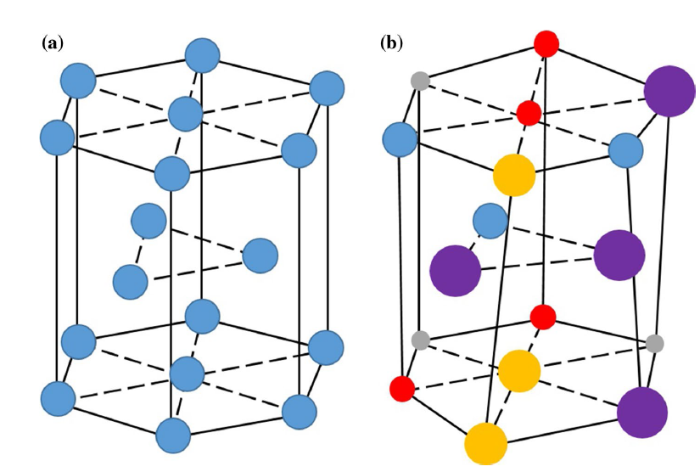
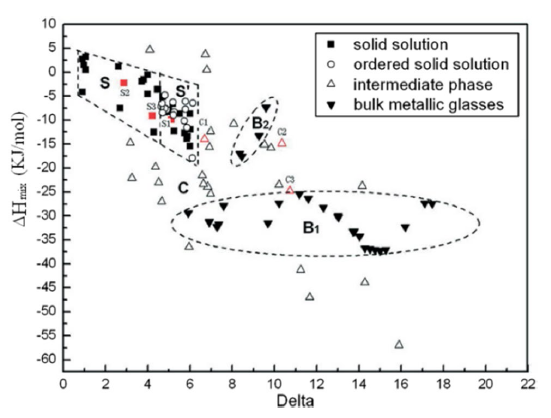
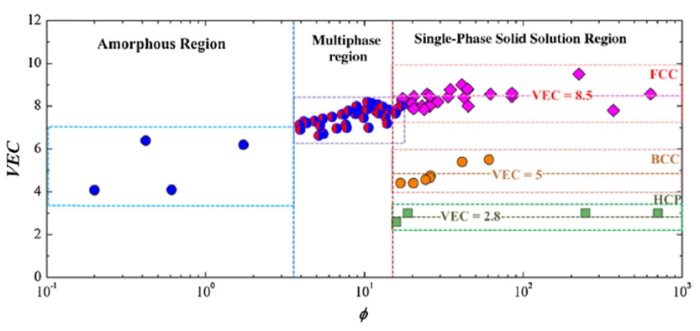
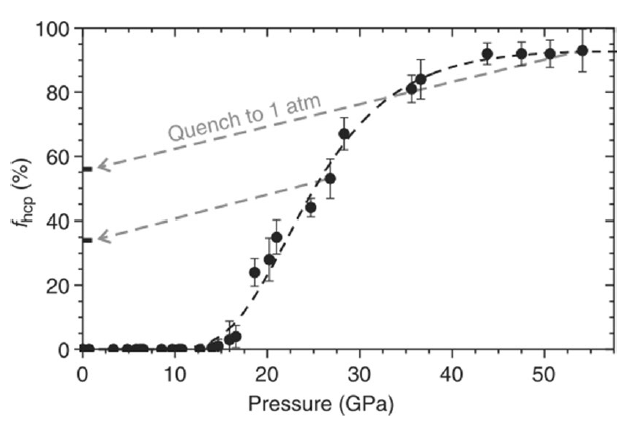
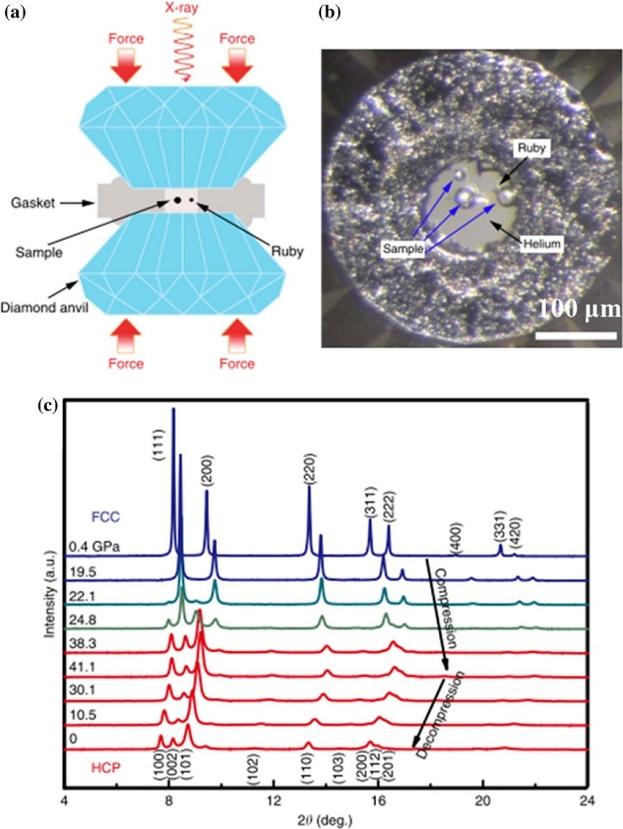
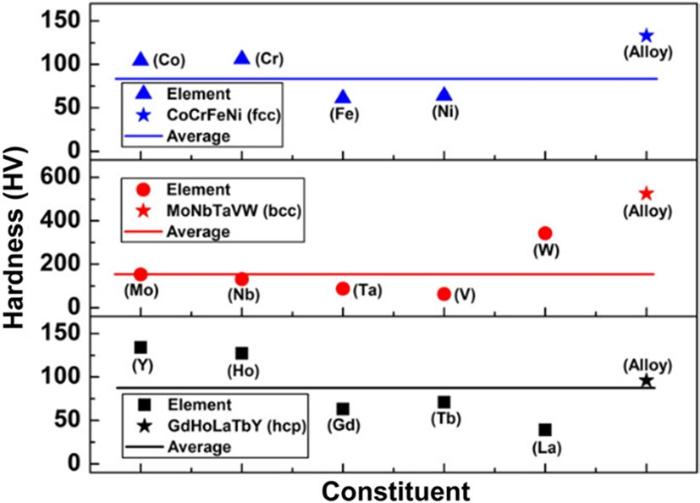
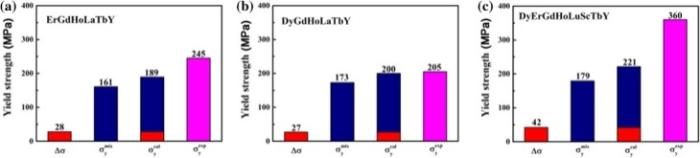
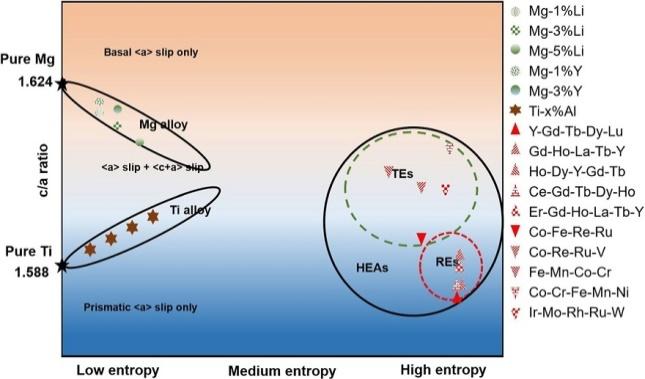
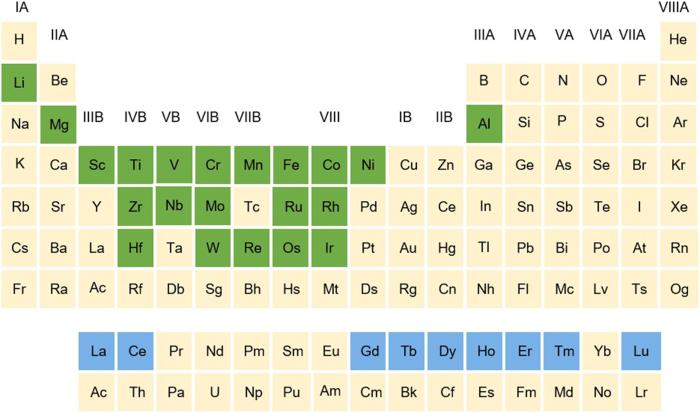

 WeChat


