Search for articles:
Ting-Ting Tan , Bang-Jie Liu
Corresponding authors:
Received: 2016-04-26
Revised: 2016-06-20
Online: 2017-01-20
Copyright: 2017 Editorial board of Acta Metallurgica Sinica(English Letters) Copyright reserved, Editorial board of Acta Metallurgica Sinica(English Letters)
More
Abstract
The chemical structures, optical properties and laser-induced damage thresholds of magnesium fluoride films annealed at different temperatures were investigated. The results showed that the stoichiometry of MgF2 film changed a little with the increase in annealing temperature. Analysis of the optical properties indicated that excellent antireflection behavior of the film in the range of 200-400 nm can be obtained by the samples coated with MgF2 film. The refractive index increased and the extinction coefficient decreased with increasing annealing temperature. Compared with the as-deposited films, the laser-induced damage threshold was improved after annealing process and decreased with the increase in annealing temperature, which was probably due to the denser film and more absorption centers under higher annealing temperature.
Keywords:
Magnesium fluoride (MgF2) thin film possesses a low refractive index, large energy band gap as well as low optical losses, high durability, high laser-induced damage threshold and good transparency over a wide range of wavelengths, which has been used for optical coatings, in particular for antireflection coatings and protective layer [1-3]. The structure and optical properties of MgF2 thin films are delicately dependent on the fabrication process and other factors. Previous work shows that temperature treatment plays an important role in the film properties [4, 5] and optical thin films are usually annealed after deposition in order to improve the properties, such as the durability and the stability [6, 7]. In addition, laser-induced damage has been observed in the transparent optical materials since the advent of high-powered lasers. Increasing laser-induced damage threshold (LIDT) of the optical materials is much important for improving the performance of high-powered lasers [8]. Therefore, it is necessary to investigate the influence of annealing process on the structure, optics and damage resistance of MgF2 thin films for the sake of more effective employment of MgF2.
In this study, MgF2 thin films were deposited on JGS1 substrates by electron beam evaporation technique and then annealed in nitrogen atmosphere at different temperatures from 200 to 400 °C. The main purpose of the work was to investigate the effect of annealing temperature on the optical and laser-induced damage properties of MgF2 film.
MgF2 thin films were deposited by electron beam evaporation on JGS1 and Si substrates, respectively. The JGS1 samples were dedicated to structural, transmission and laser damage resistance measurements. The Si samples were assigned for the optical constants characterizations. The film deposition was performed in an ion beam sputtering (IBS) chamber with a base pressure of 2 × 10⁻⁴ Pa. During the deposition, the substrate temperature was kept at room temperature and the films were deposited at a deposition rate of 0.1 nm/s. After deposition, the films were annealed at 200, 300 and 400 °C for 10 min in nitrogen atmosphere, respectively.
The film structures were characterized by X-ray diffraction (XRD). X-ray photoelectron spectroscopy (XPS) was used to investigate the structural changes in MgF2 films. The optical transmission spectra were measured by a UV-3150 UV-VIS-NIR spectrophotometer. A phase-modulated ellipsometer (HORIBA Jobin-Yvon) was used to investigate the optical constants of MgF2 thin films. The measurement of LIDT was performed according to ISO 11254 standard. A tripled Nd:YAG laser system was employed to deliver a nearly Gaussian-type pulse beam with pulse duration of 9.6 ns at 355 nm, and the laser beam was focused into a spot with a diameter of 390 μm on the sample surface at normal incidence. The damage detection was based on an image acquisition system. The damage probability was obtained with a 1 on 1 mode. The LIDT is defined as the maximum incident fluence with zero damage probability.
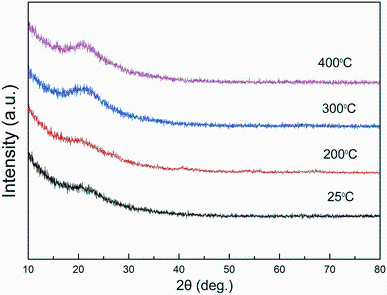
Figure 1 shows the XRD patterns of MgF2 films annealed at different temperatures. The as-deposited MgF2 film exhibited a broad peak, indicating the amorphous characteristic of the film due to the absence of intense diffraction peaks. With the increase in annealing temperature, the intensity of the broad peak slightly increased. The results showed that the main phase of the prepared MgF2 films was amorphous.
Fig. 1 XRD patterns of MgF2 films annealed at different temperatures
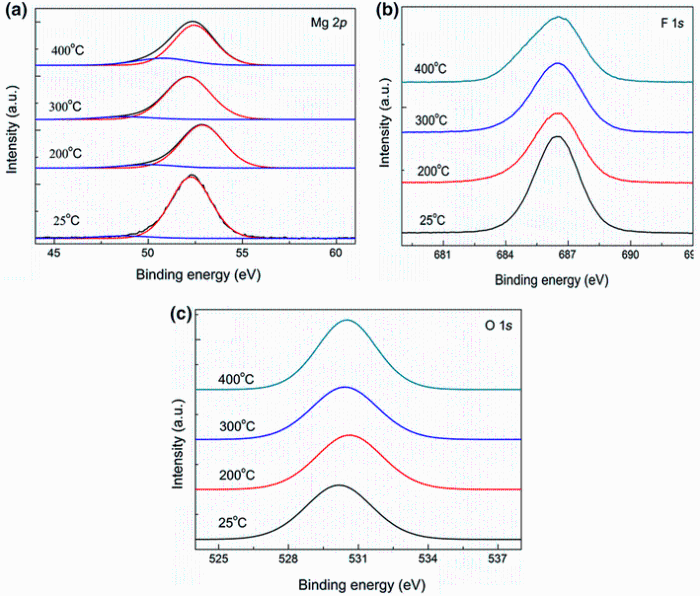
The chemical structural properties of the MgF2 films with different annealing temperatures were investigated by XPS as shown in Fig. 2. All binding energy values were determined by calibration and fixing the C 1s peak to 284.8 eV, and the intensity ratios were converted into atomic concentration ratios by using the sensitivity factors proposed by the manufacturer. From the XPS results, magnesium and fluorine were detected as the main constituents of the films, and a spot of oxygen was also found in the films. From Fig. 2, small differences in chemical composition on Mg, F and O were observed among the samples with different annealing temperatures. It is reported [9] that the shift of the binding energy is related to the atomic ratio. The closer atomic ratio is to stoichiometry, the lower binding energy is. For all samples, the Mg 2p peaks (Fig. 2a) showed two components after peak fitting treatment, the dominant peaks at 52.5 eV were attributed to Mg-F bonds, and the lower peaks at binding energy of 49.5 eV were associated with Mg-O bonds [10, 11]. The F 1s peak and the O 1s peak (Fig. 2b, c) were located at 686.5 and 530.4 eV, respectively, corresponding to Mg-F bonds and Mg-O bonds [1, 11].
Fig. 2 XPS spectra of MgF2 films annealed at different temperatures: a Mg 2p core-level spectra, b F 1s core-level spectra, c O 1s core-level spectra
Furthermore, the F/Mg ratio of the as-deposited film was 1.7, lower than the bulk MgF2 stoichiometry, and the O/Mg ratio was close to 1. The same trend was observed by other authors on IBS MgF2 coatings and F/Mg ratio was 1.6 [12]. After annealing process, the F/Mg ratio decreased slightly, leading to the weak shift of the peak. The results suggested that H2O contaminant did not exist in the MgF2 films, and the mainly contamination was MgO in the films which was induced by the residual oxygen during or after deposition. In addition, an oxygen content of about 3% was detected in the annealed MgF2 films at the as-deposited 200 and 300 °C. This suggested that MgF2 films were not oxidized after 200 and 300 °C annealing process. While for the 400 °C-annealed film, the oxygen content increased to 6.42%, which meant that Mg-F bonds breaking occurred during the high temperature annealing procedure, leading to the formation of MgO.
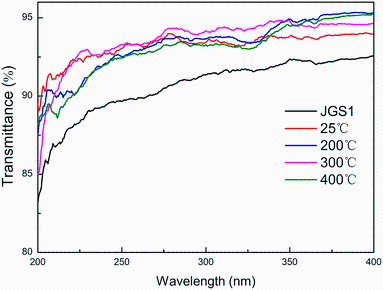
High transmittance is the basic requirement for antireflective films used in the optical areas. The transmittance spectra of the bare JGS1 substrate and the substrates coated with MgF2 films after different annealing temperatures are shown in Fig. 3. The transmittance of the bare JGS1 substrate was 90.7% at 280 nm. After the deposition of MgF2 film, excellent antireflection behavior had been obtained, and a transmittance of 94.0% at 280 nm achieved. However, the annealing process could not result to the improvement in the transmittance of MgF2 film.
Fig. 3 Transmittance spectra of the bare JGS1 substrate and the substrates with MgF2 films annealed at different temperatures
For the antireflective films, the transmittance is mainly governed by the refractive index and the absorption of the film. The refractive index and absorption coefficient are measured by a spectroscopic ellipsometer. The optical constants of MgF2 films as a function of the frequency were determined by a classical dispersion model based on the sum of Lorentz and Drude oscillators [13, 14]:
$$(n(\omega ) + ik(\omega ))^{2} = \varepsilon_{\infty } + \frac{{(\varepsilon_{\text{s}} - \varepsilon_{\infty } )\omega_{\text{t}}^{2} }}{{\omega_{\text{t}}^{2} - \omega^{2} + i\varGamma_{0} \omega }} + \sum\limits_{j = 1}^{n} {\frac{{f_{j} + \omega_{0j}^{2} }}{{\omega_{0j}^{2} - \omega^{2} + i\gamma_{i} \omega }}} + \frac{{\omega_{\text{p}}^{2} }}{ - \omega + i\varGamma \omega }$$
The constant ε∞ represents a constant contribution to the real part of the dielectric constant from high frequency electronic transitions. In the second term, εs gives the value of the static dielectric function at a zero frequency, and ωt and ω0j (in eV) are the resonant frequencies of the oscillators whose energies correspond to the absorption peak. Γ0 and γi are the broadening of each oscillator which are also known as the damping factors. The damping effect is due to the absorption process involving transitions between two states. Finally, fj is the oscillator strength present in the expression of the multiple Lorentz oscillators. A three-layer optical model consisting of the silicon substrate, the bulk MgF2 film and the surface rough layer composed of 50% void space and 50% MgF2 was used to investigate the optical constants of the as-deposited and annealed MgF2 films. The model structures and optical properties of the films were optimized by least-squares refinements (χ2) fitting their experimental data.
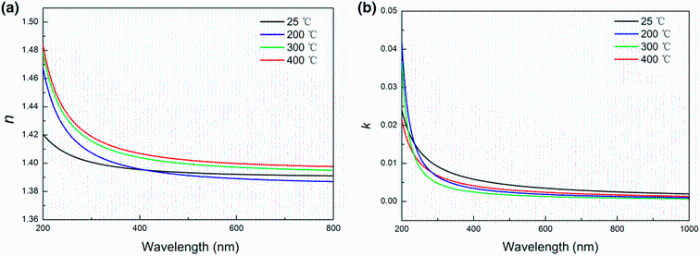
The wavelength dispersion of the refractive index, n, and extinction coefficient, k, of the MgF2 thin films annealed at different temperatures are shown in Fig. 4. A small increase was observed for the refractive index of the film after annealing process, which was due to the quicker molecule movement under higher temperature annealing process. As a result, the film gets more compact, leading to the higher refractive index. In addition, it was noted that the extinction coefficient of the films was very low and even close to zero, indicating a very small optical loss owing to the absorption in the region of 200-800 nm. It can also be seen that the extinction coefficient decreased slightly for the annealed films due to the densification of the films.
Fig. 4 Refractive index n (a) and extinction coefficient k (b) for the as-deposited and thermal annealed (200-400 °C) thin films determined by spectroscopic ellipsometry
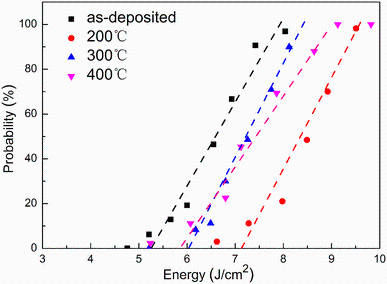
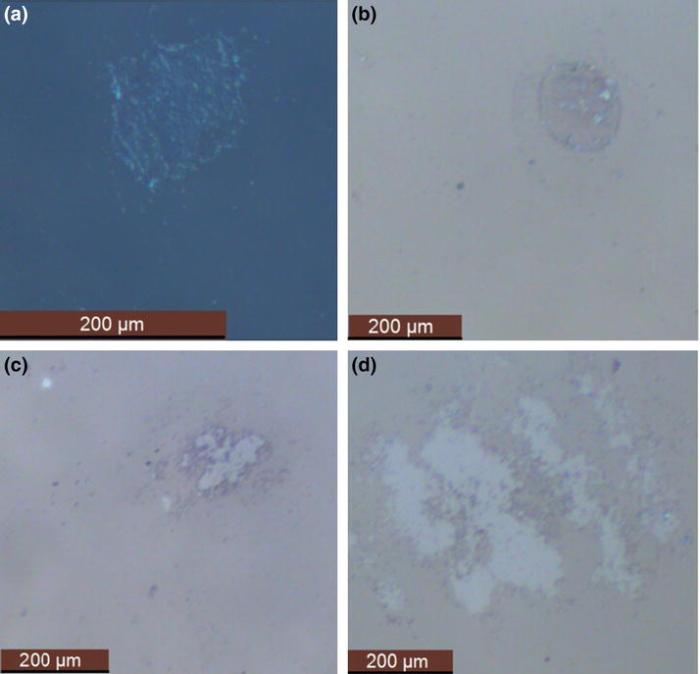
The LIDTs of MgF2 thin films annealed at different temperatures, which were determined by a linear extrapolation of the damage probability data to zero damage probability are shown in Fig. 5. The results showed that the LIDTs of MgF2 films were improved after annealing process, and the maximum LIDT appeared at 200 °C with a value of 7.17 J/cm2. However, the LIDTs decreased with the further increase in annealing temperature. And the damage morphologies of these samples are shown in Fig. 6. The results implied the inclusion in the film as the dominant factor of creating damage by making it possible for the laser energy absorb in specific point. In addition, the MgF2 thin films annealed at 400 °C had the lager damage areas, and there was a lot of absorption in the damage spots.
Fig. 5 LIDTs of MgF2 thin films annealed at different temperatures
Fig. 6 Damage morphologies of MgF2 thin films annealed at different temperatures: a as-deposited, b 200 °C, c 300 °C, d 400 °C
During the annealing process, heat energy accelerates the particle diffusion and eliminates some low melting regions, such as the region with F vacancies. Absorption in thin films is one of the most important factors contributing to the laser-induced damage [15]. The low melting areas absorb much more laser energy. When the energy is translated to temperature rise, higher temperature is formed in the low melting regions and the films easily get damaged under the laser irradiation, so the reduction in those defects in the film will reduce the damage probability of the films. Therefore, the MgF2 films after annealing process exhibited the higher LIDTs. However, the higher annealing temperature will cause the film more compact, so the LIDT of the film would decrease under the laser radiation. In the denser film, particle movement is restricted under the higher temperature. If the film is relatively porous, the particle may move through the film. Therefore, the pressure exerted on the film or substrate has a chance to dissipate and laser damage might not occur. What is more, the oxidation of MgF2 also affected the laser damage performance. The doped O would cause the transition between the valence band and impurity level to happen easily. It would cause the electron avalanche effect and reduce the LIDT of MgF2, and consequently, the MgF2 film annealed at 400 °C showed the lower LIDT and lager damage area.
In this paper, the effects of the annealing temperature on the properties of MgF2 films were investigated. The annealed films exhibited excellent antireflective properties in the range of 200-400 nm wavelengths. The refractive index increased and the extinction coefficient decreased with the increase in the annealing temperature. The results showed that the film annealed at 200 °C had the highest LIDT value. The number of low melting regions and the density of the film were responsible for the difference in LIDTs at different annealing temperatures. Therefore, it is necessary to select appropriate annealing parameters according to actual requests.
This work was financially supported by the Research Fund of the State Key Laboratory of Solidification Processing, Northwestern Polytechnical University, China (Grant No. 155-QP-2016), the Fundamental Research Funds for the Central Universities (No. 3102014JCQ01032) and the 111 Project (No. B08040).
The authors have declared that no competing interests exist.

 WeChat
/
| 〈 |
|
〉 |