Search for articles:
Qing-Feng Zhu , Fei Li
Corresponding authors:
Received: 2016-07-11
Revised: 2016-09-14
Online: 2017-05-20
Copyright: 2017 Editorial board of Acta Metallurgica Sinica(English Letters) Copyright reserved, Editorial board of Acta Metallurgica Sinica(English Letters)
More
Abstract
A reaction interface between the aluminum and K2ZrF6 during molten salt reaction process was frozen by quenching the mold in water, and the interface structure was analyzed to determine the formation process of Al3Zr. Results show that a clear conical interface existed between the K2ZrF6 and aluminum. A zirconium accumulation layer with the thickness of about 2-3 μm was formed at the aluminum side of the interface. Many initially formed Al3Zr particles (with the size of 0.4-16 μm) distributed in this layer, most of which located at the interface. The morphology of Al3Zr particles is closely related with their size. For the size of 0.4-1 μm, the Al3Zr appeared as globular and ellipsoid shapes. When it grew to the size of 1-2 and 2-16 μm, it exhibited the rule cube shape, and rule cuboids shape, respectively.
Keywords:
In aluminum alloys, zirconium (Zr) has been proved to be an effective element in increasing the recrystallization temperature and hardenability [1]. Usually, Zr is added in the form of Al-Zr master alloys. Therefore, the qualities of the master alloys are of importance in determining the effectiveness of Zr element in aluminum alloys. The Al-Zr master alloys are industrially produced through the reaction between molten aluminum and Zr-bearing fluoride (e.g., K2ZrF6) followed by a solidification process. The reaction and solidification processes involve the transfer of Zr from the K2ZrF6 to molten aluminum and result in the precipitation of stoichiometric Al3Zr. It is known that the qualities of the master alloys mainly refer to the size, morphology and distribution of the Al3Zr particle, which are closely related to the reaction and solidification conditions. Therefore, numerous studies have been carried out to investigate the above-mentioned aspects under different reaction and solidification conditions [2, 3, 4, 5, 6, 7, 8, 9, 10, 11, 12, 13, 14]. Lee and Terry [2], Zhao et al. [8] and Li et al. [14] found different types of Al3Zr particle with the “blocky,” “needle-like” and “globular” morphologies in the aluminum matrix. Ohashi and Ichikawa [10] discovered a new metastable particle in rapidly solidified Al-Zr alloys. The present authors also found the “petal-like” and “needle-like” shapes of Al3Zr particles in the Al-5Zr master alloy [11].
It should be noted that the above-mentioned morphologies of Al3Zr particles are all observed in the ingot after solidification. In fact, some Al3Zr particles may be formed at the beginning of the reaction process, but it was barely observed and analyzed. This may be indirectly evidenced by the morphology of Al3Ti particle (which possesses the same crystallographic structure as Al3Zr) in the Al-Ti and Al-Ti-B master alloys. In the Al-Ti master alloys production process (under different molten salt reaction condition), seven types of Al3Ti particles with different morphologies (flakes, feathery, metastable, plates, complex plates, block and globular) have been found. However, only the first five were summarized by Blake in the Al-Ti master alloy manufactured by melting pure aluminum and titanium [9]. This indicates that the block and globular Al3Ti particles could only be formed during the molten salt reaction process. Arnberg et al. [4] considered that the blocky Al3Ti particle nucleates on the {001} plane in the region with high supersaturation of Ti. El-Mahallawy et al. [6] also considered that the globular Al3Ti may be formed in a salt rich region, i.e., with a high supersaturation of Ti. However, because of the reaction interface was difficult to be observed directly, the formation mechanism of the block and globular Al3Ti particles was still unclear.
Inspired by these researches mentioned above, the present work focuses at the interface between the K2ZrF6 salt and aluminum during the molten salt reaction process, which has a possible high supersaturation of Zr. The reaction mold is quenched in water to preserve the initial microstructure during reaction. Therefore, the initial morphology of Al3Zr particle can be revealed and investigated in detail.
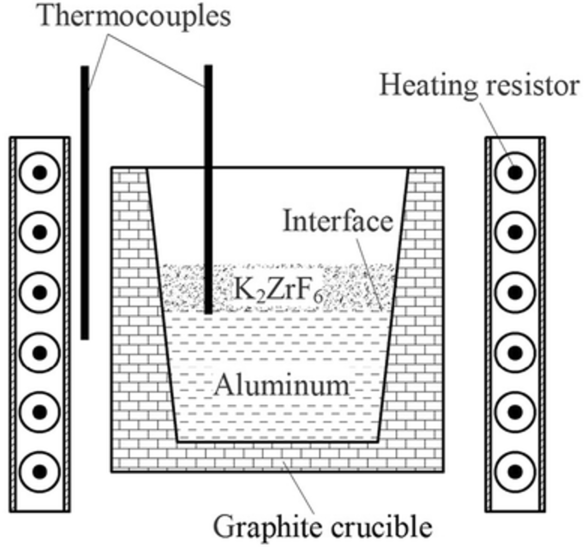
A graphite crucible (Φ20 mm × 50 mm) with 70 g commercial pure aluminum (99.7%) was placed in an electric resistance furnace, as shown in Fig. 1. Two thermocouples (K-type) were inserted in the furnace to monitor the temperature, one of which was placed at the interface between the K2ZrF6 and commercial pure aluminum. The commercial pure aluminum was heated to 845 °C and held for about 10 min. Then, 30 g K2ZrF6 (dehydrated at 200 °C for 3 h) was uniformly added onto the surface of commercial pure aluminum melt. Two minutes later, the graphite crucible was quenched in water to “freeze” the interface between the commercial pure aluminum and the molten K2ZrF6.
Fig. 1 Schematic of the experimental setup
The sample was cut in half lengthwise and then mechanically polished for macro- and microstructure observations. Afterward, salt was removed and the interface of aluminum side was observed by scanning electron microscopy (SEM) directly. Energy dispersive spectroscopy (EDS) was employed to identify the composition of the particle at the interface. Deep etching by a solution of 25 wt%, NaOH was employed to reveal the three-dimensional morphology of the initial particle on the interface.
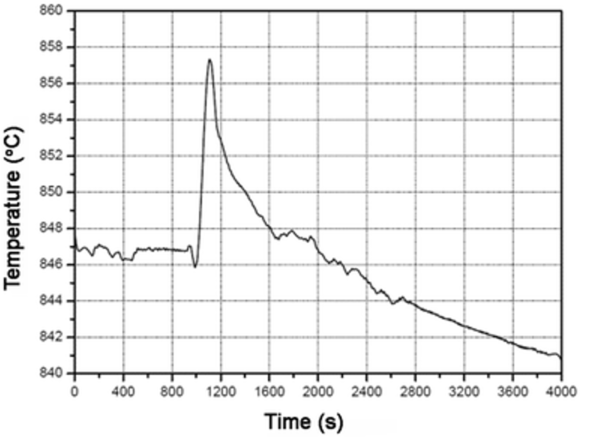
Figure 2 shows the typical time-temperature curve at the interface during reaction. The K2ZrF6 addition (at about 1000 s) leads to an abrupt temperature increase (a 12 °C increment relative to the case without addition of the K2ZrF6) due to the exothermic reaction. Afterward, the temperature decreased slowly due to the net heat loss to the surroundings.
Fig. 2 Typical time-temperature curves on the interface as K2ZrF6 added
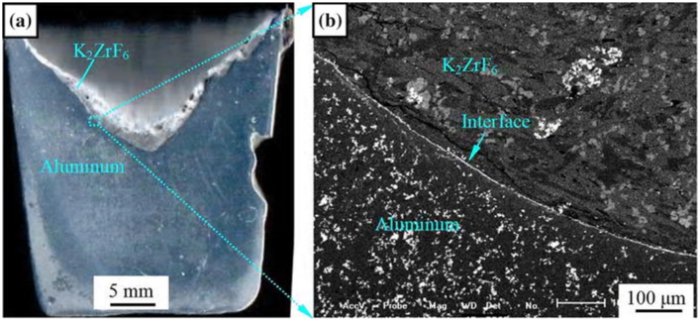
Figure 3a shows the macrostructure in the longitudinal section of the sample. It is seen that a V-shape shrinkage cavity formed on the top of the sample due to the contraction during solidification process. A layer of gray salt with the thickness from 0.05 to 2.5 mm exists on the top of the shrinkage cavity. And there is a clear V-shape interface formed between the K2ZrF6 and aluminum. Figure 3b gives the magnified back-scattered electron (BSE) image from the framed region in Fig. 3a. A bright white line with a thickness of about 2-3 μm exists at the interface. The EDS analysis indicates that Zr element is concentrated along the line. Some white blocky particles sparsely distributed in the aluminum matrix, which are identified to be Al3Zr compound.
Fig. 3 Interface between the K2ZrF6 and aluminum: a macrostructure, b magnified BSE image
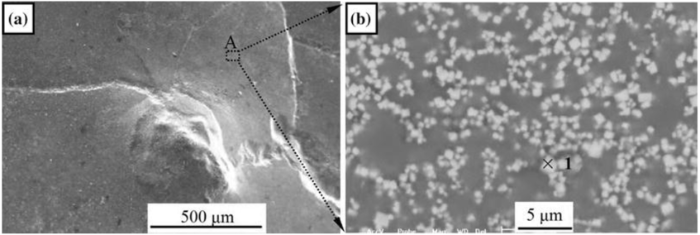
Figure 4a shows the exposed interface on the aluminum size after removing the salt. Many extremely small bright particles are found on the surface. The framed region A in Fig. 4a was magnified, as shown in Fig. 4b. It is suggested that those small particles are several micrometers in size and have blocky shapes. Image analysis of these particles shows an area percentage of about 29.3% was achieved. The EDS analysis identified these exposed particles as Al3Zr. Based on the data of area percentage and the composition of the particle, the Zr concentration in this region is estimated to be about 22 wt%.
Fig. 4 Exposed interface on the aluminum: a typical interface morphology on the aluminum size, b BSE image of the A region in a
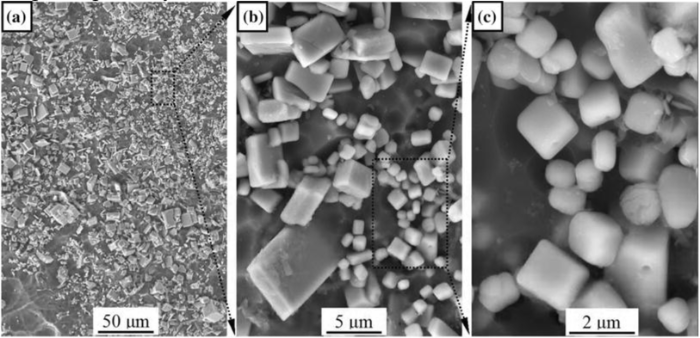
Figure 5 shows the three-dimensional morphology of the Al3Zr particle at the interface between the salt and aluminum, i.e., the bright white line in Fig. 3. A dense layer of Al3Zr particles with different sizes and shapes is present at the aluminum side. The size of the Al3Zr particle is between 0.4 and 16 μm. The shape of Al3Zr particle exhibits size dependence. For the size of 0.4-1 μm, the Al3Zr appeared as globular and ellipsoid shape. When it grew to the size of 1-2 and 2-16 μm, it exhibited the rule cube shape, and regular cuboids shape, respectively.
Fig. 5 Three-dimensional morphologies of the Al3Zr particles on the interface of aluminum side, b magnified micrographs singed by rectangular frame in a, c magnified micrographs singed by rectangular frame in b
Adding the salt K2ZrF6 into molten aluminum results in complex reactions, which involve the reaction at the interface layer, diffusion of the reaction products both in the molten aluminum side and the K2ZrF6 side, and the formation of the Al3Zr particles. The reaction at the interface layer and the formation of the Al3Zr particle can be represented as follows:
3K2ZrF6+4Al=4AlF3+6KF+3Zr,(1)
Zr+3Al=Al3Zr.(2)
The Zr is first obtained from the reaction by Eq. (1). And then, the Zr is dissolved in the aluminum melt and diffuses from the interface to the aluminum melt. When the Zr concentration in the local area is greater than a critical value, the Al3Zr particle will be produced by reaction (2).
The Zr concentration at the aluminum side near the interface is determined by the reaction rate of Eq. (1) (the formation rate of Zr element) and the diffusivity of the Zr in aluminum. It is clear that the formation rate is faster than that of the diffusivity under the present experimental condition, which leads to the accumulation of zirconium at aluminum side of the interface. As estimated from Fig. 3, the Zr concentration reaches about 22%. This may indirectly validate the conjecture of Arnberg et al. [4] and El-Mahallawy et al. [6] about the formation of blocky and globular shape Al3Ti.
The high Zr concentration in the local area increases the liquidus temperature, which results in constitutional supercooling in this area. According to the Al-Zr phase diagram, the liquidus temperature of Al-22% Zr aluminum reaches about 1600 °C. It is known that the exothermal reaction of the aluminum and K2ZrF6 can increase the temperature at the interface. However, the temperature increment caused by such reaction is only about 12 °C and the highest temperature is about 858 °C in the aluminum, as measured in Fig. 2. This means that the supercooling caused by zirconium enrichment can be about 700 °C.
The high supersaturation of Zr and the relatively low temperature at the aluminum side of the interface create a unique condition for the formation of the Al3Zr particle. The nucleation rate of Al3Zr would increase substantially. However, the growth of the Al3Zr crystals is restricted due to the impingement of the neighboring Al3Zr and limited diffusion distance of Zr. Therefore, the size of the Al3Zr particles would correspond to the different growth stage.
1. A Zr-enriched layer with the thickness of about 2-3 μm formed at aluminum side of the interface during the reaction process between the K2ZrF6 and aluminum at the temperature of 845 °C.
2. The shapes of Al3Zr particle are size dependent. For the size of 0.4-1 μm, the Al3Zr appeared as globular and ellipsoid shapes. When it grew to the size of 1-2 and 2-16 μm, it exhibited the rule cube shape, and regular cuboids shape, respectively.
The Project Supported by the National Natural Science Foundation of China (Nos. 51204053, 51374067 & 51674078), Central University Basic R & D Operating Expenses (Nos. N130409005, N130709001 & N130209001).
The authors have declared that no competing interests exist.

 WeChat
/
| 〈 |
|
〉 |