Search for articles:
K. Nithiyadevi
Corresponding authors:
Received: 2017-03-14
Revised: 2017-04-7
Online: --
Copyright: 2017 Editorial board of Acta Metallurgica Sinica(English Letters) Copyright reserved, Editorial board of Acta Metallurgica Sinica(English Letters)
More
Abstract
This research article explains the removal of methylene blue (MB) and malachite green (MG) from aqueous solution using adsorption/photodegradation activity of ZnO:Ag/bamboo charcoal (BC) nanocomposite. In addition, the antibacterial studies of the prepared samples were tested against Staphylococcus aureus (S. aureus) Gram-positive and Escherichia coli (E. coli) Gram-negative bacteria by the well diffusion method. The ZnO:Ag/BC nanocomposite exhibits superior photocatalytic activity compared with ZnO:Ag. Remarkable degradation efficiencies of 93.95% (MB) and 95.75% (MG) were recorded for ZnO:Ag/BC nanocomposite after 45 min. The degradation process follows a pseudo-first-order kinetics. The rate constant of ZnO:Ag/BC nanocomposite is two times greater than that of pristine ZnO nanopowder for the degradation of MB dye, while for MG dye degradation, it is three times. It is found that the ZnO:Ag/BC nanocomposite shows a higher rate of dye removal due to excellent adsorbing properties of bamboo charcoal (BC). The ZnO:Ag/BC nanocomposite showed better antibacterial properties compared to ZnO:Ag. In this study, the samples were prepared using a simple and low-cost soft chemical route and they were characterized by optical, structural, surface morphological, antibacterial and photocatalytic properties. These characterization studies substantiate the discussions on the photocatalytic and antibacterial activities of the synthesized samples.
Keywords:
In current trends, a lot of semiconductors such as, TiO2, ZnO, ZrO2, CdS, SnO2 and WO3 have been studied for photocatalysis [1, 2, 3, 4, 5, 6] and these are all have band gap energy in the UV (ultraviolet) region. Hence, these catalysts support photocatalytic reactions under the illumination of UV radiation. To absorb visible light radiation, band gap energy must be reduced or divided into different sub-band gaps using doping transition metal ions or noble metals, incorporating carbon materials or graphene and its derivative materials [7, 8]. ZnO is an n-type semiconducting material, which has wide band gap, nontoxic, abundant in nature and an eco-friendly photocatalyst [9]. It absorbs wide range of spectrum, which also makes it more appropriate for solar cells, photocatalysis and photovoltaic applications. However, ZnO has some negative aspects in photocatalysis, such as less utilization of visible light and fast retardation of photo-generated electron-hole pairs. It is essential to extend the optical absorption of ZnO from the range of UV to visible light region and retarding the recombination of electron-hole pairs for improving the photocatalytic efficiency of ZnO. Doping of noble metals, such as Ag, Au and Pt, has possible method to overcome the drawbacks of ZnO photocatalyst [10, 11]. Among these noble metals, Ag is the most excellent element as dopant for ZnO since it is inexpensive.
Nowadays the removal of dye molecules from wastewaters is an important environmental issue. There are several approaches for the treatment of wastewater, such as sedimentation, electrochemical methodology, advanced oxidation processes (AOPs), biological treatment, ion exchange and adsorption [12, 13, 14]. Adsorption has been proven to be an effectual process for dye removal due to its low cost and environmental friendliness [15]. Therefore, a new bioresource of bamboo charcoal (BC), which is a cost-effective adsorbent, attracts more attention compared with other adsorption materials [16]. BC is produced from moso bamboo, which is an ethnic group of evergreen plants grown in tropical regions. Moreover, bamboo is considered to be a rapid renewable and sustainable biomass material in several fields. In addition, BC has a number of beneficial characteristics, which includes high electric conductivity, self-lubricity and high absorption capacity.
In the present work, we explore the ZnO:Ag/BC nanocomposite material for significant improvement in adsorption as well as photodegradation of methylene blue (MB) and malachite green (MG) under visible light irradiation in aqueous solution. ZnO nanoparticles have been synthesized using various methods, like sol-gel, sonochemical, combustion, hydrothermal, co-precipitation, solid-state reaction and soft chemical methods [17, 18]. Among these, the soft chemical method is selected for the present work because of its low hazardousness, simplicity, low processing temperatures and low cost, which are appropriate for the preparation of nanostructured materials on a large scale. Hence, this soft chemical route is used to synthesize ZnO:Ag and ZnO:Ag/BC nanocomposite.
Pieces of bamboo with age ranging from 5 to 6 years old were collected from the region of Tamil Nadu, India. To remove the dust and other contaminants on the surface of the bamboo culm, initially tap water was used several times to remove the contaminants and then thoroughly cleaned with deionized water and then dried at room temperature for 1 day. The well-cleaned bamboo culm was chopped in the size ranging from 1 cm × 0.5 cm. The cleaned and dried bamboo pieces were taken in quartz crucible and kept in a muffle furnace at 500 °C for 3 h. The obtained charcoal of bamboo was grained well with the help of china dish. Then required amount of bamboo charcoal was taken to synthesize the composite.
The ZnO:Ag and ZnO:Ag/BC nanocomposites were synthesized using a soft chemical method. Zinc acetate dihydrate (Zn(CH3COO)2 2H2O) (0.2 M) (assay ≥ 98%) was used as the host precursor, and bamboo charcoal (5 wt%) and silver nitrate (4 at.%) were used as the dopant precursor. Zinc acetate dihydrate (8.77 g) and the dopant precursors were dissolved in 200 mL of deionized water, and NaOH solution was added drop by drop with the starting solution to maintain the pH value at 5. The solution was stirred for 3 h at a temperature of 80 °C and then cooled to room temperature. After 3 h, the settled precipitate was separated by filtration and it was washed with a mixture of ethanol and water in the ratio of 1:3. Finally, it was calcined for 2 h at a temperature of 400 °C in a muffle furnace to get the final product.
The crystalline structure of the powders was studied by X-ray diffraction method (XRD, PANalytical-PW 340/60 X’pert PRO) with CuK α (1.5406 Å) radiation. The optical absorbance measurements were taken using a PerkinElmer UV-vis-NIR double beam spectrophotometer (LAMBDA-35). The photoluminescence spectra were obtained using spectrofluorometer (Jobin-Yvon-FLUROLOG-FL3-11) with xenon lamp (450 W) as the excitation source of wavelength of 325 nm at room temperature. Fourier transforms infrared (FTIR) spectra were recorded using PerkinElmer RX-I FTIR spectrophotometer. The surface morphology was observed using a scanning electron microscope (SEM, HITACHI S- 3000H).
The photocatalytic activity of the samples was studied by the degradation of methylene blue (MB) and malachite green (MG) under visible light irradiation. In the photo-reactor, the water is circulating in a jacket surrounding the reactor and the temperature is maintained constant. 50 mL of aqueous solution of MB/MG was taken in a beaker, and 50 mg of the synthesized sample was added and stirred well. The absorption spectrum was recorded for the initial solution. After reaching the adsorption equilibrium (30 min), the reaction was beginning by irradiating the system with 500 W tungsten lamp (light source). At equal intervals of time (15 min), 5 mL of the samples was collected, centrifuged and then filtered to remove the catalyst if any present in the sample. The optical absorption was recorded each time using a UV-vis spectrophotometer. The photodegradation of both the dyes was evaluated by measuring the optical absorbance of the sample.
The antibacterial activities of the prepared ZnO:Ag nanopowder and ZnO:Ag/BC nanocomposite were evaluated using agar well diffusion method. MHA agar plates were inoculated with bacterial strain. A well of diameter was made with a sterile cork borer, and it was filled with 200 μg/mL of the test sample and incubated under suitable conditions for 24 h. After the incubation period, the zone of inhibition was measured in mm.
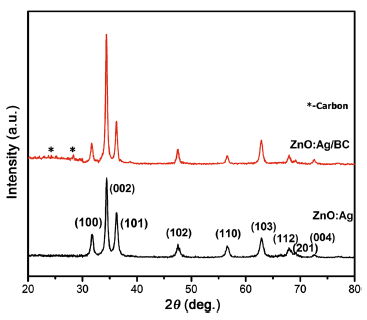
Figure 1 shows the XRD patterns of ZnO:Ag and ZnO:Ag/BC nanocomposite. The XRD peaks emerged at Bragg angles 2θ of 31.82°, 34.35°, 36.23°, 47.48°, 56.53°, 62.80°, 67.89°, 69.05° and 72.68° are found to be associated with the (hkl) planes (100), (002), (101), (102), (110), (103), (112), (201) and (004), respectively. All of the above-mentioned diffraction peaks are exactly matched well with standard XRD pattern of ZnO powder as given in the JCPDS file (card no. 36-1451). The sharp and intense diffraction peaks of the samples show that the prepared samples are of good crystalline nature. It is obvious from the XRD profiles that the synthesized powder is crystallized with hexagonal wurtzite structure of ZnO. No secondary phases related to silver are observed indicating complete incorporation of silver into the ZnO lattice. ZnO:Ag/BC nanocomposite shows weak diffraction peaks near 2θ of 24° and 28° due to the reflection of carbon. This clearly indicates that BC is a typical amorphous phase of carbon. The crystallite size (D) of the ZnO:Ag and ZnO:Ag/BC powders is calculated using the Scherrer’s formula [19]
Fig. 1 XRD patterns of ZnO:Ag and ZnO:Ag/BC nanopowders
$$ D = \frac{0.9\lambda }{{\beta { \cos }\theta }}, $$
where λ (0.15406 nm) is the wavelength of CuK α radiation, θ is the Bragg’s angle and β is the full-width at half-maximum.
The lattice constants a and c are estimated using the following relations [20],
$$ \frac{1}{{d_{hkl}^{2} }} = \frac{4}{{3a^{2} }}(h^{2} + hk + k^{2} ) + \frac{{l^{2} }}{{c^{2} }}, $$
where d is the inter-planar distance and (hkl) are Miller indices.
The determined structural parameters are given in Table 1. The computed lattice constants a and c are very close to that of the standard values of powder ZnO (JCPDS no. 36-1451), indicating that the structure is not affected by Ag and BC addition.
Table 1 Structural parameters of the synthesized samples
| Sample | D (nm) | Lattice constants | c/a | |
|---|---|---|---|---|
| a (Å) | c (Å) | |||
| ZnO:Ag | 25.25 | 3.2342 | 5.2121 | 1.6115 |
| ZnO:Ag/BC | 24.14 | 3.2523 | 5.2078 | 1.6012 |
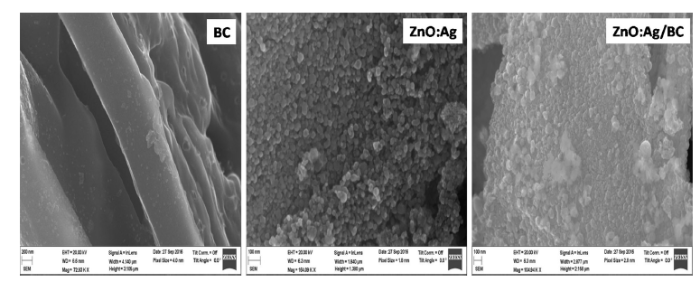
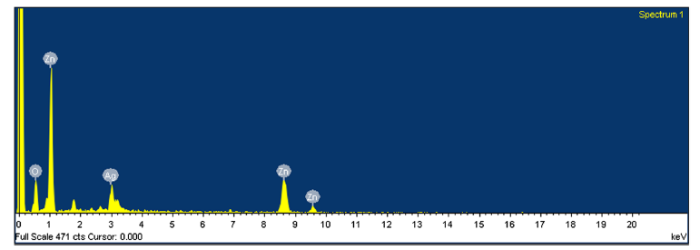
The morphologies of BC, ZnO:Ag and ZnO:Ag/BC photocatalysts were characterized via SEM images (Fig. 2). From Fig. 2, it can be seen that ZnO:Ag particles were uniformly dispersed over the bamboo charcoals, and the particle size is in the range of nanometer scale, which is beneficial to photocatalytic activities due to quantum confinement effect. If the particle size becomes less than a certain critical limit, it gives rise to quantum confinement of the electronic movement. This leads to a change in valence and conduction bands of the materials, which gives rise to change in discrete energy level that means either the electric potential of valence band changes more positive or the conduction band electric potential changes more negative. Therefore, the oxidation or reduction of nanosized ZnO:Ag/BC photocatalyst activities is enhanced. Moreover, no obvious agglomerations of ZnO:Ag/BC particles are found. The particle size values for ZnO:Ag and ZnO:Ag/BC are in the range of 59 and 52 nm, respectively. These results specify that the particle size decreases with the addition of charcoal, which is in good agreement with the crystallite sizes estimated from the XRD results. The EDS analysis of the samples confirmed the presence of zinc, oxygen, silver and carbon in the samples as shown in Fig. 3.
Fig. 2 SEM images of ZnO:Ag and ZnO:Ag/BC nanopowders
Fig. 3 EDX result of ZnO:Ag/BC nanopowder
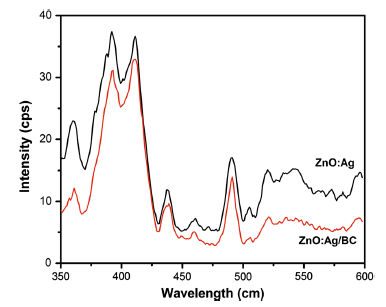
Photoluminescence (PL) spectroscopy can be used as an effective tool to evaluate surface defects of the synthesized samples. The PL spectra of ZnO:Ag and ZnO:Ag/BC nanocomposites are shown in Fig. 4. The spectra depict that a UV emission peak at 390 nm corresponds to the near-band edge emission of ZnO [21]. The peak at 416 nm is related to the Zn interstitial [22]. The peak at 440 nm is associated with singly ionized oxygen vacancies [23]. These oxygen vacancies play a vital role in the generation of hydroxyl radicals. These hydroxyl radicals enhance the photocatalytic efficiency of the synthesized samples as discussed in the forth coming section. Further, the overall PL intensity of ZnO:Ag/BC nanocomposite is significantly lower compared with ZnO:Ag. The lower intensity of the emission peak shows that the lower recombination rate of electron-hole pairs increases the lifetime of charge carriers and thereby enhances the photocatalytic activities.
Fig. 4 Photoluminescence spectra of ZnO:Ag and ZnO:Ag/BC nanopowders
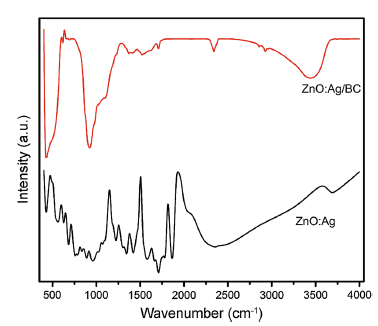
FTIR spectra of ZnO:Ag and ZnO:Ag/BC nanocomposite recorded in the range of 400-4000 cm-1 are shown in Fig. 5. The characteristics absorption band at ~3446 cm-1 can be attributed to stretching of surface hydroxyl groups [24]. The peak appears in the range of 2340 cm-1 is assigned to C-H stretching, whereas the peak at ~1722 cm-1 corresponds to stretching vibration of H2O [25, 26]. The peak at 1580 cm-1 represents C=C vibrations in aromatic systems [27]. The peak occurring at 950 cm-1 can be assigned to C-O stretching [28]. The peak at ~440 cm-1 can be characterized to the stretching vibrations of Zn-O [29].
Fig. 5 FTIR spectra of ZnO:Ag and ZnO:Ag/BC nanopowders
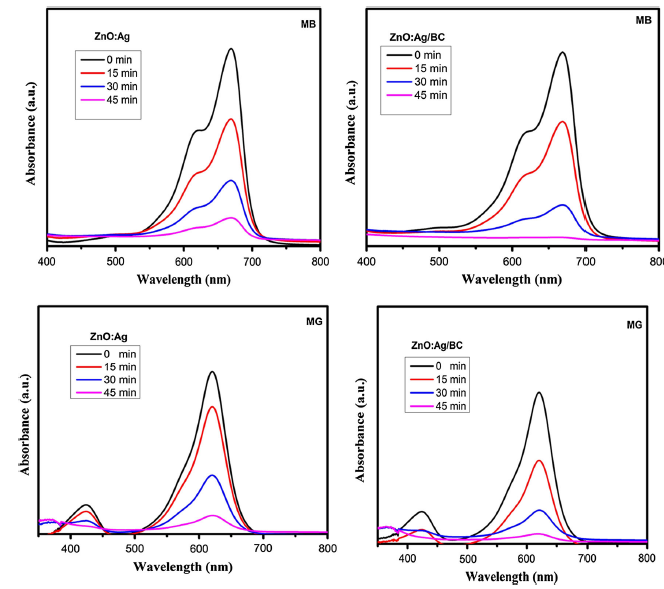
The absorption spectra of MB and MG solution for different time intervals are illustrated in Fig. 6. As seen from the spectra, the intensity of absorption peaks decreases with the increase in the irradiation time and nearly a complete degradation of dye molecules was achieved in 45 min. The decreased intensity shows that the dye molecules are decomposed due to catalyst and light energy. The mechanism of photodegradation of ZnO has been already discussed in detail in our previous work [30]. When the ZnO:Ag/BC photocatalyst irradiated with photons of energy equal to or greater than its band gap energy, valence band electrons are excited to the conduction band producing electron-hole pairs. The holes react with surface OH- groups and H2O molecules to produce hydroxyl radicals (OH.), which are strong oxidizing species and can degrade the MB and MG dyes. The electrons in the conduction band can reduce oxygen (O2) to generate superoxide anions (O2.). Consequently, O2. reacts with hydrogen ions (H+) to produce hydrogen peroxide (H2O2) and OH.. These reactive oxygen species (OH., O2. and H2O2) are responsible for degrading the organic dye solutions into H2O and CO2. The percentage of degradation was determined using the following relation [31], and the results are presented in Table 2:
Fig. 6 Absorption spectra of aqueous solutions of dye solution in ZnO:Ag and ZnO:Ag/BC nanopowders
$$ {\text{Degradation}}\;{\text{efficiency}}\;\% \;(\eta ) = (C_{0} - C_{t} )/C_{0} \times 100, $$
where C0 is the initial dye concentration and C t is the dye concentration after irradiation time t. The photodegradation efficiency of ZnO:Ag/BC is found to be higher than that of ZnO:Ag. The results clearly show that the photocatalytic activity of ZnO:Ag is improved when it is combined with BC.
Table 2 Photocatalytic degradation efficiencies and rate constant values of the synthesized samples against MB and MG
| Catalyst | Degradation efficiency (%) | Rate constant | ||
|---|---|---|---|---|
| MB | MG | MB | MG | |
| ZnO:Ag | 86.24 | 88.81 | 0.0484 | 0.0379 |
| ZnO:Ag/BC | 93.95 | 95.75 | 0.0620 | 0.0511 |
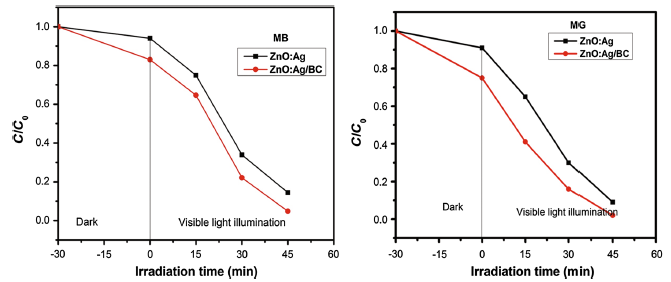
The steady-state photocatalytic rate is expressed in Langmuir-Hinshelwood model with first-order reaction kinetics. The plots between (C/C0) and irradiation time, drawn for all the samples, are shown in Fig. 7, which clearly depicts that ZnO:Ag/BC nanopowder has high adsorption in dark condition. The photocatalytic kinetics of photocatalysis can be evaluated by the following relation [32]:
Fig. 7 Plots of (C/C0) versus irradiation time (MB and MG) for ZnO:Ag and ZnO:Ag/BC nanopowders
$$ \ln (C_{0} /C) = k_{\text{app}} \times t, $$
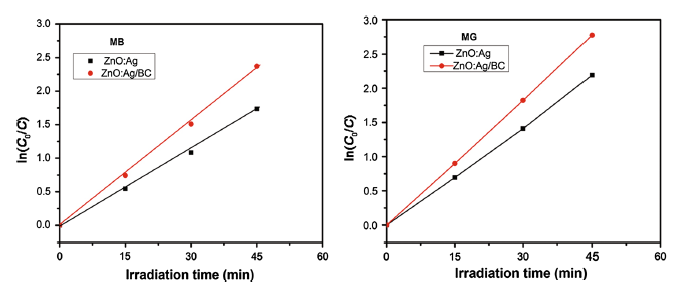
where k is the constant of the pseudo-first-order rate. A plot of ln(C0/C) vs irradiation time for the MB and MG photodegradation by the synthesized samples is shown in Fig. 8. Linear relations between ln(C0/C) and the time of irradiation for both the synthesized samples indicate that the photodegradation process obeys pseudo-first-order kinetics. The values of the pseudo-first-order rate constant k could be obtained from the linear fit curves. The estimated values of k for ZnO:Ag and ZnO:Ag/BC nanostructured samples are listed in Table 2. From Table 2, it is seen that ZnO:Ag/BC nanocomposite showed high rate constant compared to ZnO:Ag nanopowder.
Fig. 8 Photodegradation kinetics of MB and MG using ZnO:Ag and ZnO:Ag/BC nanopowders
The BC materials have the following features. (1) BC has an excellent adsorption capacity, and hence it effectively adsorbs organic compounds from waste water. (2) The surface hydrophilic functional group of the carbon nanomaterials (BC) acts as a suitable substrate for the uniform growth of ZnO:Ag with hierarchical morphology. (3) It suppresses the agglomeration of ZnO nanoparticles when they grow on the BC. (4) It acts as excellent conductive pathway toward collecting and transporting the conduction band electrons to the adsorbed oxygen. From the above discussion, it is obvious that the synergistic effect of ZnO:Ag and bamboo charcoal leads to the significantly enhanced photocatalytic activity. These synergistic effects of adsorptive and photocatalytic activities of the material lead to an enhancement in the degradation efficacy. Remarkably, ZnO:Ag/BC nanocomposite exhibits excellent photocatalytic activities for the decomposition of MB and MG under visible light irradiation.
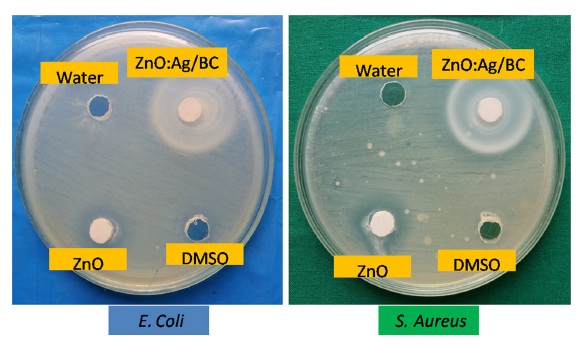
The antibacterial activities of the prepared samples were tested against E. coli and S. aureus bacteria using the agar well method. Figure 9 shows the photographic images of the zone of inhibition for the synthesized samples, and the measured inhibition zones are summarized in Table 3. The appearance of inhibition zone obviously indicates the antibacterial activities of the synthesized samples. From Table 3, it is observed that ZnO:Ag/BC nanocomposite sample exhibits remarkably higher antibacterial activity than ZnO:Ag sample. The possible reasons for the improved antibacterial activity of ZnO:Ag/BC nanocomposite can be elaborated as follows:
Fig. 9 Zone of inhibition caused by ZnO:Ag and ZnO:Ag/BC nanopowders against E. Coli and S. aureus
Table 3 Zone of inhibition observed by ZnO:Ag and ZnO:Ag/BC nanopowders against the tested bacteria (E. coli and S. aureus)
| S. no. | Bacteria | Zone of inhibition (diameter in mm) | |
|---|---|---|---|
| ZnO:Ag | ZnO:Ag/BC | ||
| 1 | E. coli | 20 | 28 |
| 2 | S. aureus | 21 | 30 |
1.ZnO:Ag/BC nanocomposite may interact directly with the bacterial cell membrane by releasing zinc ions (Zn2+).
2.ZnO:Ag/BC nanocomposite with smaller particle size and larger surface areas is more effective in generating reactive oxygen species. The reactive oxygen species are capable of penetrating the cell, damage the cell membrane, spoil the cell proteins and DNA and eventually cause cell death.
3. In addition, this large surface area of the BC can lead to the adsorption of microorganism by the charcoal surfaces, improving the antibacterial activity.
The simple, low cost, easiness of synthesis and higher photodegradation activity of the ZnO:Ag/BC is used for wastewater treatment. ZnO:Ag/BC nanocomposite showed rapid and higher degradation of MB and MG as compared to dye removal of ZnO:Ag. The degradation rate constant of MB dye for ZnO:Ag is 0.0484 min-1. It increases 1.28 times (0.0620 min-1) for ZnO:Ag/BC nanopowders. Similarly, in the case of MG dye the rate constant increases 1.34 times due to efficient natural adsorbent bamboo charcoal. The ZnO:Ag/BC nanocomposite proved as a promising photocatalyst toward harmful organic dyes and antibacterial agent against microorganisms.
Financial support from the Department of Science and Technology-Science and Engineering Research Board (DST-SERB), India, through the research scheme (EMR/2016/003326) is gratefully acknowledged.
The authors have declared that no competing interests exist.

 WeChat
/
| 〈 |
|
〉 |