Search for articles:
Rizwan Bajwa , Zulfiqar Khan, H. Nazir, Vivek Chacko, Adil Saeed
Received: 2016-04-10
Revised: 2016-06-13
Online: 2016-10-20
Copyright: 2016 Editorial board of Acta Metallurgica Sinica(English Letters) Copyright reserved, Editorial board of Acta Metallurgica Sinica(English Letters)
More
Abstract
This paper presents research findings on the tribological performance of electrodeposited coatings subject to nano-lubricants with the addition of nano-Al2O3 and graphene and Ni/nano-Al2O3 composite coatings. Electrodeposited coatings were produced by using a pulse electrodeposition method. Tribological experiments were conducted by using a linear reciprocating ball on flat sliding tribometer. Experimental results confirmed that the wear and friction resistance properties were significantly enhanced by doping of nano-effects in the lubricating oil and composite coating. The addition of Al2O3 nanoparticles in the lubricating oil showed the best tribological properties, followed by Ni-Al2O3 composite coatings and nano-oil with graphene. The surface morphology and microstructure of electrodeposited coatings were examined by scanning electron microscopy, energy-dispersive spectroscopy and X-ray diffraction. The wear mechanisms of these coatings subjected to tribological testing were investigated by post-test surface analyses. This research provides a novel approach to design durable nano-coatings for tribological applications in various industries such as automotive, aerospace, locomotive and renewable energy technologies.
Keywords:
This paper enables researchers to fully understand the advantages of two distinct approaches of nano-additives within lubricants and nano-coatings, to solve complex tribological issues in terms of design for durability and reliability. Optimisation of surfaces in contact and in relative motion is needed to enhance their tribological performance. This research is focus on enhancing the tribological performance of contact surfaces through nano-composite coatings and nano-additives in lubrication. Almost one-third of the energy losses in mechanically interacting systems or components are attributed to friction or wear behaviour. For a long time, oil lubricants or greases have been used to reduce these frictional forces and wear asperities between two interacting surfaces. In recent years, nanoparticles have been widely studied in various applications due to their unique wear, friction and corrosion resistant properties. Nanoparticles are used both as an additive in the lubricant oil and as a metal matrix nano-composite (MMC) materials. The term nano-additive is commonly used for nanoparticles when they are used as an additive to conventional lubricants. Many studies have reported an effective role of nano-additives in lubricants in terms of the improvement of anti-friction and anti-wear properties of materials [1-3]. These nano-additives are made up of nano-sized metals [4], metal-oxides [5] and diamond nanoparticles [6]. The optimum fraction of nano-additives in lubricants is an important factor. Several studies have been conducted to investigate the optimised percentage of nanoparticles in lubricants to achieve the best tribological properties [7-9]. Their results concluded that the optimised concentration of nano-sized particles in lubricants is always <1%. This is because of the higher concentration can lead to surface damage due to extensive wear and high frictional heat.
On the other hand, the use of nanoparticles in composite coatings is also widely investigated in the last decades. Likewise, the composite coatings incorporating a variety of nanoparticles made up of nano-sized alumina oxide [10-12], zirconium oxide [13-15], titanium oxide [16], iron (III) oxide Fe2O3 [17], cerium oxide CeO2 [18] and carbides such as silicon carbide [19, 20] and tungsten carbide WC [21] have enhanced anti-wear, anti-friction, anti-corrosion and mechanical properties. In addition, in composite coatings/materials the concentration of reinforcement content of nanoparticles is an important factor to obtain optimum tribological properties. Recently, Gül et al. [22] investigated the influences of particle concentration on the tribological properties of nickel composite incorporating silicon carbide particles. It was found that 20 g L-1 concentration of immersed particles in the electrolyte demonstrated excellent anti-wear properties of co-deposited coatings. Beltowska-Lehman et al. [23] examined the influence of ultrasonic treatment during the deposition process of nickel-zirconia nano-composite coating on their microstructural and functional properties. It was established that the lower ultrasonic treatment demonstrated excellent nanoparticles distribution in the matrix, and consequently, enhanced mechanical properties were achieved.
In recent years, a few studies have been reported on the use of graphene as an additive in the lubricating oil [24-26]. It was found that the anti-wear and anti-friction properties were improved significantly with the addition of graphene in the lubricant. Researchers investigated the effects of varying content ratios of graphene in lubricants on their tribological behaviour [26]. It was found that the average friction coefficient was reduced by 24% with the addition of 0.5 vol% of graphene. Lin et al. [25] studied the tribological properties of chemically modified graphene platelets in stearic and oleic acids. They concluded that the optimal value of 0.07 wt% of modified graphene platelets can significantly enhance the anti-wear and anti-friction properties than that of raw oil.
The influence of micro- and nano-sized alumina particles on the corrosion resistance of Ni-based coatings was investigated by Zhou et al. [27]. It was found that the reinforcement of nano-alumina presented better corrosion resistance than that of microalumina particles in nickel composite. This is because of better particle distributions and relatively refined compact microstructure of nano-alumina composite coatings. Previously, the effect of chemical solution concentration on the tribological performance of pure nickel and nickel-alumina composite coatings was investigated [12]. It was found that the ionic strength of electrolyte has significant influence on the tribological and mechanical properties of electrodeposited coatings. The effect of electrodeposition methods and incorporating various nanoparticles such as Al2O3, SiC and ZrO2 were studied by Borkar and Harimkar [13]. It was concluded that pulse current can present better tribological properties of electrodeposited composite coatings. Furthermore, the nickel composite of alumina nanoparticle exhibits better mechanical and anti-wear properties than Ni-SiC and Ni-ZrO2 composites.
Tribological performance of various nano-lubricants and nano-composite coatings has been investigated extensively as reported above. Nevertheless, it has been left ambiguous that whether nano-lubricant or nano-composite coatings approach provides a more favourable solution to ever growing tribological operational challenges. Therefore, tribological properties of nano-dispersed lubricants and nano-composite are experimentally evaluated and comparative results are presented here. X-ray diffraction (XRD) results are extended from the previous reported work [15] in which the tribological performance of various nano-composite was investigated. This research is a continuation of existing work in terms of enhancing tribological and anti-corrosive properties in harsh environment [28-41].
Pure Ni and Ni-alumina nano-composite coatings (~10 µm in thickness) were produced by electrodeposition method. Pulse current condition was controlled by using a MicroStar Pulse Interface connected to Dynatronix pulse power supply. The pulse current conditions were kept persistent as current density 3 A/dm2, pulse on/off time (20-80 ms) and a duty cycle of 20%. An optimised Watt’s bath chemical composition was used for deposition process based on previous findings [12]. For the development of nano-enhanced composite coating, alumina nanoparticles (40-50 nm; supplied by Lo-Li-Tech) were added into an electroplating bath under continuous magnetic stirring process. Moreover, to ensure better suspension of particles, the chemical solution was ultrasonically stirred during the deposition process. A nickel sheet with high purity was used as anode and a steel rectangular plate of dimensions 30 mm × 10 mm × 3 mm to be coated on both sides as a cathode. Standard surface conditioning was deployed before coating development process. Flat plate specimen, to be coated with a surface area of 0.09 dm2, was mechanically polished to an average roughness of 0.05 µm and ultrasonically conditioned with acetone.
Surface morphology of electrodeposited samples was studied by using a scanning electron microscope (SEM, JSM-6010, JEOL). The elements content analysis was conducted by using an energy-dispersive X-ray spectroscope (EDS). X-ray diffraction (XRD) analysis (D8 Advance, Bruker) was conducted in 2θ range of 20°-100° and with a step increment of 0.02°.
Nano-enhanced lubricants were fabricated by using a commercial oil SAE10W40 with the addition of 0.1 wt% Al2O3 nanoparticles and graphene, respectively. Nanoparticles and graphene were added into oil under continuous sonication process to achieve better suspension and then cooled down to room temperature. Figure 1 displays a visual appearance of pure oil and nano-oils with uniformly dispersed nanoparticles and graphene platelets. A clear yellow colour was apparent of pure oil as shown in Fig. 1a. However, nano-oils displayed darker yellow and black colour due to dispersed nanoparticle and graphene platelets, respectively, as shown in Fig. 1b, c.
Fig. 1 Visual appearance of lubricants after combined ultrasonic and mechanical agitation: a pure oil, b oil + nano-Al2O3, c oil + graphene
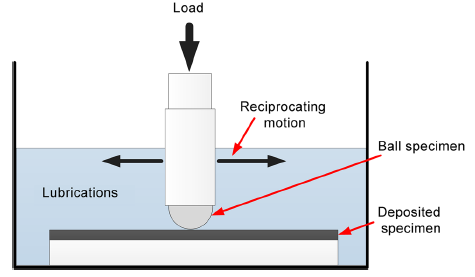
Tribological behaviour tests were conducted in accordance with ASTM G133 wear test principle by using a linearly reciprocating sliding wear/friction tribometer. A schematic diagram of reciprocating sliding contact set-up is shown in Fig. 2. Briefly describing the tribometer consisted of lower fixed electroplated plate (30 mm × 10 mm × 3 mm) and upper 100Cr6 steel ball (H: 740HV10, E: 210GPa and υ: 0.3) of a 9.525 mm diameter. All tests were performed under a constant load of 15 N, reciprocating frequency of 10 Hz and stroke length of 5 mm. These testing conditions were selected to maintain a boundary lubrication regime. Tribological performance data had been collected on coated specimen before these coatings were completely failed. Four different types of tribological tests were conducted as listed in Table 1. Each tribological test was repeated three times to ensure the repeatability and to achieve the minimum data scattering.
Fig. 2 Schematic diagram of reciprocating sliding contact testing
Post-test surface analyses of worn tracks during wear experiments were performed to investigate the wear mechanism and elemental contents by SEM and EDS, respectively. Three-dimensional white light interferometer (ZYGO) was used to measure the wear volume of the worn surfaces of the coated specimens. Wear volume was calculated as V = AL, where A is the cross-sectional area of the worn scar in mm2, and L is the length of the worn scar in mm. The specific wear rate (mm3/Nm) was determined as a function of the wear volume V (mm3) divided by the applied load (N) multiplied by sliding distance S (m) [15]. The tangential friction force at the contact interface was recorded continuously by using a piezoelectric transducer. The coefficient of friction was then calculated from measured friction force dividing by normal applied load.
Surface morphologies of electrodeposited pure nickel and nickel composite of nano-sized alumina coatings are shown in Fig. 3a, b, respectively. The effect of reinforced Al2O3 nanoparticle on microstructure morphology of electroplated coating is evident from changes in grain structure of Ni coatings. Typical pyramidal and globular-shaped microstructure of composite coating is shown in Fig. 3b. In comparison with pure Ni, the crystallite grains of composite coating exhibit more compact morphology with clear grain edges. These surface morphologies of electrodeposited Ni and Ni-alumina composites are consistent with the previous observations [42, 43]. The reduced grain sizes and compact morphology of composite coatings incorporating nanoparticles have been attributed to the cathodic polarisation as a result of nanoparticles adsorption at cathode specimen surface. The addition of nano-sized alumina in the nickel matrix leads to the formation of agglomerated spherical particles on the surface of composite coatings as shown in Fig. 3b. This agglomerated morphology was also reported by Borkar and Harimkar [13] for Ni-Al2O3 composite coatings which contributed to the higher surface roughness of resulted coatings. The distribution of incorporated nanoparticles in the co-deposited coatings and cross-sectional thickness of deposited coatings were observed by SEM and are shown in Fig. 3c, d. It is evident that coatings are crack-free and well adhered to the substrate and nanoparticles are homogeneously distributed in the nickel matrix.
Fig. 3 SEM surface morphologies and cross-sectional deposited thickness of pure nickel a, c and Ni/nano-Al2O3 electrodeposited coatings b, d, respectively
Figure 4a, b presents XRD results of pure Ni and Ni-alumina composite coatings. XRD patterns were categorised by the typical high intensity peaks of (111) and (200) as reported previously by other researchers [44, 45] for Ni-based coatings. Reduction in crystallite size of the nickel-alumina composite is evident from low intensity peaks than pure Ni coatings intensity peaks. The corresponding peaks of nano-sized alumina particles were not possible to retrieve due to nano-sized and very low loaded content of particles in the nickel matrix.
Fig. 4 XRD patterns of pure nickel a and Ni/nano-Al2O3 electrodeposited coatings b
In Fig. 5, the wear resistance results of electrodeposited coatings are compared when using nanoparticles as reinforced contents in nickel matrix and as an additive in the lubricating oil. By comparing with pure nickel coating under pure oil lubrication, nano-enhanced conditions (with the addition of nanoparticle in the matrix or oil) significantly enhanced anti-wear properties. Wear rate is reduced by 58.59% with 0.1 wt% addition of nano-alumina nanoparticle in pure lubricating oil. On the other hand, the wear rate is reduced by 43.86% with reinforcement of Al2O3 nanoparticles in nickel matrix followed by nano-oil with the addition of graphene with reduction of about 30%. Therefore, it is evident from Fig. 5 that the use of Al2O3 nanoparticle as an additive in the lubricating oil exhibits better wear resistance. This reduction in wear behaviour of electrodeposited coating with doping of nano-sized particles in both cases can be credited to three main reasons. First, the nanoparticles in lubricating oil or into the nickel matrix reduced the direct contact between two surfaces during sliding contact, and consequently the wear rate decreased [13]. Second, the self-repairing properties of nanoparticles contributed to the reduction in the abrasion mechanism [46]. The formation of a protective tribofilm with the presence of nanoparticles decreases the wear as confirmed by several researchers [47-49].
Fig. 5 Variation in specific wear rate post-tribotesting conditions of Ni coatings under pure oil, Ni-Al2O3 under pure oil, Ni coatings under nano-oil with nano-Al2O3 and Ni coatings under nano-oil with graphene
Similar wear rate results were observed in previous work [15] in which wear characteristic of pure nickel and Ni-Al2O3 composite were studied subject to water-lubricated conditions. However, microploughing and microcutting wear mechanisms were observed on the coatings wear tracks. In addition to nano-effects, the reduced surface damage behaviour in this study may relate to higher viscosity lubricating oil.
Experimental results of average coefficient of friction during sliding ball on disc test are shown in Fig. 6. As shown in Fig. 6, the friction coefficient is lower in nano-enhanced composite coatings and nano-oil (with nano-Al2O3 or graphene) than that of the pure nickel coating under pure oil friction testing. Friction coefficient is reduced by 21.69% in nano-oil incorporating nano-Al2O3 particles followed by Ni-Al2O3 composite coatings and nano-oil incorporating graphene with reduction of 18.07% and 9.64%, respectively. This is because of load-bearing effect of the addition of reinforced nano-alumina nanoparticles in the composite and as an additive in the lubricating oil. This premise is also confirmed by other researchers about various nano-sized nanoparticles [2, 50].
Fig. 6 Variation in average friction coefficient post-tribotesting conditions of Ni coatings under pure oil, Ni-Al2O3 under pure oil, Ni coatings under nano-oil with nano-Al2O3 and Ni coatings under nano-oil with graphene
In summary, it can be concluded that by using 0.1 wt% Al2O3 nano-sized particles as a nano-additive in the lubricating oil can produce better anti-friction and anti-wear properties than if reinforced in the nickel matrix.
SEM and EDS were used to investigate worn surfaces. Figure 7 shows the overall and magnified view of worn tracks after the wear/friction tests with Ni coatings/pure oil, Ni-Al2O3/pure oil, Ni coatings/nano-oil with nano-Al2O3 and Ni coatings/nano-oil with graphene. Figure 7a, e presents the worn wear track of pure Ni coating after testing with pure lubricating oil. From magnified view in Fig. 7e, severe surface wear can be seen where grooves and coating delamination take place, whereas the tribological tests conducted with nano-composite and that of nano-enhanced lubricant oil incorporating nano-alumina particles and graphene showed relatively much smooth worn surface without coating delamination, as shown in Fig. 7b-d, f-h, respectively. Nano-lubricants with addition of nano-alumina particles exhibit relatively smoother worn surface. These observations also validate the wear rate results of the corresponding type of tribotest conditions. Similarly, the wear mechanism with various nano-sized particles, including Cu [47], ZnAl2O3 [2] and ZrO2 [51], has been reported by other researchers. They reported that this is because of the bearing ball effect of the nanoparticles which reduces the contact between the interacting surfaces.
Fig. 7 SEM images with overall and magnified view of worn surface post-tribotesting conditions: a, e Ni coatings under pure oil, b, f Ni-Al2O3 under pure oil, c, g Ni coatings under nano-oil with nano-Al2O3, d, h Ni coatings under nano-oil with graphene
Post-test chemical element analyses of worn tracks were conducted by using EDS in order to validate the hypothesis that nanoparticles contributed to the reduction in wear scars. The EDS spectra of worn tracks subject to nano-composite coating and nano-oil showed the presence of Al, as shown in Fig. 8b, c, respectively. The formation graphene protective tribofilm is evident from relatively higher (C) content element of 20.51% as shown in Fig. 8d. This is also in agreement with previous investigations about using nanoparticles as Fe, Cu, and Co as nano-additives in the lubricants [47]. The EDS spectra of the worn track, testing with pure nickel and pure oil (without nanoparticles) are also shown in Fig. 8a for comparison purpose.
Fig. 8 EDS spectrum analysis of worn surface post-tribotesting conditions: a Ni coatings under pure oil, b Ni-Al2O3 under pure oil, c Ni coatings under nano-oil with nano-Al2O3, d Ni coatings under nano-oil with graphene
Experimental results showed that the use of Al2O3 nanoparticles and graphene in the lubricating oil and nano-alumina reinforcement in composite coating can considerably reduce the wear and friction. In comparison, the addition of Al2O3 nanoparticles in the lubricant can provide the best tribological performance than Ni-Al2O3 and using graphene as an additive in the lubricating oils. Also, the use of nanoparticle as an additive in lubricating oil is relatively cost-effective approach and a simple process, whereas the reinforcement of nanoparticles into the composite coating by electrodeposition technique is a complicated method involving a wide range of parameters to be controlled. Post-test surface analyses of worn tracks reveal that nano-enhanced lubricants and composite coatings display smoother surfaces and free of coating delamination, while pure nickel coatings which have been sliding against steel ball subjected to conventional oil presented severe surface deformation.
Moreover, during the EDS elemental surface analysis, the presence of Al2O3 hard nanoparticles and graphene within the worn track areas has confirmed the formation of, respectively, protective tribofilm.
The authors have declared that no competing interests exist.

 WeChat
/
| 〈 |
|
〉 |